
Publication in peer-reviewed journals is integral to advancing nursing science, evidence-based practice, and professional growth (Manal, 2023; Fashafsheh et al, 2020). Despite this, nursing teachers often struggle with academic publishing due to a lack of mentorship, inadequate research infrastructure, and ethical concerns (Sethapong et al, 2023; Bahadori et al, 2016). Understanding the level of knowledge and barriers among nursing teachers is essential to designing interventions that will foster a stronger research culture in nursing education. Publishing in indexed journals is an essential academic responsibility of nursing educators, as it advances nursing science, promotes evidencebased practice and ultimately improves patient outcomes (Publishing ethics; Gunawan et al, 2021) and rectitude.
In the Indian context, nursing faculty often face significant barriers to research publication, including limited time, inadequate institutional support, and insufficient training in research methodology and academic writing. Assessing the level of knowledge and perceived barriers among nursing teachers is crucial for developing targeted interventions, such as training programmes, mentorship initiatives, and institutional policy reforms (Manal, 2023; Sethapong et al, 2023).
Review of Literature
Manal (2023) explored barriers to conducting and publishing research among nursing faculty in Saudi Arabia. They identified insufficient institutional support, lack of funding, absence of research assistants, and inadequate access to scholarly resources (Hakami, 2023).
In a comparative descriptive study on nurses’ perceptions of barriers to research utilisation in hospitals Fashafsheh et al (2020) found that time constraints due to heavy workloads, lack of administrative support, and inadequate access to research resources were major hindrances.
Sethapong et al (2023) discussed how an inadequate understanding of publication ethics compromises research credibility and limits acceptance in high-standard international journals.
Rajeshwari et al (2023) assessed knowledge regarding publication ethics among medical and dental faculty. The authors reported gaps in understanding research methodology, statistical analysis, and ethical standards.
Bahadori et al (2016) examined nurses’ perspectives on applying research findings in clinical settings. They noted limited awareness of ethical issues in research publications, including plagiarism, authorship disputes, and conflicts of interest, which could result in unintentional ethical violations.
In their study, Gunawan et al (2021) found that the lack of research infrastructure, mentorship, institutional incentives, and clear guidelines significantly hinder the motivation of nursing educators to pursue scholarly publications, and that without systematic changes, nursing research remains underutilised, impacting evidence-based practice and the advancement of nursing science.
Objectives
The study was carried out with the objectives to
(1) evaluate the level of knowledge on research publication and ethics,
(2) identify perceived barriers faced by nursing teachers, and
(3) analyse associations between demographic variables and knowledge/barriers.
Material and Methods
The study adopted a quantitative non-experimental research approach. A descriptive cross-sectional research design was employed. The sample was collected by using Cochran’s formula. The study utilised a non-probability convenience sampling technique. Research variables were knowledge of nursing teachers regarding research publication and publication ethics, and perceived barriers of nursing teachers regarding research publication and publication ethics.
Participants were 76 nursing teachers from 23 nursing teaching institutions across four regions of India (North, South, East, and West). Institutions were selected through non-probability convenience sampling, based on accessibility and voluntary participation. The teachers within selected institutions were also selected by convenience sampling, with no exclusion criteria other than consent to participate.
Data were collected using a structured online questionnaire (Google Forms) consisting of three sections: Demographics, a 12-item knowledge questionnaire and a 12-item three-point rating scale on perceived barriers. The link was distributed via email and social media platforms, and responses were collected over four weeks. Participation was voluntary, and confidentiality was ensured. Content validity was established by five experts. A Cronbach’s alpha value of 0.82 makes the tool reliable.
Results
Age-wise, around one-third of the teachers (39.5%) were in the age group of 31- 40 years. As for educational qualification, 53.9 percent had an MSc degree. Regarding the number of publications, 85.5 percent of the teachers had 1 to 5 numbers of publications. In terms of designation, the majority of the teachers (27.6%) were clinical instructors. In the context of the number of studies conducted, 61.8 percent had conducted 1-5 number of studies. With regard to total years of experience, 39.5 percent had a total of 6-15 years of teaching experience. It was also observed that 88.2 percent had an exposure to conferences/webinars on research publication. Regarding the place of residence, over a third of the teachers (39.5%) belonged to the southern region of India.
Further, it was found that 43.4 percent of the teachers had a moderate level of knowledge regarding research publication and Publication Ethics. It was also seen that the majority of the nursing teachers (55.2%) had a strong level of perceived barriers in relation to the barriers regarding research publication and publication ethics. It was observed that the number of publications (p=0.021) had a statistically significant association with the level of perceived barriers regarding research publication and publication ethics among the nursing teachers at p<0.05 level of significance (Table 1).
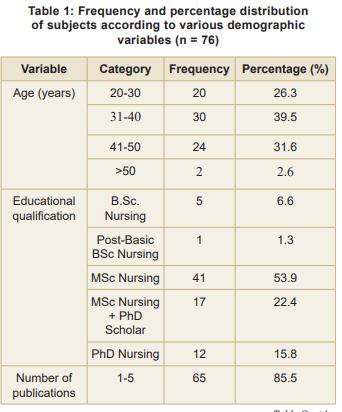
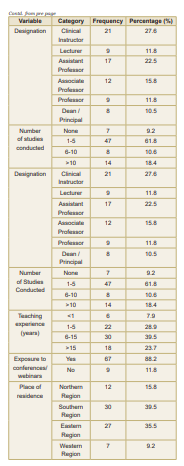
The study comprised 76 nursing teachers from 23 nursing teaching institutions across India. The majority of participants were mid-career professionals, with the highest representation in the 31-40 years age group (39.5%).
In terms of research output, 85.5 percent had published 1-5 articles. Regarding academic position, Clinical Instructors formed the largest group (27.6%). Most respondents (61.8%) had conducted 1-5 research studies, and 39.5 percent had 6-15 years of teaching experience. Professional development exposure was high, with 88.2 percent attending conferences or webinars on research publication. Representation spanned all regions of India, with the highest proportion from the Southern region (39.5%).
Knowledge assessment revealed that 43.4 percent had moderate knowledge of research publication and ethics. Perceived barriers were notably high, with 55.2 percent reporting strong barriers. A significant negative correlation (r = -0.433, p < 0.001) indicated that higher knowledge levels were associated with fewer perceived barriers. While no demographic variable was significantly associated with knowledge levels, the number of publications was significantly associated with perceived barriers (p = 0.021), suggesting that faculty with fewer publications experienced greater challenges in the publication process.
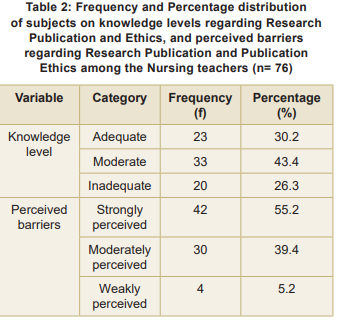
The findings showed (Table 2) that knowledge regarding research publication and publication ethics among nursing teachers was suboptimal, with the largest proportion (43.4%) demonstrating moderate knowledge. Perceived barriers to research publication and ethical compliance were notably high. More than half of the respondents (55.2%) reported strong barriers.
A statistically significant negative correlation (r = -0.433, p < 0.001) was found between knowledge levels and perceived barriers suggesting that faculty with higher knowledge encountered fewer perceived barriers.
Strongly perceived hindrance: The top strongly perceived barriers were lack of time (76.3%),
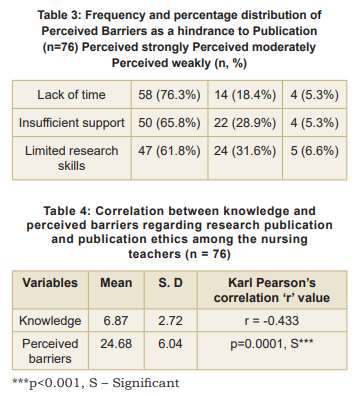
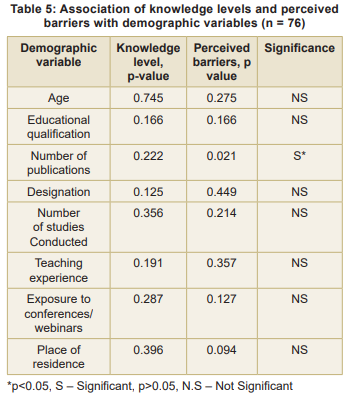
insufficient institutional support (65.8%), and limited research skills (61.8%) (Table 3). The correlation analysis revealed a statistically significant negative relationship between the knowledge of research publication and publication ethics and the perceived barriers among nursing teachers (r = -0.433, p < 0.001) (Table 4). The analysis showed no statistically significant association between knowledge levels regarding research publication and publication ethics and the selected demographic variables. However, there was a statistically significant association between perceived barriers and the number of publications (p = 0.021), indicating that faculty members with fewer publications experienced higher levels of perceived barriers.
Discussion
Numerous studies have examined the barriers that nursing educators face when trying to publish their research. A common barrier identified is the lack of time due to competing responsibilities, such as teaching, clinical practice, and administrative tasks. Institutional support has been identified as a critical determinant of whether nursing educators engage in research publication.
It was noted that many faculty members are discouraged due to the lack of mentorship, research infrastructure, and incentives for publication. Limited skills and knowledge related to research methodology and academic writing also contribute to the difficulties that nursing faculty encounter in publishing. Rajeshwari et al (2023) found that nursing faculty often feel inadequately trained in areas such as statistical analysis, manuscript writing, and the peer-review process.
Bahadori et al (2016) conducted a study exploring the perceptions of nurses about the barriers to the application of research findings, and while their focus was on research utilisation in clinical practice, they also highlighted concerns related to the ethical conduct of research.
Study Limitation
The study was conducted through Google Forms, targeting a specific group of participants who actively engaged with and responded to the survey. This approach allowed for a focused and insightful exploration, based on the valuable feedback of those who took the time to share their perspectives.
Nursing Implications
Nursing Education
Integrate structured courses on research methodology and publication ethics into nursing curricula to develop research capacity among future nurse educators.
Nursing Practice
Equip nursing faculty with knowledge and skills to promote evidence-based practice and ethical research conduct, contributing to quality patient care.
Nursing Administration
Encourage institutional policy development to provide dedicated research time, mentorship programmes, and research funding.
Nursing Research
Remove barriers by fostering a collaborative research culture, offering workshops, and enhancing access to research resources and ethical guidelines.
Recommendations
Conduct qualitative research to explore individual perceptions and lived experiences regarding publication barriers deeply.
Investigate the effectiveness of structured training programmes on improving research knowledge and reducing perceived barriers.
Study institutional factors in greater detail, such as policy frameworks and resource availability, impacting publication practices.
Assess the impact of mentorship and research support on nursing faculty’s publication productivity.
Conclusion
This study identifies a significant gap in research knowledge and a high perception of barriers among nursing educators in India. The findings demonstrate a need for further research to implement and evaluate interventions aimed at enhancing research skills, ethical understanding, and institutional support.
The study encourages other nurse researchers to focus on building a research culture and advancing publication ethics in nursing academia.
1. Manal SA Hakami. Barriers to conducting and publishing scientific research among nursing faculty members in Saudi Arabia. J Multidiscip Health Care 2023; 16: 2733- 43. Available from: https://www.ncbi.nlm.nih.gov/pmc/ articles/PMC10516187/
2. Fashafsheh I, Ayed A, Mohammed J, Alotaibi Y. Nurses’ perception of barriers to research utilisation in hospitals: comparative descriptive study. Open J Nurs 2020; 10: 1-14. DOI: 10.4236/ojn.2020.101001. Available from: https://www.scirp.org/journal/paperinformation?paperid=97668
3. Sethapong L, Kaophiphat T, Kanlaya J, et al. Practices, perceptions, attitudes, barriers and motivation and its impacts on research publication. An Int J Health Prof Educ 2023; 8(4): 23-35. Available from: https://medicine.nus. edu.sg/taps/issues/practices-perceptions-attitudes-barriers-and-motivation-and-its-impacts-on-research-publication/
4. Rajeshwari S, Somashekara SC, Mala P. Evaluation of knowledge regarding publication ethics among medical and dental faculty at a tertiary care hospital. Asian J Pharm Clin Res 2023 Nov; 16 (11). DOI: 10.22159/ ajpcr.2023.v16i11.49592. Available from: https://www. researchgate.net/publication/376360933_Evaluation_ Of_Knowledge_Regarding_Publication_Ethics_Among_ Medical_And_Dental_Faculty_At_A_Tertiary_Care_ Hospital
5. Bahadori M, Raadabadi M, Ravangard R, et al. The barriers to the application of the research findings from the nurses’ perspective: A case study in a teaching hospital. J Educ Health Promot 2016 Jun 5: 14. DOI: 10.4103/2277-9531.184553. Available from: https:// www.ncbi.nlm.nih.gov/pmc/articles/PMC4960792/
6. Publishing ethics and rectitude. The Open Nurs J Available from: https://opennursingjournal.com/publishing-ethics.php
7. Gunawan J, Aungsuroch Y, Fisher ML. Nurse education today: Between teaching and publication focus. Belitung Nurs J 2021 Aug; 7(4): 262-66. DOI: 10.33546/bnj.1798. Available from: https://www.ncbi.nlm.nih.gov/pmc/articles/PMC10361047/
8. Schroeter Kathryn. Research ethics: What nurses need to know. The American Nurse J. 2020 Nov 8. Available from: https://www.myamericannurse.com/research-ethics-what-nurses-need-to-know/
9. Rashid D. Ethics in nursing research. J Nurs Care 2022 March; 11(3): 520. Available from: https://www. hilarispublisher.com/open-access/ethics-in-nursing-research-88798.html
10. Gelling L, Ersser S, Heaslip V, Tait Desi, Trenoweth Steve. Ethical conduct of nursing research. J Clin Nurs 2021 Sep; 30 (23-24): 3606-13. DOI: 10.1111/jocn. 16038.Available from: https://onlinelibrary.wiley.com/doi/ full/10.1111/jocn.16038
11. Bowrey S. Nursing research: Ethics, consent and good practice. Nurs Times 2014 Jan 10. Available from: https://www.nursingtimes.net/roles/nurse-educators/ nursing-research-ethics-consent-and-good-practice-10-01-2014/

This work is licensed under a Creative Commons Attribution-NonCommercial-ShareAlike 4.0 International License.
