The professional well-being of nurses is a critical determinant of healthcare quality, workforce retention, and patient outcomes. As frontline caregivers, nurses face complex demands that influence their job satisfaction, mental health, and career progression. Nursing has traditionally been perceived as a female profession, but the presence of male nurses has gradually increased. In India, male nurses now constitute approximately 10-15 percent of the nursing workforce (Indian Nursing Council, 2021), reflecting a modest but meaningful shift towards gender diversity.
Yet male nurses continue to encounter unique challenges that affect their professional well-being. Societal perceptions of nursing as a ‘female profession’ often lead to role strain, workplace discrimination, and limited career advancement (Sharma et al, 2022). Studies from South India reveal that a significant proportion of male nurses experience psychological distress and occupational stress due to gender based expectations and physically demanding assignments. These challenges are compounded by inadequate mentorship, limited leadership opportunities, and the absence of gender-sensitive workplace policies.
Tamil Nadu, recognised for its leadership in healthcare delivery and nursing education, employs many male nurses across its extensive network of public and private hospitals. However, emerging evidence suggests that male nurses here report higher levels of burnout, stress, and job dissatisfaction compared to their female counterparts (Jayapal & Arulappan, 2020). A recent regional survey indicated that 48 percent of male nurses experienced moderate to high occupational stress, and 35 percent expressed dissatisfaction with workplace support systems. These findings underscore a pressing need to examine the specific occupational experiences of male nurses in this context.
Tamil Nadu’s advanced healthcare infrastructure and concentration of nursing institutions provide a distinct opportunity to explore the professional well-being of male nurses across diverse clinical settings.
Further, there is a lack of empirical data on the gendered experiences of its nursing workforce. Understanding the challenges faced by male nurses in the state is essential for developing targeted interventions that promote inclusivity, enhance job satisfaction, and support mental health.
Globally, efforts to increase male representation in nursing have gained momentum; however, the proportion has plateaued at around 12-13 percent in recent years. International studies highlight that male nurses often remain underrepresented in critical care settings and face barriers linked to departmental placement, family attitudes, and professional identity (George & Bhatti, 2019).
In India, male nurses are mainly employed in high-pressure environments such as emergency departments and ICUs, where stress levels are elevated (Karmakar et al, 2025). Research suggests that those with strong professional identity and mindfulness report better well-being, particularly in the early years of their career.
There is a notable lack of localised research exploring the experiences of male nurses in India. This descriptive cross-sectional study aims to assess the professional well-being of male nurses employed in selected hospitals across Tamil Nadu on work environment, self-esteem, and psychological distress. It also explores the interrelationship among these factors and examine how background variables influence professional well-being. The findings are expected to contribute to a more resilient, inclusive, and motivated nursing workforce, ultimately improving healthcare delivery in Tamil Nadu and beyond.
Review of Literature
Recent studies have revealed the changing perceptions, professional engagement, and psychosocial challenges that male nurses face in various healthcare settings. A descriptive crosssectional study conducted in a tertiary care hospital in Uttarakhand, which included 400 patients, showed that most held neutral views towards male nurses, with nearly 90 percent expressing no gender preference for their caregivers. Educational levels of patients significantly influenced their perceptions, thereby challenging the stereotype of nursing as a feminine profession (Sharma et al, 2022).
In China, a survey of 328 male nurses across 13 hospitals indicated moderate levels of work engagement, with career identity, career satisfaction, and social support emerging as significant predictors. Structural equation modelling confirmed that these factors accounted for 66.4% of the variance in engagement (Basiony et al, 2023). Another study conducted in a general hospital affiliated with the Ministry of Health highlighted workplace violence as a critical issue, with bullying being the most prevalent form, followed by verbal and sexual harassment. Despite these adversities, most male nurses reported high levels of self-esteem (ibid, 2023).
Additionally, a cross-sectional study involving 257 male nurses found that higher empathy was associated with reduced depersonalisation and increased personal accomplishment (Debnath et al, 2024). However, emotional distress remained prevalent, particularly among those whose spiritual beliefs influenced their professional values. Elevated job stress, depersonalisation, and emotional exhaustion were identified as significant contributors to psychological distress, underscoring the need for targeted interventions to support male nurses’ mental health and professional well-being.
Materials and Methods
Study design and participants:
This study adopted a descriptive cross-sectional design, with data collected from 100 male nurses at selected hospitals in Tamil Nadu. The samples were selected through convenience sampling techniques.
Inclusion & Exclusion Criteria
Male nurses accessible to use smartphones and laptops were included; male nursing students were excluded.
The sample size was estimated based on previous findings (Sharma et al, 2022) on the prevalence of psychological distress as 81.7 percent rounded to 82 percent and allowable error d = 10 percent with a confidence level of 99 percent; the sample size required was 98, calculated using the OpenEpi, Version 3 online calculator. With 10 percent attrition sample size was 110.
Of the Google Forms sent to 110 male nurses, only 100 responses were received in return. Data was collected after obtaining informed consent using the Google Forms link shared through WhatsApp. Therefore, the final samples included for analysis were rounded to 100. The data collection period was from December 2023 to January 2024.
Description of the tool:
Data collection tools were developed through a comprehensive literature review and expert consultation, ensuring relevance to the study. The instruments included a background proforma for male nurses and three validated scales: the Healthy Work Environment Assessment Tool (HWEAT 2.0) (Connor et al, 2018), Rosenberg Self-Esteem Scale and Kessler Psychological Distress Scale (K10) (Andrews et al, 2001).
Formal permission was obtained from the authors for all standardised tools, which were reviewed for cultural appropriateness and pilottested for clarity. Reliability was confirmed using Cronbach’s alpha, with all instruments demonstrating acceptable internal consistency (α > 0.70).
To assess professional well-being holistically, a composite score was derived by integrating the three domains: work environment, selfesteem, and psychological distress, based on their theoretical and empirical relevance. Each domain was measured using validated tools - the Healthy Work Environment Assessment Tool (HWEAT 2.0), Rosenberg Self-Esteem Scale, and Kessler Psychological Distress Scale (K10), and normalised to ensure equal weightage. Psychological distress scores were reverse-coded to reflect their inverse relationship with wellbeing. The normalised scores were summed to yield a composite score ranging from 3 to 9. Based on this total, participants were categorised into three levels of professional well-being: high (7–9), moderate (4–6), and low (≤3). This multidimensional approach captured both environmental and psychological determinants influencing male nurses’ professional well-being.
Ethical consideration:
The study was conducted as per World Medical Association Declaration of Helsinki on Ethical Principles for Medical Research Involving Human Subjects after approval from the Apollo College of Nursing, Chennai. Informed consent was acquired after stating the goal of the study. Confidentiality was protected, and participants made aware that their participation was entirely voluntary, and they could leave at any moment.
software (version 21) for all the statistical analyses. The demographic data of the participants reveal that the majority of the male nurses were aged below 30 years (93%), unmarried (85%), and qualified with a BSc Nursing (90%), residing in Chennai (45%), working in the ICU (42%) of a private organisation (90%), as a staff nurse (67%), and 40 percent of them had 1-3 years of experience.
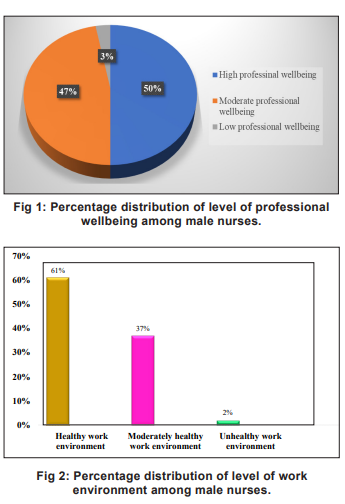
Fig 1 shows that 50 percent of the male nurses had high professional wellbeing, followed by 47 percent having moderately professional wellbeing, and 3 percent with low professional wellbeing. Fig 2 depicts the level of work environment among male nurses; 61 percent of them reported a healthy work environment followed by a moderately healthy work environment (37%) and an unhealthy work environment (2%).

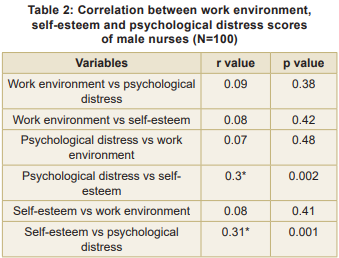
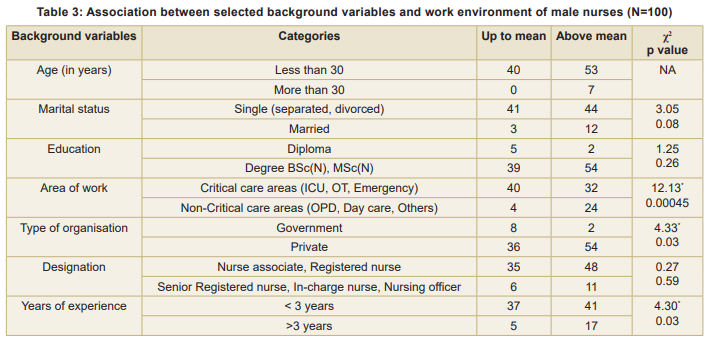
Table 1 shows the mean and standard deviation of overall score (155.81/9±42.59), work environment (105.8/144±24.4), self-esteem (22.5/40±7.59), and psychological distress (27.53/50 ±10.59). Table 2 depicts that there was a positive correlation between psychological distress and self-esteem, which was statistically significant at p < 0.001. Table 3 shows that there was a statistically significant association between background variables such as area of work, type of organisation, years of experience, and work environment among male nurses at p <0.05.
Discussion
The demographic profile of male nurses in this study aligns with global trends, indicating a younger, unmarried workforce predominantly employed in private healthcare settings. Similar findings reported in the secondary descriptive analysis of the 2018 National Sample Survey of Registered Nurses in the United States revealed that 9.6 percent of all RNs worked in the US in 2018. Male nurses were 46.5 years old on average, compared to 48.9 years old for female nurses (Llop-Gironés et al, 2021). This suggests a shifting demographic in nursing, with younger male professionals entering the field, particularly in urban and specialised care settings. To support this evolving workforce, healthcare institutions should adopt gender-sensitive policies, structured mentorship for early-career male nurses, and tailored mental health support systems. These measures are vital for promoting inclusivity, reducing stigma, and enhancing retention and professional well-being.
The mean scores across professional wellbeing, work environment, self-esteem, and psychological distress in this study suggest a moderate level of overall well-being among male nurses. Participants generally perceived their work environments as supportive, which aligns with recent findings that emphasised that positive organisational culture and leadership responsiveness are key to nurse satisfaction (Zhang et al, 2024).
Self-esteem levels indicated a stable sense of self-worth, reinforcing the conclusion that selfesteem significantly influences career identity and engagement (Sharma et al, 2022). These findings underscore the need for gender-sensitive policies, structured mentorship, and mental health support systems to promote resilience and retention in the nursing workforce.
The relationship between professional wellbeing and workplace conditions has been widely documented. Before the onset of COVID-19 pandemic, studies highlighted the informalisation of nursing employment and its detrimental effects on health. During the pandemic, these conditions worsened, linking poor employment practices to adverse physical and mental health outcomes among nurses (Zhang et al, 2024). These findings underscore the urgent need for enforceable standards and supportive policies that prioritise nurse wellbeing and work-life balance.
Self-esteem has emerged as a critical factor influencing work engagement and career identity among male nurses. Male nurses with strong professional identity and social support report higher levels of engagement and career satisfaction (Basiony et al, 2023). This reinforces the importance of fostering environments that build self-worth and recognise the unique contributions of male nurses.
Psychological distress among male nurses has been linked to perceived prejudice and lack of career alignment. Feng et al (2019) found that individuals not choosing nursing as their first career option experienced higher levels of distress and lower self-esteem. These findings suggest that career motivation and societal perceptions play a significant role in shaping mental health outcomes for male nurses. Moreover, social support and career identity are key determinants of professional well-being, highlighting the need for targeted interventions.
The correlation between psychological distress and self-esteem has been supported by multiple studies. Job stress is known to alter psychological and physiological states, affecting performance and overall well-being (Ali Hassan H et al, 2023).
Self-esteem, as a core component of mental health, positively influences professional identity and acts as a buffer against distress. Research indicates that psychological distress mediates the relationship between self-esteem and professional identity among male nurses, emphasising the interconnectedness of these variables. Further evidence suggests that self-esteem is a strong predictor of life satisfaction and inversely related to psychological distress, including anxiety, depression, and interpersonal challenges.
According to the theory of conservation of resources, nurses invest significant emotional and psychological energy into preserving job stability. When these efforts are unmet, emotional exhaustion ensues (Khan et al, 2024). This highlights the importance of organisational support in mitigating burnout and promoting resilience.
Gender dynamics in nursing continue to pose challenges for male professionals. Feelings of alienation, communication barriers, and genderbased misunderstandings can hinder workplace integration (Lee et al, 2022).
Promoting public awareness, challenging stereotypes, and encouraging male participation in nursing are essential steps toward inclusivity. Creating equitable work environments, offering mentorship, and addressing discrimination are vital for fostering diversity in the profession (Damian et al, 2023).
Associations between background variables and professional attributes have been explored in previous studies. While some research found significant links between educational status and self-esteem, others reported no correlation between self-esteem and socio-demographic factors such as age, gender, marital status, and socioeconomic background (Debnath et al, 2024).
These inconsistencies suggest that selfesteem may be influenced more by experiential and contextual factors than by demographic characteristics. This would provide a more comprehensive understanding of the factors influencing professional well-being among male nurses and inform evidence-based strategies for improvement.
Nursing Implications
The research highlights the importance of improving the professional well-being of male nurses through the incorporation of mental health and self-esteem enhancement within nursing education and practice. Policies that are sensitive to gender, along with organised mentorship, peer support systems, and readily available counselling services, are crucial for promoting inclusivity, alleviating distress, and cultivating resilience.
Recommendations
Enforce standards for nurse wellbeing, including work-life balance, job security, and fair practices; Launch campaigns to challenge gender stereotypes and boost male participation in nursing; Conduct longitudinal, multi-site studies to establish causality and improve generalizability; Tailor interventions for career motivation, social support, and contextual factors affecting male nurses’ wellbeing.
Limitations
This study was limited by its cross-sectional design and reliance on self-reported data, which restricts causal inference. The sample may not fully represent male nurses across India, and findings may vary across different hospital types and regions. Future research should include larger, more diverse samples and longitudinal approaches to validate and expand upon these findings.
Conclusion
This research uncovers a complex interplay between the professional well-being of male nurses and their psychological, organisational, and social experiences. Psychological distress and selfesteem have been identified as significant factors, shaped by workplace conditions, career alignment, and perceptions related to gender. These findings emphasise the need for inclusive, supportive, and evidence-based approaches to improve the well-being of male nurses, ultimately leading to better patient care and enhanced institutional performance.
1. Indian Nursing Council. Annual Report. New Delhi: INC; 2021
2. Sharma SK, Mudgal SK, Rawat R, Sehrawat S, Mehra T, Choudhary S. Patient perception towards males in the nursing profession in India: A single-centre, cross-sectional survey. Int J Afr Nurs Sci 2022; 16:100417
3. Jayapal SK, Arulappan J. Historical trajectory of men in Nursing in India. SAGE Open Nurs 2020; 6 (3): 1-10
4. George C, Bhatti FA. The voices of male nurses in Kerala: Career choice and satisfaction. Space & Culture India 2019; 7(3): 115-26. doi:10.20896/saci. v7i3.492
5. Karmakar S, Swain T, Pattanayak A, Sonalika S, Sahoo KC. Male nursing officers’ perceptions and experiences of workplace gender inequality in Odisha, India: A qualitative study. Cureus 2025; Aug 25; 17(8): e90994. doi:10.7759/cureus 90994
6. Wu X, You X, Pu J, Li J, Wu W, Ma X, et al. Self-esteem and professional identity among male nurses and male nursing students: Mediating roles of perceived prejudice and psychological distress. Front Psychol 2023; 13(14): 1176970
7. Basiony MRA, Mostafa HAE, Ali HassanH. Relation between workplace violence among staff nurses and their self-esteem. Egypt J Health Care 2023; 14(2): 277-86
8. Debnath S, Sathiyaseelan M, Tharyan P, Mahasampath G. The association between perceived job stress and satisfaction, empathy and spiritual beliefs on burnout and emotional distress in nurses: A cross-sectional study. Indian J Soc Psychiatry 2024; 40(1): 78-83
9. Connor JA, Ziniel SI, Porter C, Doherty D, Moonan M, Dwyer P, et al. Interprofessional use and validation of the AACN Healthy Work Environment Assessment Tool. Am J Crit Care 2018; 27(5): 363-71
10. Rosenberg Self-Esteem Scale - an overview. ScienceDirect Topics [Internet]. [cited 2024 Dec 18]. Available from: https://www.sciencedirect.com/topics/medicine-and-dentistry/rosenberg-self-esteem-scale
11. Andrews G, Slade T. Interpreting scores on the Kessler Psychological Distress Scale (K10). Aust N Z J Public Health 2001; 25(6): 494-97
12. Llop-Gironés A, Vra?ar A, Llop-Gironés G, Benach J, Angeli-Silva L, Jaimez L, et al. Employment and working conditions of nurses: Where and how health inequalities have increased during the COVID-19 pandemic? Hum Resour Health 2021; 19(1): 112
13. Zhang X, Zhang C, Gou J, Lee Shin-Yu. The influence of psychosocial work environment, personal perceived health and job crafting on nurses’ well-being: A cross-sectional survey study. BMC Nurs 2024 June 3; 23 (1): 373. https://doi.org/10.1186/s12912-024- 02041-5
14. Feng D, Kong W, Zhao W, Li Z, Wang L. The mediating role of perceived prejudice in the relationship between self-esteem and psychological distress among Chinese male nursing students. J Prof Nurs 2019; 35(6): 505-11
15. Khan DA, Khan MT, Masih AG, Siddiqui DA, Parvez A, Ali FM, et al. Anxiety, depressive symptoms and socio-demographic factors associated with self-esteem among male nursing students. Pak J Health Sci 2024; 15-20
16. Lee H, Kim NY, Lee M, Park H. Factors influencing male nursing students’ adaptation to college life in Korea. J Nurs Res 2022 Aug 1; 30(4): e220. doi: 10.1097/ jnr.0000000000000502
17. Damian M?czy?ski, Pawlak Natalia, Pasek Maciej, Wardak Aleksandra, Serafin Lena, Czarkowska-Paczek B. Challenging stereotypes: Examining patients’ attitudes towards male nurses - mixed methods systematic review. Research Square September 2023. https://doi. org/10.21203/rs.3.rs-3370592/v1

This work is licensed under a Creative Commons Attribution-NonCommercial-ShareAlike 4.0 International License.