
The migration of Indian nurses around the globe is not new. But the migration of nursing officers from the Indian government sector has been a concerning trend in recent years. The migration of talented nurses represents a ‘brain drain’ for India, as valuable human capital is lost to other countries, hindering the country's ability to develop and sustain a skilled healthcare workforce.
The migration of nurses from developing to developed nations has increased significantly over the years, affecting healthcare workforce stability in source countries. India is one of the primary nations that exports nurses. The primary cause of emigration from India are: disparity in pay, working conditions, and workplace atmosphere. English-speaking nations, including Australia, the United States, and the United Kingdom, are the primary destinations. Hence, India faces a critical shortage in its government healthcare sector. While studies exist on international nurse migration, there is limited research focusing specifically on the migration of nurses from India’s government sector and their post-migration satisfaction. This study aims to bridge this gap by evaluating the satisfaction levels of migrated nurses.
Objectives
This study aimed to (1) assess the post-migration satisfaction level of nurses migrated from the Indian Government sector overseas; and (2) seek the association of satisfaction level of migrated nurses from the government sector with selected demographic variables.
Review of Literature
In a systematic review, Rajpoot et al (2024) highlighted that internationally educated nurses experienced challenges such as discrimination, workload pressures, and credential recognition, but supportive work environments and fair policies were enablers of satisfaction.
After an integrative review of migrant care workers, Eriksson et al (2023) concluded that job satisfaction was closely linked to psychosocial wellbeing, recognition, and supportive interpersonal relationships, underscoring the importance of workplace culture.
Marie Douce Parimeao et al (2021) conducted a cross-sectional study among 1,951 internationally educated nurses (IENs) in Canada and found generally high career satisfaction, influenced by sociodemographic and organisational factors. Satisfaction was higher among older, experienced, female nurses and those with children. Alameddine et al (2020) surveyed 153 emigrant Lebanese nurses and found that they were generally older, more educated, and experienced than those in Lebanon. Key reasons for migration included low salary, limited opportunities, and lack of professional development. Despite this, 59 percent expressed willingness to return if offered better pay, benefits, and career prospects.
Kumar A et al (2020) conducted a study that meticulously evaluated the quality of life experienced by Indian nurses employed in developed countries. Through a mixed-methods approach involving surveys and focus group discussions, the research scrutinised multiple dimensions such as job satisfaction, work-life balance, social integration, cultural adaptation, and overall well-being. It provided nuanced insights into the challenges and satisfactions encountered by migrant nurses in their new professional and social environments. Results showed that the majority of migrated nurses were satisfied.
Kingma (2018) noted that global nurse migration trends often result in mixed satisfaction outcomes. While financial and professional opportunities improve, challenges related to social integration, recognition of qualifications, and family separation affect overall well-being. In a cross-sectional survey with 495 migrant nurses working in a publicly funded tertiary hospital in Singapore, Tan et al (2016) found that job satisfaction was negatively correlated with poor practice environments, while supportive managers and teamwork improved retention intentions. Aluttis C et al (2014) conducted a study that explored the experiences of migrant nurses in Germany. It revealed that while many nurses were satisfied with their decision to migrate, they faced numerous challenges. Language barriers often hindered effective communication with patients and colleagues, while difficulties in obtaining recognition for their qualifications limited their professional advancement. Social integration was a significant concern for many migrant nurses, impacting their overall well-being and satisfaction. The study underscored the importance of providing language support.
Materials and Methods
Quantitative research approach was found to be most appropriate. The exploratory survey design was used in the study to assess the satisfaction level after migration.
Data Collection Tools and Techniques
Section I - Demographic data included 19 items to ascertain general information like age, gender, marital status, occupation of spouse, number of children, religion, state in which they worked just before migration, professional qualifications obtained from India, years of experience in the Indian government sector with designation, type of government hospital, last drawn salary before migration, whether they had any debt before migration, type of accommodation before migration, the destination country, total years of experience overseas, professional qualifications obtained from overseas, and whether they were engaged in any part-time job or not.
Section II - Level of satisfaction assessment rating scale for migrated nurses was developed by the investigator to assess the satisfaction of nurses who migrated from the government sector to overseas countries. Review of literature, opinion of experts and the investigator’s professional experience helped to develop the tool. It comprises 25 statements for assessing the satisfaction level of migrated nurses related to personal, professional, organisational, and social life satisfaction. Among 25 statements, 23 were positive and 2 were negative. The statements are rated on a 5-point Likert scale about their status after migration. The rating is 1-strongly disagree, 2-agree, 3-neutral, 4-agree, 5-strongly agree. The possible range of satisfaction level score is 25-125, Highly satisfied 91-125, Satisfied 46-90, Not satisfied 25-45.
Reliability of tools used:
The reliability coefficient of the structured satisfaction assessment rating scale was established through Cronbach's alpha and was found to be 0.85. A pilot study was conducted among 30 migrant nurses to check the feasibility of the study. The content validity of the tools was obtained by submitting them to 15 experts. There was 100 percent agreement among all the experts, with a few suggestions, which were incorporated.
Ethical clearance:
The study was undertaken after seeking formal approval of the Institutional Research Committee of RAK College of Nursing.Informed consent was obtained from the participants. Confidentiality was maintained throughout the study.
The main study was conducted from 24 January to 19 February 2024. Data was collected from 305 migrated nurses selected through exponential non-discriminative snowball sampling. Google Forms were sent to 363 migrated nurses, which consisted of a consent form and a rating scale for assessing the satisfaction of migrated nurses. However, 305 migrated nurses completed the survey questionnaire and submitted it. Selfintroduction and establishment of rapport were done through the WhatsApp Messenger application. Each subject who completed the survey was approached to provide their contact subjects who lay within the inclusion criteria.
Samples were informed about the nature of the study and their role in the study. The Google Form link was disabled at midnight of the last day of data collection. Subjects who did not submit the Google form were sent reminder messages on a weekly basis till the last day of data collection. Subjects who had difficulty filling out the Google were contacted personally to resolve the issue. No major technical glitches were faced during data collection.
Sample size was calculated using the Cochran formula
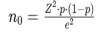
On calculation, the sample size found was 284. In the present study, a sample of 305 nurses migrated from the Indian Government sector currently working in various overseas countries, and willing to participate in the study were selected.
Results
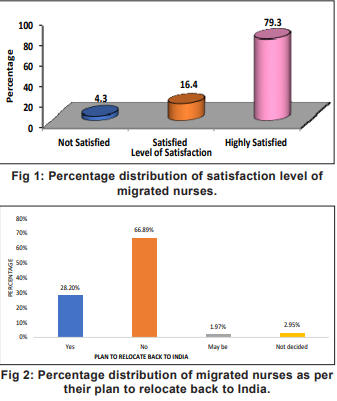
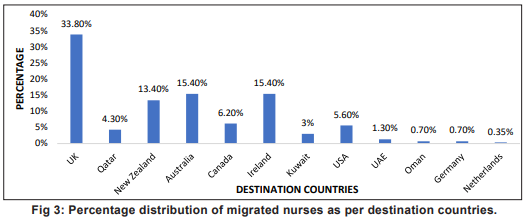
The demographic data of migrated nurses shows that most (83.9%) were aged between 31-40 years, the majority (66.6%) were female, most (92.1%) were married, majority (49.8%) had 2 children. Most (92.1%) of the nurses were married, with nearly half having spouses who are also nurses; 49.8 percent of the nurses had two children, suggesting that family dynamics play a crucial role in the decision to migrate. These findings suggest that mid-career, married female nurses with family responsibilities are more likely to migrate, reflecting broader social and professional motivations influencing migration patterns in this sector. About a third (33.8%) of nurses migrated to the UK. Most nurses had a total overseas experience of 6 months to 5 years (59.3%) and did not obtain any professional qualifications from overseas (63.3%). Most nurses (92.8%) were not engaged in any part-time job alongside their profession. These findings shed light on the destinations chosen by nurses for migration, their qualifications, and their employment preferences, reflecting trends in the nursing workforce's international mobility and professional engagement (Figs 1-3).
The Chi-square test was used to assess whether there is a significant association between the level of satisfaction among nurses who migrated
overseas and various demographic variables. The findings indicate that none of the demographic variables were statistically associated with the level of satisfaction (p > 0.05 for all variables).
This means that satisfaction levels of migrated nurses were not dependent on their age, gender, or marital status. The state they worked in before migration and the country they migrated to did not significantly influence their satisfaction. Seemingly important factors like years of experience, salary, or type of hospital they worked in before migration did not impact their satisfaction abroad suggesting that satisfaction is likely influenced by other non-demographic factors. These might include: workplace environment in the overseas country, support systems available to migrant nurses, professional growth opportunities, cultural acceptance, worklife balance, recognition and respect for nurses in the host country.
This indicates that policymakers, healthcare institutions, and recruiters should look beyond demographic factors, and focus on workplace and systemic factors that contribute to the satisfaction of migrant nurses.
Discussion
The distribution of sample subjects shows that most (83.9%) of the migrated nurses of the Government sector were aged between 31 and 40 years, and the majority (66.6%) were females. These findings are similar to those of Konlan et al (2023), which found that the age group of migrated nurses was below 40, and most of them were females. The distribution of sample subjects in the present study shows that the majority of the sample subjects (92.1%) were married. These findings are similar to those of 70 percent reported by Charlene Pressley et al (2022).
In the present study, it was found that the majority (79.3%) of migrated nurses were highly satisfied with their decision to migrate. This finding is supported by Yong-Shian Goah et al (2016), which shows that migrant nurses were delighted with their jobs. This finding is supported by another study of Elisabet Eriksson et al (2023) which shows that migrant nurses are highly satisfied overseas. In this study, most respondents (74.6%) reported smooth professional adaptation in the overseas setting. This finding is supported by the study of Stievano et al (2017) in Italy, which showed that Indian migrant nurses were able to integrate professionally despite initial language and cultural barriers, and gradually reported satisfaction with workplace adaptation.
Although overall satisfaction was high, 37.1 percent of respondents reported experiencing initial difficulties related to language and cultural adaptation. This finding is similar to the study of Jose (2011), which revealed that Indian nurses working overseas initially faced communication difficulties and cultural adjustment issues; however, over time, adaptation improved and job satisfaction increased significantly.
Recommendations
The study highlights the urgent need for improvements in India’s government healthcare sector to reduce the migration of skilled nurses. Key areas of focus should include better salaries, more opportunities for career growth, and improved working conditions to retain nursing professionals. Future research should examine the long-term career paths of nurses who migrate and evaluate the effectiveness of policy measures aimed at retaining the nursing workforce in India. Can compare the experiences, job satisfaction, and career progression of nurses who have migrated to those who have remained in the government sector. This analysis highlights the factors driving migration and their impact on overall workforce dynamics.
Conclusion
The migration concerns need to be addressed through supportive policies, career advancement opportunities, and efforts to enhance the professional image of nursing for retaining skilled nurses within the country. The high level of satisfaction postmigration reflects improved working conditions, remuneration, and opportunities abroad. The fact that a large majority have no plans to return to India further emphasises the need for policy reforms to retain skilled nurses in the government sector. Understanding the factors driving nurses’ migration and post-migration satisfaction can address the issues to improve workplace conditions, providing mentorship and support programmes, or offering incentives for nurses to stay within the government sector.
1. Sujita Y. International Nurse Migration from India: Time to Say Goodbye? Institute of Developing Economies [cited 2024 Mar 22]. Available from: https://www.ide.go.jp/English/ ResearchColumns/Columns/2023/tsujita_yuko.html
2. Rajpoot Aasia, Merriman Clair, Rafferty Anne-Marie, Henshall Catherine. Transitioning experiences of internationally educated nurses in host countries: A narrative systematic review. Int J Nurs Stud Adv 2024 Mar 27:6:100195. Available from doi: 10.1016/j. ijnsa.2024.100195. eCollection 2024 Jun
3. Sharma Khina, Kumar Ashok, Kumar Mahendra, Singh RP. Indian nurse’s diaspora in global health care - Uncovering the key findings about migration of nurses from an Indian perspective: A review. National Journal Comm Med Aug 2022; 13(8): 565-70. Available from: https:// www.researchgate.net/publication/363152525_Indian_ Nurse's_Diaspora_in_Global_Health_Care_Uncovering_ the_Key_Findings_About_Migration_of_Nurses_from_ Indian_Perspective_A_Review
4. WHO. Review-of-international-migration-of-nurses-fromthe-state-of-kerala--india-2024 https://cdn.who.int/media/ docs/default-source/searo/india/publications/reviewof-international-migration-of-nurses-from-the-state-ofkerala--india-.pdf?sfvrsn=524dffc1_2
5. Bakshi Mukul, Alvarez TD, Cook Kaley (eds). Nursing Shortage and Migration: The Benefits and Responsibilities. CGFNS International, Inc.; 2022 [cited 2024 Mar 24]. Available from: https://www.cgfns.org/nursing-shortageand-migration-the-benefits-and-responsibilities/
6. Machi LA, McEvoy BT. Literature Review cited 2024 Apr 26 Available from: https://www.oxfordbibliographies. com/display/document/obo-9780199756810/obo9780199756810-0169.xml
7. Konlan KD, Lee TW, Damiran D. The factors that are associated with nurse immigration in lower? and middle? income countries: An integrative review. Nursing Open 2023 Dec; 10(12): 7454-66
8. Philip H, Babu PB, Babu A, Cutinha E, Joseph J, Vas J. A study on contributing factors of Nurses' migration to overseas among the staff nurses working in a selected hospital at Mangalore. J Health Allied Sci NU 2018 Dec; 08: 003-06
9. Srinivasan P. Migration: A descriptive study to explore nurses’ opinion. IJHSR 2018; 8(7): 230-33. Available from: https://www.researchgate.net/publication/344069390_ Migration_A_Descriptive_Study_to_Explore_Nurses'_ Opinion_-_IJHSR
10. Garner SL, Conroy SF, Bader SG. Nurse migration from India: a literature review. Int J Nurs Stud 2015 Dec; 52(12): 1879-90
11. Gill R. Nursing Shortage in India with special reference to International Migration of Nurses. Social Medicine 2011; 6(1): 52-59. Available from https://www.academia. edu/9960479/Nursing_Shortage_in_India_with_special_ reference_to_International_Migration_of_Nurses
12. Walton-Roberts M. Nurse emigration from Kerala: ‘Brain Circulation’ or ‘Trap’?’ In: India Migration Report 2013, edited by Irudaya Rajan. Routledge: New Delhi 2024 Apr 26. Available from: https://www.academia.edu/2335246/_ Nurse_emigration_from_Kerala_Brain_circulation_or_ trap_
13. Primeau Marie-Douce, St-Pierre, Isaelle, Ortmann Janosch, Kilpatrick Kelly, Covell CL. Correlates of career satisfaction in internationally educated nurses: A crosssectional survey-based study. Int J Nurs Stud 2021 May 1; 117: 103899
14. Newton S, Pillay J, Higginbottom G. The migration and transitioning experiences of internationally educated nurses: A global perspective. J Nurs Manag 2012 May 1; 20(4): 534-50
15. Alameddine M, Kharroubi SA, Dumit NY, Kassas S, DiabEl-Harake M, Richa N. What made Lebanese emigrant nurses leave and what would bring them back? A crosssectional survey. Int J Nurs Stud 2020 Mar 1; 103: 103497

This work is licensed under a Creative Commons Attribution-NonCommercial-ShareAlike 4.0 International License.