
The Simulation Learning System (SLS) is a catalogue of scenarios and instructions that guide facilitators in staging, pre-briefing for running, and debriefing after simulations with learners in the simulation laboratory (Simulation Learning System, Elsevier Education, n.d.). Types of simulators in healthcare are: Mannequinbased (for practicing CPR, surgical procedures, medication administration, childbirth, and patient assessment) (Barbieri & Palmer, 2025), Virtual reality (for complex surgeries, emergency room scenarios, practising empathy, and communication with virtual patients) (Healthy simulation, n.d.), and Branching path simulations (decision leads to different patient outcomes) (Banta-Wright et al, 2024).
Branching path simulation moves beyond traditional linear learning, offering a dynamic and effective way to teach, train, and engage users by navigating and influencing their learning journey (Banta-Wright et al, 2024). By using a branching story approach, students were motivated and given the enthusiasm to read (Alduraby & Liu, 2014). In nursing education, using branching path simulation as an innovative teaching method can improve the academic performance of the students (Rababa, 2021). When encountering a challenging case scenario or a real patient situation, it will help the students within accurate conclusions (Nair & Stamler, 2013). Nursing students can use and access various technologies in branching simulation scenario design, including telehealth, real-time decision-support algorithms, medication information resources, and electronic medical records that facilitate decision making and development of comprehensive care plans in the clinical setting (Kim & Kim, 2015). Clinical decision-making is challenging in the case of a rapidly deteriorating patient, even for experienced professionals, and causes frustration for students (Genuino, 2018; Woda et al, 2017). This branching simulation gives an opportunity to train the students in using mobile technology that promotes real-time and rapid decision-making in critical situations that will influence patient outcomes positively (Pasklinsky et al, 2021).
Review of literature
Masha’al & Rababa (2020) investigated the undergraduate nursing student’s perception of branching path simulation as an interactive learning approach. Using a quantitative evaluative approach, a convenience sample of 44 undergraduate nursing students from various academic years was selected. Four case scenarios on pain management in individuals with dementia were presented. It was found that undergraduate nursing students favourably viewed branching path simulation regarding its design, usability, confidence, and overall satisfaction. Banta-Wright et al (2024) conducted a study on using branching path simulation to promote critical thinking among 22 paediatric nurse practitioner students at a University in the Pacific Northwest of the United States. It was found that incorporating BPS scenarios with traditional lecture and discussion methods offers another way to engage students in active learning with immediate feedback. Masha’al & Rababa (2020) conducted an experimental study to investigate the effectiveness of branching path simulation in enhancing the critical thinking abilities of nursing undergraduates. Among 102 undergraduate nursing students, the traditional method was used to train the control group, while the intervention group was trained using branching path simulation. The Critical Thinking SelfAssessment Scale (CTSAS) was used to gather data. Following the training sessions, the average scores of the CTSAS and its subscale domains in the intervention group were markedly higher compared to those in the control group.
In an experimental study to assess whether branching simulations can improve nurses’ knowledge, attitude, practices, and decision making on sepsis assessment and treatment Rababa et al (2022) found that the intervention group showed significant improvements in their practices and decision-making skills both right after the simulation and two weeks later.
Need for the Study
Branching path simulation develops and enhances critical thinking, reasoning, clinical decision-making, and problem-solving skills in a safe and interactive environment for the students before encountering a real patient (Dabney et al, 2020). In making decisions about patient care, it provides personalised feedback immediately, improving the acquisition of knowledge on complex conditions such as newborn care, trauma, and sepsis, and allowing the practice of multi-component protocols (Hee-Ok & Insook, 2016). As reported by the National Council of State Boards of Nursing (NCSBN) in 2024, in the US, approximately 75 percent nursing schools employed simulation for nurse training. Other studies indicate that 57 percent to 87 percent of health care programmes use simulation nationwide (National Council of State Boards of Nursing, n.d.).
With this method, students can learn to handle complex situations, such as high-stakes cases, offering flexible and effective learning experiences. Students repeatedly practice in a simulated environment that helps build confidence in their abilities before dealing with actual patients. It standardises the exposure to critical scenarios across all students, ensuring consistent learning experiences (Stewart, 1990).
This paper explores the theoretical aspects, their practical implementation in various nursing specialities, and their potential to significantly enhance student engagement, knowledge retention, and improve patient safety and outcomes.
Case Scenarios
In a branching simulation, nursing students face a pretend patient situation (Fig 1). They get information, just like they do in a real hospital. Then they have to make a decision in situations like:
l “Should I give this medicine?”
l “Should I call the doctor now?”
l “What is the top priority to do first?”
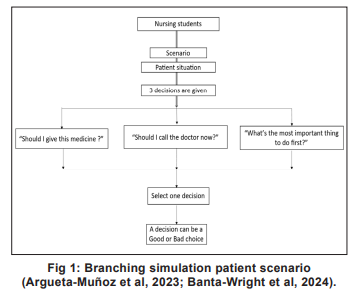
Whatever choices the student exercises, the story “branches” off. If they make a good choice, the patient may improve. If they make a poor choice, the patient might worsen, or something else might happen. The important thing is that they see the results of the actions right away (Masha’al & Rababa, 2020).
Types of Branching Path Simulations
Depending on the aspect emphasised and the specific domain, the types of branching path simulation are (Chapela-Campa et al, 2025):
1. Decision-based branching: Simulation focuses on scenarios in which the user makes explicit/ specific choices leading to different future paths. These simulations are used for interactive storytelling, exploring hypothetical scenarios, and training.
2. Probabilistic/stochastic branching: The branching is driven by random probability rather than explicit decisions and decides the path to be taken based on the predefined probabilities.
3. State-dependent/Conditional branching: Branching occurs due to an explicit decision or random chance but rather based on the current simulation state or certain conditions.
Categorisation Based on Complexity or Length (Masha’al & Rababa, 2020)
1. Short Branching Simulation: In this type, the branching points are limited in number and are a few relatively short paths. They are used for straightforward scenarios to illustrate a few distinct outcomes based on a few critical events or decisions.
2. Moderate branching simulation: In this type, several clear but manageable branching points lead to different paths. This enables the exploration of multiple consequences and interconnections without becoming complex.
3. Long branching simulation: In this type, there are numerous features of branching points with cascading effects, which lead to a large theoretical infinite number of potential paths.
Indian Scenario
In India, the current facilities of Branching Path Simulation are concentrated in the fields of Medical/healthcare education and Corporate/Elearning training. The setting up of a simulation lab is very limited in nursing institutes due to the need for a secure space, adequate environment, staff training, integrating simulation in the curriculum effectively, and technology management (Sage University, n.d.). In October 2018, Tetra Partite, in collaboration with the Indian Nursing Council, Jhpiego, Laerdal and SGT University, established the National Reference Simulation Centre (NRSC) to implement inter-professional education in the State-of-the-Art simulation Centre (INC, n.d.). AIIMS intends to establish the National Advanced Nursing Simulation Institute (NANSI) under the SET facility as per INC norms and simulation training courses according to international requirement (AIIMS, n.d.).
India has seen a significant growth in the establishment of medical simulation centres with advanced patient simulators and high-fidelity manikins that use branching scenarios to train healthcare professionals in critical decision-making and teamwork (Maverick simulation, n.d.). Some major medical institutions that have centralised simulation centres are:
l VASA (Vydehi Advanced Simulation Academy), Bengaluru: One of the largest in Southeast Asia with advanced simulation zones such as ICU, Operating room, Obstetrics.
l MGMCRI Medical Simulation Center, Puducherry: Centralised facility for various simulation training.
l KMC Manipal: Uses a wide range of simulationbased education methods including computerbased training units like SimMan.
l DMIHER, Wardha: Central India’s large, comprehensive, multidisciplinary medical simulation centre.
Global Scenario
Globally, branching path simulation is used by the Healthcare and Corporate or E-learning sectors. Simulation-based learning is becoming significant in nursing education and in the clinical setting. The use of branching simulation tools, software, and games facilitates practical understanding of complex systems allows enhancement of students’ learning experience through the development of hands-on activities designed properly by the instructors (Healthy simulation, n.d.). In various European universities, simulation education is used both online and on campus, and blended learning models. It also highlights the potential transformation of simulation-based learning through innovative teaching practices and serious games (Bauman, 2012).
Global high-fidelity medical simulation centres that use branching path scenarios are:
lCentre for Medical Simulation CMS, USA. l Karolinska University Hospital CAMST, Sweden.
l Simulation Program, Nationwide Children’s Hospital, USA.
l Mario Luzzatto Simulation Centre, Italy.
l Global Accreditation Bodies, worldwide.
Nurse Educator Role
The nurse educator plays a crucial role in facilitating experiential learning by designing and implementing interactive tools that develop clinical judgment and decision-making skills in a safe environment. They must integrate branching path simulation with mobile technology and computerised decision support to teach the students real-time data analysis, develop evidencebased care plans, and understand their choices and consequences in complex clinical environments (Pasklinsky et al, 2021).
Key roles and responsibilities are (Sage University):
l Design and implement branching path simulations. 66 THE NURSING JOURNAL OF INDIA
l Facilitate experientiallearning.
l Enhances clinical reasoning.
l Provide immediate feedback.
l Align with competencies.
l Bridge the theory and practice gap.
l Foster evidence-based practice
l Support professional development.
Conclusions
Branching simulations is an effective and dynamic approach in preparing future nurses students and practicing nurses at various levels.
References
1. AIIMS. AIIMS Simulation. https://aiims.edu/images/ pdf/notice/director. 2023. 14 June 2023
2. Alduraby H, Liu J. Using the branching story approach to motivate students’ interest in reading. International Electronic Journal of Elementary Education 2014; 6(3): 463-78. www.iejee.com
3. Banta-Wright SA, Wright BM, Taha AA, Miehl N. Branching path simulation for pediatric nurse practitioner students to promote critical thinking: A quasi-experimental study. Journal of Pediatric Health Care 2024; 38(5): 737-46. https://doi.org/10.1016/j. pedhc.2024.03.004
4. Barbieri W, Palmer E. Risks and Opportunities in Using Educational Technologies, pp 100-102. Springer Briefs in Education 2025
5. Bauman EB. Game-Based Teaching and Simulation in Nursing and Health Care, pp 80-85. Springer Publishing Company 2012
6. Dabney C, Appling NA, Herr MJ. An interprofessional branching simulation to introduce RN First assistant students to their role in the perioperative setting. AORN Journal 2020; 112 (5): 471-77. https://doi. org/10.1002/AORN.13211
7. Genuino MJ. Effects of simulation-based educational program in improving the nurses’ self-efficacy in caring for patients with COPD and CHF in a post-acute care (PACU) setting. Applied Nursing Research 2018; (39): 53-57. https://doi.org/10.1016/j.apnr.2017.10.012
8. Healthy simulation (n.d.). Virtual Reality in Medicine | Healthcare Simulation | 25 December 2025. HealthySimulation.com. https://www. healthysimulation.com/virtual-reality-in-medicine/
9. Hee-Ok P, Insook L. Enhancing critical thinking through simulation problem based learning in nursing education. Indian Journal of Science and Technology 2016; 9 (37): 1-7. https://doi.org/10.17485/IJST/2016/ V9I37/101758
10. Kim JY, Kim EJ. Effects of simulation on nursing students’ knowledge, clinical reasoning, and self confidence: A quasi-experimental study. Korean Journal of Adult Nursing 2015; 27(5); 604-11. https:// doi.org/10.7475/kjan.2015.27.5.604
11. Masha’al D, Rababa M. Nursing students’ perceptions towards branching path simulation as an effective interactive learning method. Teaching and Learning in Nursing 2020; 15(4): 218-25. https://doi.org/10.1016/j. teln.2020.05.002
12. Maverick simulation (n.d.). Revolutionary Patient Simulator India: Empowering Future Doctors with Confidence. https://mavericksimulation.com/patientsimulator-india-medical-training
13. Nair GG, Stamler LL. A conceptual framework for developing a critical thinking self-assessment scale. Journal of Nursing Education 2013; 52(3): 131-38. https://doi.org/10.3928/01484834-20120215-01
14. NCSBN (nd). National Council of State Boards of Nursing. https://www.ncsbn.org/
15. Pasklinsky N, Graham-Perel A, Villacarlos-Philip P, Slaka-Vella M, Tilley CP. Real-time decision-making in chronic illness branching simulation. Mhealth 2021; 7. https://doi.org/10.21037/mhealth-19-215
16. Rababa M. Comparing the Effects of Regular lecture and branching path simulation on nursing students’ academic performance evaluation. Nurse Educator 2021; 46 (2): E28-E32. https://doi.org/10.1097/ NNE.0000000000000873
17. Rababa M, Bani-Hamad D, Hayajneh AA. The effectiveness of branching simulations in improving nurses’ knowledge, attitudes, practice, and decision-making related to sepsis assessment and management. Nurse Education Today 2022; 110. 105270. https://doi.org/10.1016/J.NEDT.2022.105270
18. Rababa M, Masha’al D. Using branching path simulations in critical thinking of pain management among nursing students: Experimental study. Nurse Education Today 2020; 86. https://doi.org/10.1016/j. nedt.2019.104323
19. Sage University (nd). Clinical Simulation in Nursing Education: Transforming Learning and DecisionMaking. https://sageuniversity.edu.in/blogs/clinicalsimulation-in-nursing-education-transforminglearning-decision-making
20. Simulation Learning System (SLS) - Elsevier Education (n.d.). https://evolve.elsevier.com/education/training/ simulations-learning-system/
21. Stewart SA. Interactive video primer: medical education 1990. https://books.google.com/books/ about/Interactive_Video_Primer_Medical_Educati. html
22. Woda A, Hansen J, Paquette M, Topp R. The impact of simulation sequencing on perceived clinical decision making. Nurse Education in Practice 2017; 26: 33-38. https://doi.org/10.1016/j.nepr.2017.06.008

This work is licensed under a Creative Commons Attribution-NonCommercial-ShareAlike 4.0 International License.