Adolescence is a critical developmental period characterised by the formation of selfesteem and identity, which are essential for academic achievement, interpersonal relationships, and mental health (Brummelman et al, 2015). Self-esteem refers to an individual’s evaluation of their own worth, while identity formation involves exploring and committing to values, roles, and beliefs (Erikson, 1968; Marcia, 1966). Parenting behaviours play a significant role in shaping these outcomes, as adolescents internalise parental feedback when constructing their self-concept (Skowron et al, 2014).While traditional research has examined the influence of parenting styles—authoritative, authoritarian, or permissive—on adolescent development (Baumrind, 1991; Maccoby & Martin, 1983), there is growing interest in the impact of parental personality traits, particularly narcissism, on child’s psychosocial outcomes. Maternal narcissism, characterised by grandiosity, emotional exploitation, lack of empathy, and a strong need for admiration, can disrupt normative developmental processes by prioritising the mother’s needs over the child’s (Sternberg, 2012; Twenge & Campbell, 2018). Adolescents raised by narcissistic mothers may experience emotional invalidation, conditional approval, and role reversal, which are likely to undermine self-esteem and restrict opportunities for independent identity exploration (Kim et al, 2017; Skowron et al, 2014).
In the cultural context of Kerala, where parental expectations are often closely tied to academic and social achievement, these dynamics may be particularly salient (Ghosh et al, 2020). This study investigates the relationship between maternal narcissism, adolescent self-esteem, and identity formation using a mixed-methods explanatory design, combining both quantitative surveys and qualitative interviews. Unlike most other studies focussing on general parenting styles, this study used a mixed-methods approach to examine both the statistical relationships and the lived experiences of adolescents to provide culturally relevant insights for adolescent mental health and nursing practice.
Quantitative study
Primary objectives: To assess the level of perceived maternal narcissistic traits among adolescents aged 13-18 years; to determine the relationship between perceived maternal narcissism and adolescents’ self-esteem as measured by the Rosenberg Self-Esteem Scale; and to examine the association between perceived maternal narcissism and adolescents’ identity status (achievement, moratorium, foreclosure, diffusion). Secondary objectives: To determine the extent to which maternal narcissism predicts variance in adolescent self-esteem; to compare identity status distributions across different levels of perceived maternal narcissism.
Qualitative study
Primary objectives: To explore adolescents lived experiences of maternal narcissistic behaviours; and to understand how maternal emotional invalidation, conditional approval, and role reversal influence adolescents’ self-esteem and identity development. Secondary objectives: To identify perceived relational mechanisms linking maternal narcissism with identity confusion and emotional distress in adolescents.
Hypothesis
H1: Higher level of maternal narcissism will be significantly associated with lower adolescence selfesteem;
H2: Higher level of maternal narcissism will be associated with non-achieved identity status compared to identity achievement; and
H3: Maternal emotional invalidation and role reversal will significantly predict lower adolescent self-esteem, even after controlling for overall perceived maternal narcissism.
Assumptions
(1) Adolescents are capable of accurately perceiving and reporting maternal behaviours;
(2) Perceived maternal narcissistic traits influence adolescents’ emotional and psychological development;
(3) Self-esteem and identity formation can be reliably measured using standardised instruments;
(4) Participants provided honest and truthful responses during questionnaire completion and interviews; and
(5) Qualitative interviews reflect adolescents’ subjective experiences and meanings related to maternal behaviour.
Literature Review
Narcissistic mothers prioritise self-image and emotional needs over those of the child, often manifesting as emotional insensitivity, conditional regard, psychological control, and role reversal (Sternberg, 2012; Kim et al, 2017). The contingent parenting environment undermines attachment security and restricts the child’s development of autonomy (Fonagy & Target, 2000). Studies indicate that such maladaptive parenting behaviours interfere with normative psychosocial development, creating relational contexts where emotional expression and self-definition are only acceptable if they align with maternal expectations (Twenge & Campbell, 2018; Skowron et al, 2014).Self-esteem during adolescence is influenced largely by reflected appraisal from caregivers (Coopersmith, 1967). Maternal narcissism can produce conditional approval, where acceptance is contingent on enhancing the mother’s image rather than on the child’s intrinsic worth (Brummelman et al, 2015). Adolescents internalise this pattern, resulting in fragile, defensive, and performancebased self-esteem. Over time, this conditional selfworth is associated with heightened self-criticism, anxiety, and depressive symptoms (Twenge & Campbell, 2018).
k of adolescence, requires opportunities for exploration and autonomous decision-making (Erikson, 1968; Marcia, 1966). Narcissistic parenting constrains autonomy, discourages exploration, and imposes parental values on adolescents (Luyckx et al, 2008). Such environments are associated with identity foreclosure, where adolescents adopt imposed roles prematurely, or identity diffusion, characterised by lack of direction or disengagement (Sadeghi & Shokrkon, 2018). Empirical evidence suggests that controlling and psychologically intrusive parenting predicts restricted identity development (Luyckx et al, 2008).
Maternal narcissism can be conceptualised as a distal personality factor that impacts adolescents via proximal relational behaviours— emotional invalidation, conditional approval, and role reversal—leading to low self-esteem and disrupted identity formation (Brummelman et al, 2015; Kim et al, 2017). In Kerala, cultural emphasis on academic success may exacerbate these effects (Ghosh et al, 2020).
se effects (Ghosh et al, 2020). Mothers with high levels of narcissistic traits typically exhibit a constellation of behavioural and emotional characteristics that shape the parent–child relationship in distinct ways; these include: (1) Emotional invalidation: A consistent dismissal or minimisation of the child’s emotions, particularly when emotional expression does not serve the mother’s needs or self-image; (2) Conditional regard: Affection, approval, and attention are contingent upon the child’s performance, obedience, or ability to enhance the mother’s social image; (3) Psychological control: Use of guilt, shame, withdrawal of affection, or emotional manipulation to regulate the child’s behaviour and maintain control; (4) Role reversal (parentification); Expectation that the child provides emotional support, reassurance, or validation to the mother, often at the expense of the child’s own developmental needs; (5) Enmeshment and boundary violations: Difficulty recognising the child as a separate individual, leading to intrusion into decision-making, preferences, and identityrelated choices; (6) Image-oriented parenting: Excessive concern with the child’s achievements, behaviour, or appearance, rather than on the child’s well-being. These characteristics collectively prioritise maternal needs over adolescent development, thereby increasing vulnerability to low self-esteem and identity confusion.
Materials and Methods
This study, using a cross-sectional explanatory mixed-methods design and qualitative interviews was conducted in selected secondary and higher secondary schools in Kerala (India). Interviews were held in private locations to ensure confidentiality and emotional security. The study included adolescents aged 13-18 years enrolled in selected schools in Kerala and living with their biological mothers.
Study Variables
Independent variable was perceived maternal narcissism, assessed as the level of narcissistic traits exhibited by mothers as perceived and reported by adolescents. Dependent variables - Adolescent self-esteem, measured as the individual’s global evaluation of self-worth; and identity formation/identity status, assessed in terms of Marcia’s identity statuses: achievement, moratorium, foreclosure, and diffusion. Selected qualitative focus variables were: emotional invalidation, conditional approval, role reversal (parentification), and identity confusion and autonomy restriction.
Sample and Sampling Technique
Quantitative component: A sample of 120 adolescents was selected using non-probability convenience sampling from the selected schools. This sample size was considered adequate for correlation and regression analysis. Qualitative component: For the qualitative phase, 12 adolescents were selected using purposive sampling who scored high on the maternal narcissism scale. This ensured inclusion of participants with rich and relevant experiences related to the phenomenon.
Inclusion & exclusion criteria: Adolescents aged 13-18 years; those living with their biological mother; able to read and understand Malayalam or English; and willing to participate and provide assent, with parental consent, were included. Adolescents with diagnosed severe psychiatric or cognitive disorders; those not residing with their mother; and those unwilling to participate in either phase of the study were excluded.
Instruments and Tools for Data Collection
Quantitative instruments: (I) Maternal Narcissism Inventory (adapted) - The Maternal Narcissism Inventory (MNI) was used to assess adolescents’ perceptions of narcissistic traits in their mothers. The scale consists of 20 items rated on a 5-point Likert scale ranging from strongly disagree (1) to strongly agree (5). The items assessed dimensions such as grandiosity, need for admiration, emotional insensitivity, conditional approval, and role reversal. The original version of the tool was adapted to suit the adolescent population and cultural context of Kerala. Minor modifications were made to simplify language and enhance clarity without altering the core constructs. Content validity of the adapted tool was established through expert review by specialists in psychiatric nursing, psychology, and psychiatry. Permission to use and adapt the tool was obtained from the original author/publisher prior to data collection.
The internal consistency of the adapted MNI in the present study was assessed using Cronbach’s alpha, which yielded a coefficient of α = 0.86, indicating good reliability. (II) The Rosenberg Self-Esteem Scale (RSES), a widely used standardised instrument for measuring global self-esteem, has 10 items rated on a 4-point Likert scale ranging from strongly agree to strongly disagree. Higher scores indicate higher self-esteem. The scale has been extensively validated across adolescent populations and cultural settings. The English version was used, explanations were provided in Malayalam to ensure comprehension. Permission to use the scale was obtained from the source.
In this study, the RSES demonstrated good internal consistency (Cronbach’s alpha 0.88). (III) Identity Status Questionnaire (adapted), an Identity Status Questionnaire, based on Marcia’s identity status model, was used to assess adolescents’ identity development across four statuses: achievement, moratorium, foreclosure, and diffusion. The questionnaire was adapted from existing validated measures to suit the age group and cultural context. The adapted version included items assessing exploration and commitment across such domains as education, values, and future goals. Content validity was ensured through expert evaluation. The internal consistency of the identity status questionnaire in this study was α = 0.81, indicating acceptable reliability.
Qualitative tool: A semi-structured interview guide, developed by the researcher to explore adolescents’ lived experiences related to maternal narcissistic behaviours included open-ended questions focusing on: emotional validation and responsiveness; conditional approval and expectations; role reversal & emotional responsibility; and experiences of self-worth and identity confusion. The interview guide was reviewed by subject experts to establish content validity, and was pilot-tested to ensure clarity and relevance.
Instrument Adaptation, Translation, and Psychometric Properties
All instruments, standardised tools or adapted, used in the study were relevant in the cultural context of Kerala, while preserving the conceptual integrity of the original constructs. For the MNI and the Identity Status Questionnaire, items were reviewed and adapted by the researcher to simplify language, reduce ambiguity, and ensure comprehension by adolescents 13-18 years. Adaptations focused on wording clarity rather than content modification; no items assessing the core constructs were removed.
Translation procedure: The instruments were administered in English and Malayalam, depending on participant preference. The translation to followed a standard forward-backward process, ensure semantic, conceptual, and content equivalence between the English and Malayalam versions.Standardised tools with established psychometric properties were used. Content validity of the adapted tools and interview guide was ensured by professionals in nursing, psychology, and psychiatry. A pilot study was conducted to assess feasibility and clarity of the tools.
Quantitative data were collected first using self-administered questionnaires in classroom settings under the supervision of the researcher. Thereafter, adolescents who scored high on perceived maternal narcissism were identified and invited to participate in the qualitative phase. Indepth interviews were conducted, audio-recorded with consent, and transcribed verbatim. Quantitative data were analysed using descriptive statistics, Pearson correlation, multiple linear regression, and ANOVA to examine relationships and predictive associations between variables. Qualitative data were analysed using thematic analysis, following systematic coding, categorisation, and theme development to identify recurrent patterns and meanings.Ethical approval was obtained from the Institutional Ethics Committee. Written informed consent was obtained from parents; assent was obtained from adolescents. Confidentiality, anonymity, and the right to withdraw at any stage were ensured. Emotional support and referral were provided if participants experienced distress during data collection.
A pilot study was conducted among 10 adolescents to assess the feasibility, clarity, and appropriateness of the tools and procedures; its findings were not included in the final analysis, but minor modifications were made to improve clarity of items.
Results
Quantitative Findings
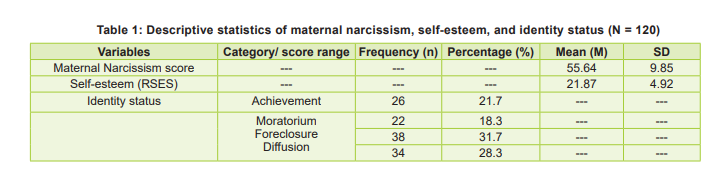
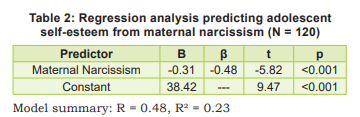
The mean maternal narcissism score (M = 55.64, SD = 9.85) indicates a moderate level of perceived narcissistic traits among mothers as reported by adolescents (Table 1). The average self-esteem score (M = 21.87, SD = 4.92) suggests that a substantial proportion of adolescents had below-average self-esteem. Regarding identity formation, the majority of participants fell under foreclosure (31.7%) and diffusion (28.3%), indicating limited identity exploration and commitment. A statistically significant moderate negative correlation was found between maternal narcissism and adolescent self-esteem (r = -0.52, p < 0.001) indicating that higher levels of perceived maternal narcissism are associated with lower self-esteem among adolescents. Linear regression analysis revealed that maternal narcissism significantly predicted adolescent self-esteem (β = -0.48, p < 0.001), explaining 23 percent of the variance (Table 2) confirming that maternal narcissistic traits have a substantial negative impact on adolescents’ selfesteem, even when considered as a single predictor.
Adolescents exposed to higher maternal narcissistic traits are more likely to experience emotional challenges and identity confusion, underscoring the need for early identification and targeted nursing and psychosocial interventions.
Qualitative Findings
Qualitative data were analysed using thematic analysis, following the six-step approach proposed by Braun & Clarke. Interview transcripts were read repeatedly to achieve familiarisation, and open coding. Codes were grouped into categories, further organised into subthemes and overarching themes that reflected patterns across participants’ narratives. Analysis yielded four major themes.
Theme 1: Emotional invalidation. Category: Lack of emotional responsiveness. Subthemes: Dismissal of feelings; Minimisation of emotional distress. Adolescents described experiences where their emotions were ignored, criticised, or trivialised by their mothers, leading to feelings of emotional invisibility.
“When I feel sad or stressed, she says I am overreacting and that my problems are not real.” (Participant 4)
“She never listens when I talk about my feelings; she only talks about herself.” (Participant 9)
Theme 2: Conditional approval and performancebased acceptance. Category: Conditional affection. Subthemes: Approval linked to academic success. Acceptance was based on obedience and social image. Participants reported that affection and praise were provided only when they met maternal expectations, particularly related to academic performance or behaviour.
“When I score well, she is happy with me. If not, she ignores me for days.” (Participant 2)
“I feel loved only when I do what she wants me to do.” (Participant 7)
Theme 3: Role reversal and emotional burden. Category: Parentification. Subthemes: emotional caretaking; responsibility for maternal well-being. Several adolescents described being placed in emotionally inappropriate roles, feeling responsible for managing their mother’s emotions.
“She comes to me with all her problems, and I feel like I have to take care of her.” (Participant 6)
“If she is upset, I blame myself and try to make her feel better.” (Participant 11)
Theme 4: Identity confusion and restricted autonomy. Category: Impaired identity exploration. Subthemes: suppression of personal preferences; difficulty making independent decisions. Participants expressed confusion about their own preferences, goals, and identity, often prioritising maternal expectations over personal desires.
“I don’t know what I like anymore. I just choose what she wants for me.” (Participant 1)
“I feel scared to decide anything on my own because she may not approve.” (Participant 10)
The qualitative findings reveal that emotional invalidation, conditional approval, and role reversal function as key relational mechanisms through which maternal narcissism affects adolescents’ selfesteem and identity formation. These experiences contribute to emotional distress, reduced self-worth, and identity confusion, supporting and enriching the quantitative findings of the study.
Discussion
Higher levels of perceived maternal narcissism are significantly associated with lower self-esteem and less adaptive identity statuses among adolescents. Our study found a significant negative correlation between maternal narcissism and adolescent selfesteem (r = -0.52, p < 0.001). Adolescents who perceived higher maternal narcissism reported lower self-worth, consistent with prior research indicating that narcissistic parenting fosters fragile, conditional self-esteem (Brummelman et al, 2015; Sternberg, 2012; Twenge & Campbell, 2018; Kim et al, 2017). Emotional invalidation and conditional approval are key mechanisms; adolescents internalise that their value depends on meeting maternal expectations, leading to self-criticism, anxiety, and depressive tendencies (Brummelman et al, 2015). This highlights the importance of recognising personality-driven parenting behaviours, beyond general parenting styles, in assessing adolescent psychosocial outcomes (Sternberg, 2012; Skowron et al, 2014).
Identity analysis revealed that a significant proportion of adolescents fell within foreclosure (31.7%) and diffusion (28.3%) statuses, indicating restricted identity exploration and weak commitment. These results emphasise the importance of autonomy-supportive parenting for normative identity formation (Erikson, 1968; Marcia, 1966; Luyckx et al, 2008). Narcissistic mothers often impose their own aspirations or discourage independent decision-making, leading adolescents to adopt roles prematurely (foreclosure) or disengage from identity tasks (diffusion) (Luyckx et al, 2008; Sadeghi & Shokrkon 2018).Qualitative findings complement these results. Adolescents suppressing personal preferences and fearing independent choices underscore the emotional dimension of identity disruption. These dynamics demonstrate how personality-driven maternal behaviours, such as psychological control and role reversal, constrain adolescent selfauthorship (Kim et al, 2017; Skowron et al, 2014).
Integration of quantitative and qualitative findings: Quantitative results showed a significant negative relationship between maternal narcissism and adolescent self-esteem (r = -0.52, p < 0.001), and a high prevalence of foreclosure (31.7%) and diffusion (28.3%) identity statuses. Qualitative data provided deeper insight into the mechanisms underlying these associations. Thematic analysis revealed four overarching themes:
Theme 1: Emotional invalidation. Under category: Lack of emotional responsiveness, subthemes: dismissal and minimisation of emotions, the representative quotations were:
“When I feel sad or stressed, she says I am overreacting and that my problems are not real.” (Participant 4)
“She never listens when I talk about my feelings; she only talks about herself.” (Participant 9)
This theme explains how maternal narcissism undermines adolescents’ self-esteem by denying validation for their emotional experiences, consistent with Brummelman et al (2015) and Twenge & Campbell (2018).
Theme 2: Conditional approval and performancebased acceptance. Category: Conditional affection Subthemes: approval was linked to academic success; and acceptance based on obedience or social image. Representative quotations:
“When I score well, she is happy with me. If not, she ignores me for days.” (Participant 2)
“I feel loved only when I do what she wants me to do.” (Participant 7)
This aligns with quantitative findings showing lower self-esteem in adolescents reporting higher maternal narcissism. Conditional approval fosters fragile self-worth and heightens self-criticism.
Theme 3: Role reversal and emotional burden. Category: Parentification; subthemes: emotional caretaking; responsibility for maternal well-being, representative quotations were:
“She comes to me with all her problems, and I feel like I have to take care of her.” (Participant 6)
“If she is upset, I blame myself and try to make her feel better.” (Participant 11)
This theme illustrates how adolescents assume inappropriate adult roles, which can interfere with autonomy and identity exploration.
Theme 4: Identity confusion and restricted autonomy. Category: impaired identity exploration; subthemes: suppression of personal preferences; difficulty making independent decisions, the representative quotations were:
“I don’t know what I like anymore. I just choose what she wants for me.” (Participant 1)
“I feel scared to decide anything on my own because she may not approve.” (Participant 10)
This qualitative evidence complements quantitative data showing a high proportion of foreclosure and diffusion identity statuses, reinforcing that maternal narcissism can limit identity exploration and autonomy development (Erikson, 1968; Marcia, 1966).
Strengths of the Study
(1) Mixed-methods design: Integration of quantitative and qualitative data provided a comprehensive understanding of maternal narcissism’s impact.
(2) Culturally adapted instruments: Standardised tools were translated and pilot-tested for the Kerala adolescent population.
(3) Use of validated measures: Reliability and validity of adapted instruments were established, enhancing credibility.
(4) Clinical relevance: Findings provide actionable insights for nursing interventions, school-based programmes, and family guidance.
Limitations
Cross-sectional design limits the ability to infer causality between maternal narcissism and adolescent outcomes. Participants were recruited from schools in Kerala and purposive sample size (N = 12), limits generalisability to other regions or out-of-school adolescents. Self-reported measures have potential for response bias, particularly in reporting maternal behaviours.
Nursing Implications
For nursing practice: Since nurses have an important role in identifying and supporting adolescents affected by maladaptive parenting behaviours, they should include psychosocial assessment of family dynamics, emotional support, and parental expectations during routine adolescent health assessments.
For school and community health nursing: School and community health nurses can implement preventive and promotive interventions, including self-esteem enhancement programmes, lifeskills education, and group counselling sessions. Collaboration with teachers and counsellors can help in identifying adolescents requiring additional emotional support. Parent education initiatives led by nurses can promote emotionally responsive and autonomy-supportive parenting practices.
For family and mental health nursing: In family and psychiatric nursing settings, nurses can support adolescents through counselling, psychoeducation, and guidance on establishing healthy emotional boundaries. Family-focused interventions may help address emotional invalidation, conditional approval, and role reversal, thereby improving adolescent psychological well-being.
For nursing education: Nursing programmes should incorporate the psychological impact of parenting behaviours on adolescent development. Training nursing students in psychosocial assessment and therapeutic communication will strengthen holistic and family-centred nursing care.
For nursing administration: Administrators can integrate adolescent mental health programmes into schools, community centres, & hospitals. Developing protocols for psychosocial screening, allocating resources for staff training, and promoting interdisciplinary collaboration can help address the impact of maladaptive parenting.
For nursing research: Future research can focus on longitudinal studies to examine long-term effects of maternal narcissism, intervention-based studies to test nurse-led counselling or parent education programmes, and development of culturally sensitive assessment tools to support adolescents’ self-esteem and identity formation.
Recommendations
Adolescents exposed to maternal narcissism may benefit from targeted interventions to support self-esteem and identity development. Individual counselling and mentorship programme can help strengthen emotional resilience and autonomy. Parents should encourage consistent emotional validation and avoid conditional approval. Family-based intervention and school support programme may also promote healthier parent-child relationship and facilitate identity exploration. Future research should explore longitudinal effect and cultural factors influencing these dynamics.
Acknowledgements: The author thanks the adolescents and parents who participated in this study; school authorities for permission to conduct the research; and the experts who supported instrument adaptation and content validation.
Conclusion
Maternal narcissism significantly undermines adolescents’ self-esteem and identity development. Adolescents experiencing emotional self-focus, conditional regards, or controlling behaviours from their mothers are more likely to report lower self-worth and restricted identity exploration. Counselling, parental guidance, and interventions fostering emotional validation and autonomy are recommended to promote resilience, positive selfesteem, and coherent identity formation.
References
1. Brummelman E, Thomaes S, Nelemans SA, de Castro BO, Overbeek G, Bushman BJ. Origins of narcissism in children. Proc Natl Acad Sci USA 2015; 112(12): 3659-62
2. Erikson EH. Identity: Youth and crisis. New York: Norton; 1968
3. Marcia JE. Development and validation of ego-identity status. J Pers Soc Psychol 1966; 3(5): 551-58
4. Skowron EA, Kozlowska K, Pincus AL. Differentiation, self-other representation, and parentification: Developmental pathways to adolescent adjustment. Fam Process 2014; 53(2): 221-35
5. Baumrind D. The influence of parenting style on adolescent competence and substance use. J Early Adolesc 1991; 11(1): 56-95
6. Maccoby EE, Martin JA. Socialization in the context of the family: Parent-child interaction. In: Mussen PH, Hetherington EM, ed. Handbook of Child Psychology, 4th edn. New York: Wiley; 1983, pp 1-101
7. Sternberg RJ. Narcissistic parenting and child development: A review and implications for intervention. J Child Psychol Psychiatry 2012; 53(4): 1-15
8. Twenge JM, Campbell WK. The narcissism epidemic: Living in the Age of Entitlement. New York: Atria Books; 2018
9. Kim J, Schneider B, Leary MR. Parenting behaviors and adolescent self-esteem: The role of maternal narcissism. J Adolesc 2017; 57: 35-46
10. Ghosh A, Nair S, Menon S. Academic pressure and adolescent mental health in Kerala. Indian J Psychol Educ 2020; 10(2): 45-56
11. Fonagy P, Target M. Attachment and reflective function: Their role in self-organization. Dev Psychopathol 2000;12(3):345– 75
12. Coopersmith S. The antecedents of self-esteem. San Francisco: Freeman; 1967
13. Luyckx K, Goossens L, Soenens B. A developmental contextual perspective on identity formation in adolescence: The role of parental behaviors. J Youth Stud 2008; 11(4): 437-54
14. Sadeghi H, Shokrkon H. The influence of parental narcissism on identity formation in adolescents. Int J Psychol 2018; 53(3): 201-10

This work is licensed under a Creative Commons Attribution-NonCommercial-ShareAlike 4.0 International License.