
I n the recent past there had been a steady rise in caesarean section rate as against the vaginal delivery. Information is still scarce on the benefits of physiotherapy and birthing experience of women who exercises in antenatal duration (Chauhan et al, 2017). Physical activity during pregnancy has been associated with decreased risks of adverse maternal and neonatal outcomes, including, but not limited to, gestational diabetes, preeclampsia, and macrosomia (Watkins et al, 2021). Physical inactivity is the fourth-leading risk factor for early mortality worldwide. Concerns that regular physical activity during pregnancy may cause miscarriage, poor foetal growth, musculoskeletal injury, or premature delivery have not been substantiated for women with uncomplicated pregnancies (American College of Obstetricians & Gynecologists 2020). Labour is a physiological event. Pain is a common phenomenon and is an inevitable part of the childbirth process. Exercise has become an integral part of the life styles of many women (Prince et al, 2015).
Physical activity during pregnancy, especially in the first trimester of pregnancy, is very beneficial for a pregnant woman (Al Hassan et al, 2022). In India, the proportion of pregnant women receiving the minimum 4 antenatal visits has increased from 37.0 to 51.2 percent during 2006-2016. This is relatively modest when compared to increase in the rate of institutional delivery which has doubled from 38.7 to 79 percent during the same time period, largely driven by the conditional cash transfer schemes of the government(Kumar et al, 2019).
lude promoting healthy lifestyle through proper counselling, medical information over physiological and biological changes during pregnancy, prenatal nutrition, pre-natal screening through regular monitoring, and lab investigation for risk identification that may lead to hazardous intrapartum and post-partum outcomes and appropriate management of high-risk pregnancies (Keya et al, 2021).
Review of Literature
An institutional cross?sectional study in Hawassa city, Sidama Region, Ethiopia, involving 600 pregnant women found that only 25.5 percent met recommended antenatal physical exercise practices and 43.7 percent had adequate knowledge, with factors such as mass media exposure, higher husband education, adequate knowledge, and availability of supporting facilities significantly associated with better exercise practice (Belachew et al, 2023). A recent quasi?experimental study (ElShrqawy et al, 2024) conducted at the New Obstetrics and Gynaecology Hospital in Mansoura, Egypt, reported that structured antenatal education significantly improved pregnant women’s knowledge, attitudes, and preferences towards mode of delivery in the intervention group compared to the control group (p < 0.001), highlighting the positive impact of pre-natal education on maternal outcomes.
Material and Methods
This study employed a quantitative research approach, specifically utilising a quasi-experimental design among 60 pregnant mothers in selected hospitals of Nadiad City. Mothers in the second or third trimester, physically fit for antenatal exercises, and willing to complete 15-20 supervised Integrated Antenatal Care sessions were included, while those with complicated pregnancies or unable to follow instructions were excluded. A pilot study was conducted at a maternity hospital in Nadiad city with the approval of the respective hospital authorities and ethical clearance and the main study at Shubham Hospital, Samjulaxmi Maternity Hospital, and CG General Hospital, Uttarsanda, in Gujarat, India with formal permission obtained from all authorities.
Data were collected during January-May 2025 after written informed consent. Each session involved greeting the mother, ensuring comfort, explaining Integrated Antenatal Care activities, assessing their condition, providing rest, and observing for complications. The intervention included a holistic approach with supervised exercises, yoga, pranayama, yoga nidra, nutritional guidance, relaxation activities, and sound healing to promote maternal and neonatal well-being. Data were collected using a structured questionnaire and APGAR scores, covering demographic, obstetric, maternal, and neonatal outcomes.
Sample Size Calculation
Power analysis estimated a required sample of 110 participants. However, due to time constraints and limited eligible participants, 60 mothers (30 experimental, 30 control) were enrolled as advised by the Research Ethics Committee and guide. To avoid contamination, the control group received only routine antenatal care without the integrated intervention.
Results
Frequency and Percent Distribution of Demographic Variables among Antenatal Mothers in Experimental and Control Groups
In the experimental group, most mothers (76.7%) were aged 25-30 years, while the control group had a more even age distribution. A higher proportion of the experimental group were graduates (76.7%), whereas half of the control group had only primary education. Most mothers in both groups had normal BMI (80% vs 86.7%) and normal haemoglobin levels (70% vs 80%). The experimental group was slightly taller (160 cm vs 154 cm) and heavier (61 kg vs 52 kg), with similar haemoglobin levels overall.
Logistic Regression Analysis of Maternal Outcomes (Mode of Labour)
Logistic regression was conducted to evaluate the effect of gravida, gestational age, and current pregnancy complications on mode of labour (spontaneous vaginal vs forceps). None of the predictors were statistically significant (p = 0.999- 1.000). The model showed very large standard errors and extreme odds ratios with wide confidence intervals. These findings indicate that the variables could not reliably predict the mode of labour.
Linear Regression Analysis of Neonatal Outcomes (Baby Weight)
The linear regression model for baby weight was statistically significant (r² = 0.316, Adjusted r² = 0.237, p= 0.018). Among the predictors, only ICU admission showed a significant positive association with baby weight (B = 0.86, p = 0.020), indicating higher average birth weight among admitted babies. Gestational week (p = 0.189) and term status (p = 0.334) were not significant predictors. Overall, ICU admission was the only significant factor influencing baby weight in the model.
Association between Maternal Demographic Variables and Maternal Outcomes among Antenatal Mothers
Significant associations were found between BMI and mode of labor (p = 0.01), HB level and duration of hospital stay (p = 0.034), parity and total duration of labor (p = 0.004), and the duration of each session per day with total duration of labor (p = 0.009) and episiotomy (p = 0.029).
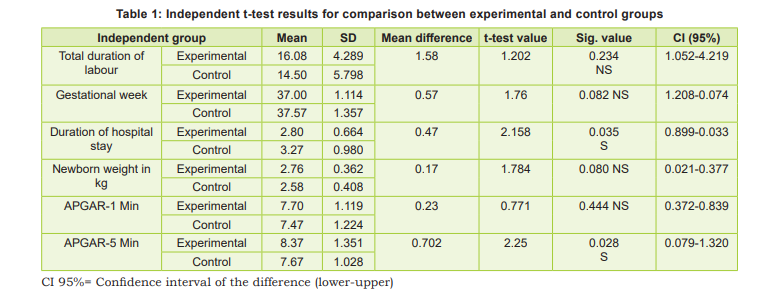
Independent t-test analysis showed no significant differences between experimental and control groups in total labour duration, gestational week, newborn weight, or 1-minute APGAR scores. However, the experimental group had significantly shorter hospital stays (p = 0.035) and higher 5-minute APGAR scores (p = 0.028) compared to the control group (Table 1)
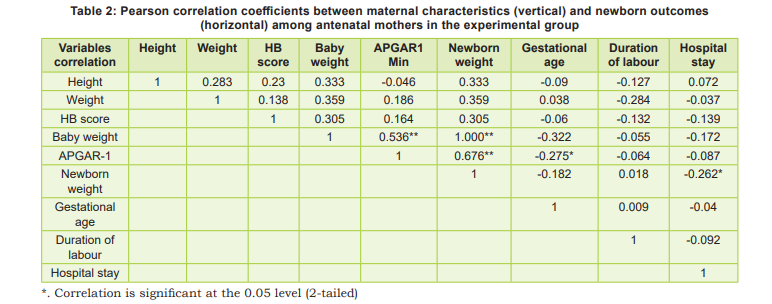
Pearson correlation analysis in the experimental group showed significant positive relationships between newborn outcomes. Baby weight was strongly correlated with 1-min. APGAR score (r = 0.536, p < 0.01) and newborn weight (r = 1.000, p < 0.01). APGAR-1 scores were positively correlated with newborn weight (r = 0.676, p < 0.01) and negatively correlated with gestational age (r = −0.275, p < 0.05) and hospital stay (r = −0.262, p < 0.05) (Table 2). Maternal height, weight, and haemoglobin showed weak to moderate positive correlations with baby and newborn weight, while correlations with labor duration and hospital stay were generally low. Overall, the results suggest that better newborn outcomes (higher APGAR scores and higher birth weight) are positively associated with each other.
Association between Maternal and Antenatal Factors with Neonatal Outcomes
The study examined the association between maternal and antenatal factors and neonatal outcomes using the Chi-square test. Variables such as maternal age, BMI, haemoglobin level, parity, gestational age, pregnancy complications, labour duration, and mode of labour were analysed against APGAR score, birth weight, ICU admission, and term status. All p-values were greater than 0.05, indicating no statistically significant associations. These findings suggest that the selected maternal and antenatal factors did not significantly influence neonatal outcomes in this study population.
Discussion
Silveira et al (2012) in their study, ‘Physical exercise during pregnancy and its influence in the type of birth’ found that pregnant women who performed moderate physical exercise had a significantly higher rate of vaginal deliveries compared to sedentary women (p = 0.031). Similarly, in the current study, mothers who received integrated antenatal care showed a higher proportion of spontaneous vaginal delivery compared to control group. Both studies indicate that structured antenatal exercise during pregnancy positively influences mode of delivery and promotes normal vaginal birth.The present study showed that integrated antenatal care increased the rate of normal vaginal delivery (93.3%) and improved neonatal outcomes such as better APGAR scores and normal birth weight. Similar findings were reported at Chauhan et al (2017), who found that 89.3 percent of mothers who underwent antenatal physiotherapy delivered vaginally, with shorter labour duration and better neonatal outcomes. Both studies suggest that structured antenatal exercise and physiotherapy improve maternal fitness, reduce the need for caesarean section, and promote favorable maternal and perinatal outcomes (Chauhan et al, 2017).
Nursing Implications and Recommendations
Integrated antenatal care, combining routine checkups, maternal education, and supervised physical activity, improved maternal and neonatal outcomes, including safer deliveries, shorter hospital stays, and higher five-minute APGAR scores. Nurses should implement integrated antenatal care in both hospital and community settings to enhance maternal preparedness, promote safe delivery, and improve newborn health through structured health education.
Further Research
Future studies should involve larger samples to strengthen validity, compare factors influencing normal labour in low-risk mothers, and explore determinants of maternal and newborn outcomes to support integrated antenatal care practices.
Conclusion
Nurses play a key role in implementing integrated antenatal care through education, risk identification, and supporting safe physical activity. Incorporating integrated antenatal care into nursing training can strengthen antenatal services, and future research should explore long-term outcomes, implementation in rural areas, and cost-effectiveness.
Patient consent and ethical approval:
The authors duly obtained consent of the participants. Ethical clearance was obtained from Institutional Ethics Committee of Maganbhai Adenwala Mahagujarat University, Nadiad.
References
1. Chauhan R, Saho B, Singh N, Malviya R, Tiwari P. Enhancing normal labor by adopting antenatal physiotherapy: A prospective study. International Journal of Reproduction, Contraception, Obstetrics and Gynecology 2017; 5(8): 2672-76 https://doi.org/10.18203/2320-1770.ijrcog20162643
2. Watkins VY, O’Donnell CM, Perez M, Zhao P, England S, Carter EB, Kelly JC, Frolova A, Raghuraman N, et al. The impact of physical activity during pregnancy on labor and delivery. Am J Obstet Gynecol 2021 Oct; 225(4): 437.e1-8. doi: 10.1016/j.ajog.2021.05.036
3. American College of Obstetricians and Gynecologists. Physical activity and exercise during pregnancy and the postpartum period. Committee Opinion No. 804. Obstet Gynecol 2020 Apr; 135: e178-88. doi:10.1097/ AOG.0000000000003772
4. Prince EJ, Seshan V. The effect of selected antenatal exercises in reduction of labor pain among primigravid women: Implication for practice. J South Asian Fed Obst Gynae 2015 Sep–Dec; 7(3): 185–90. doi:10.5005/jp-journals-10006-1353. jaypeejournals.com
5. Al Hassan R, Ali RR, Alsheikh MSK. The effect of physical activity during pregnancy on childbirth. Open Access Maced J Med Sci [Internet] 2022 Jan 19; 10(A): 475-80. Available from: https://oamjms.eu/index.php/mjms/article/view/8175
6. Kumar G, Choudhary TS, Srivastava A, Upadhyay RP, Taneja S, Bahl R, et al. Utilization, equity and determinants of full antenatal care in India: Analysis from the National Family Health Survey 4. BMC Pregnancy Childbirth 2019; 19: 327. doi:10.1186/s12884-019-2473-6
7. Keya TA, Fernandez Kevin; Kharkwal Kailash, Habib Nasrin. Impact of antenatal care on pregnancy outcomes: A cross-sectional study in a rural community in Malaysia. Med Journ Dr DY Patil Vidyapeeth 2021 Mar–Apr; 14(2): 172-79. doi: 10.4103/mjdrdypu.mjdrdypu_14_20
8. Belachew DZ, Melese T, Negese K, Abebe GF, Kassa ZY. Antenatal physical exercise level and its associated factors among pregnant women in Hawassa city, Sidama Region, Ethiopia. PLoS One 2023 Apr 28; 18(4): e0280220. doi: 10.1371/journal.pone.0280220. PMID: 37115792; PMCID: PMC10146453.
9. El-Shrqawy EH, Elnemer Amina, Elsayed HM. Effect of antenatal education on pregnant women`s knowledge, attitude and preferences of delivery mode. BMC Pregnancy Childbirth 2024 Nov 12; 24(1): 740. https://doi.org/10.1186/ s12884-024-06922-0
10. Suman. A Descriptive Study to assess the knowledge regarding antenatal care among pregnant women in selected hospitals of Haryana. Asian Journal of Nursing Education and Research 2021; 11(3): 337-39. doi: 10.52711/2349- 2996.2021.00081
11. Silveira LC, Segre CA. Physical exercise during pregnancy and its influence in the type of birth. Einstein (Sao Paulo) 2012 Oct-Dec; 10(4): 409-14. doi: 10.1590/ s1679450820120004000

This work is licensed under a Creative Commons Attribution-NonCommercial-ShareAlike 4.0 International License.