
Sleep constitutes a cornerstone of holistic well-being, exerting a pivotal influence in preserving physiological and psychological health across diverse biological entities. In India, cancer patients undergoing chemotherapy face significant sleep disturbances, with studies reporting poor sleep quality in up to 57.6 percent of cases as assessed by the Pittsburgh Sleep Quality Index. Among these, females comprised 73.5 percent of those affected, highlighting gender-specific vulnerabilities in this population.
ghly prevalent among patients undergoing chemotherapy, often exacerbating fatigue and diminishing quality of life.
Warm water foot baths represent a simple, non-pharmacological intervention that applies local moist heat to promote relaxation, reduce fatigue, and enhance sleep onset and quality. Recent studies confirm their effectiveness in alleviating insomnia symptoms in cancer patients receiving chemotherapy, with significant improvements noted post-intervention. For instance, a 2024 quasi-experimental study on cancer patients demonstrated higher mean sleep quality scores (9.85 ± 2.47) in the footbath group compared to controls (8.97 ± 2.44; p=0.017) (Kumar et al, 2024).
A network meta-analysis further supports non-pharmacological approaches like massage therapy, akin to foot baths, for improving sleep in cancer-related insomnia (Li et al, 2024). Chemotherapy-induced sleep issues affect 30-70 percent of patients, underscoring the need for accessible therapies.
Warm foot baths are non-invasive, cost-effective, and suitable for home use, making them ideal for routine integration into oncology care. Evidence from randomised trials shows reduced sleep latency and better overall sleep post-foot bath sessions. Ongoing research emphasises their role in holistic symptom management during treatment.
Need for the Study
hemotherapy patients experience heightened insomnia rates, rising from 11 percent pre-treatment to 36 percent during therapy, yet pharmacological options carry side effects. Limited recent trials specifically targetted warm water foot baths’ efficacy on sleep in this group, with call for further validation. Integrating such interventions could enhance patient well-being and treatment adherence without added costs. This study addresses gaps by providing empirical data tailored to chemotherapy contexts.
Objectives
This study sought to:
1. Assess the pre-test level of sleep among patients receiving chemotherapy;
2. Evaluate the effectiveness of warm water foot bath on level of sleep among patients receiving chemotherapy; and
3. Find out the association between post-test level of sleep among patients receiving chemotherapy with their selected demographic variables.
Hypotheses
H1: There will be significant difference in the pre-and post-test levels of sleep among patients receiving chemotherapy within the experimental and control group.
H2: There will be significant difference in the pre- and post-test levels of sleep among patients receiving chemotherapy between the experimental and control group.
H3: There will be significant association between post-test levels of sleep among patients receiving chemotherapy with their selected demographic variables.
Review of Literature
Kumar et al (2024) studied a quasi experimental on 200 cancer patients in Rajasthan, India, with 100 samples in experimental and control groups. The hot water foot bath intervention was administered to the experimental group, while the control group received standard care. Data were collected using demographic proforma and the Groningen Sleep Quality Scale. Although a greater proportion of participants in the experimental group were initially categorised as having disturbed or poor sleep, the overall response to warm water foot bath intervention showed measurable benefit. However, the experimental group demonstrated a significantly higher mean sleep quality score (9.85 ± 2.47) compared to controls (8.97 ± 2.44). Statistical analysis confirmed the effectiveness of foot bath therapy in improving sleep quality among cancer patients receiving chemotherapy Warm water footbath effectively improved sleep quality among cancer patients despite varied responses within experimental group. Integrating foot bath intervention into cancer care regimens is recommended to alleviate sleep disturbances and enhance overall wellbeing during chemotherapy.
Materials and Methods
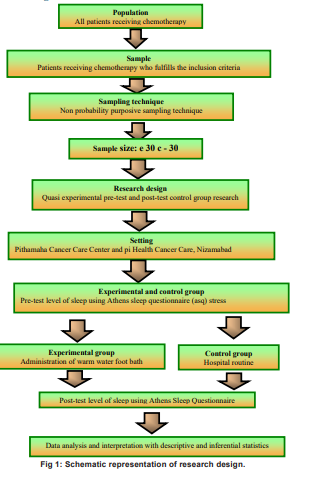
A quasi-experimental pre-test post-test control group design with purposive sampling (n=60) was employed among chemotherapy patients (21-50 years, stage I-III solid tumours) at Pithamah Cancer Care Center and Pi Health Cancer Care, Nizamabad (Fig 1). Tools included demographic/clinical proforma and Athens Insomnia Scale (ASQ; 8-items, 0-3 scoring; r=0.86). Institutional Ethical Committee approval was obtained (IEC-TCON/321/2022) following expert validation (oncologist, nursing professors, statistician) and informed consent. Pre-test ASQ was administered to both groups (experimental n=30; control n=30). Experimental intervention comprised warm water foot immersion (39-43°C, lotion thermometer) for 15 min twice daily (morning/ evening) over 5 days, with temperature monitored q5min (>39°C maintained); feet dried post-procedure. Controls received routine care. Post-test ASQ occurred on day 6.
Results
Demographic and clinical variables showed homogeneity between groups except cancer stage (χ²=4.511, df=3, p=0.034). In experimental group, majority were aged 41-50 years (60%), male (53.3%), nuclear family (63.3%), married (73.3%), secondary educated (40%), private employees (36.6%), income >Rs 20,000 (40%), rural residents (40%), vegetarian (53.3%), slept <5 hours (76.6%), illness 1-2 months (53.3%), hypertensive (53.3%), 2nd chemotherapy cycle (63.3%), stage I cancer (60%). Control group characteristics were comparable.
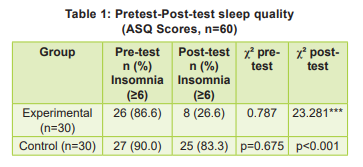
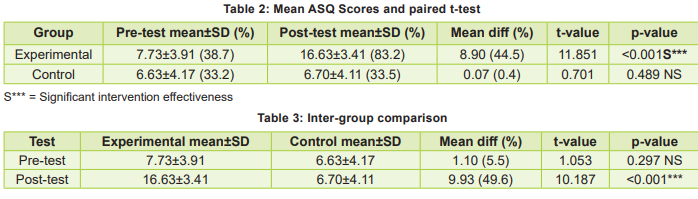
Sleep quality improvement: Table 1 depicts that the pre-test insomnia prevalence was similar (χ²=0.787, p=0.675). Post-test showed significant reduction in experimental group (73.3% no insomnia) vs control (83.3% insomnia) (χ²=23.281, p<0.001). The experimental group showed significant sleep improvement (t=11.851, p<0.001), while the control group showed negligible change (t=0.701, p=0.489) (Table 2).
Between-group analysis: The post-test scores differed significantly (t=10.187, p<0.001), confirming the efficacy of warm foot bath (Table 3).
Association with demographics: Type of family showed significant association with post-test sleep in both groups (p<0.05); other variables showed no association.
Discussion
The present study demonstrated that warm water foot immersion significantly improved sleep quality among chemotherapy patients, reducing ASQ insomnia scores from 86.6 percent to 26.6 percent in the experimental group (χ²=23.281, p<0.001), while the control group showed minimal improvement (83.3% persistent insomnia).
Effectiveness of Intervention
Warm water foot bath (39-43°C, 15 min) produced substantial sleep enhancement (pretest 7.73±3.91 to post-test 16.63±3.41; t=11.851, p<0.001), confirming its efficacy as a nonpharmacological intervention. Between-group post-test analysis revealed highly significant differences (t=10.187, p<0.001), supporting warm hydrotherapy’s role in modulating chemotherapyinduced sleep disturbance through improved peripheral circulation and parasympathetic activation. These findings align with prior research on foot reflexology and hydrotherapy for cancerrelated insomnia.
Corroborating current findings, Kumar et al (2024) conducted a quasi-experimental study demonstrating hot water footbath therapy significantly improved sleep quality scores (9.85±2.47 vs 8.97±2.44; p=0.017) among cancer patients undergoing chemotherapy, recommending routine integration into oncology care protocols. This reinforces warm hydrotherapy’s efficacy through enhanced peripheral circulation and parasympathetic activation, validating its role as a standardised nursing intervention for chemotherapy-induced insomnia (Kumar et al, 2024)
Clinical Implications
This simple, cost-effective intervention addresses a critical supportive care gap, particularly relevant for resource-limited oncology settings in India. Implementation requires minimal training and equipment (lotion thermometer, basin), making it feasible for routine nursing practice. Family type emerged as a significant correlate (p<0.05), suggesting nuclear family patients may benefit most due to enhanced home support post-discharge.
Limitations
Homogeneity was compromised by cancer stage distribution (χ²=4.511, p=0.034); stage-specific effects warrant future investigation. The 5-day intervention and single-center design limit generalizability. ASQ captures insomnia but not sleep architecture; polysomnography could validate objective improvements.
Recommendations
1. A multi-centre randomised controlled trial to evaluate the sustained effectiveness of warm water foot bath protocol over complete chemotherapy cycles on sleep quality, fatigue, and quality of life among breast cancer patients.
2. Quasi-experimental study comparing warm water foot bath with progressive muscle relaxation on chemotherapy-induced insomnia among head-neck cancer patients.
3. Mixed-methods study examining the effectiveness of nurse-facilitated home-based warm foot bath programme (with family training) on post-discharge sleep maintenance among nuclear versus joint family chemotherapy patients, measuring adherence via mobile app logs and exploring cultural barriers through qualitative interviews.
1. Kumar V, Rawat A & Charan S G.A quasi-experimental study to evaluate the effectiveness of hot water footbath therapy on sleep quality among cancer patients. Annals of African Medicine 2024; 24(1): 161-66. https://pmc.ncbi.nlm.nih.gov/articles/PMC11837824/
2. Chen ML, Chang HC, Huang CM. Effectiveness of warm water foot submerged technique on the level of fatigue among cancer patients receiving chemotherapy. Homoeopathic Links 2024. https://doi. org/10.1055/s-0044-1778721
3. Sindhe PS, Pujari S, Natekar SD, Devi G N, Kariyappa T, Sneha G, et al. Study to assess the effectiveness of warm water foot bath in reducing level of fatigue & insomnia among chemotherapy cancer patients. SSR Institute of International Journal of Life Sciences 2023; 9(6): 3374-81
4. Gök MZ, Ozdemir L, ?nan E. Comparing effects of warm footbath and foot massage on fatigue in lung cancer patients. Integrative Cancer Therapies 2023; 22
5. Seo ES, Choi WH, Lee SJ. Effects of aroma foot baths on stress and sleep in hospitalized cancer patients. Evidence-Based Complementary & Alternative Medicine 2021, 5515192
6. Ozdemir FA, Can Gulbeyaz. Effect of warm salt water foot bath on chemotherapy-induced fatigue Eur Journal Oncol Nursing 2021; 52: 101954
7. Wang Y, Li M, Zhang X. Effect of foot bath on symptom control in cancer patients: Systematic review and meta-analysis. Asia-Pacific Journal of Oncology Nursing 2025; 12(10): 1-12
8. Erdim N, Öz F. Effect of foot bathing on sleep quality in cancer patients: Randomized controlled trial. Journal of Alternative and Complementary Medicine 2022; 28(5): 456-63

This work is licensed under a Creative Commons Attribution-NonCommercial-ShareAlike 4.0 International License.