Adolescence i.e. the age group of 10–19 years, is a critical phase of growth marked by rapid physical, psychological, and social changes. During this period, adolescents develop psychosocial competencies to cope effectively with academic demands, peer relationships, and emotional challenges. Life skills are psychosocial abilities that enable individuals to effectively manage the demands and challenges of everyday life and to function positively within society (World Health Organization, 2020).
Studies in India reveal marked regional variation in adolescents’ life skills. Sudies in Assam (Borah et al, 2020), Karnataka (Thippeswamy et al, 2024) and Delhi (Dhingra & Chauhan, 2017) reported an average level of life skills, while studies in Tamil Nadu (Sudha & Mythili, 2022) and Meghalaya (Wahlang et al, 2022) reported low level. Research across Madhya Pradesh, Chhattisgarh, and Bihar showed that about 52 percent of adolescents had a medium level of life skills (Deya et al, 2022). The regional disparities invite attention towards identification of factors associated with life skills in early adolescents.
Need of the study:
The Comprehensive Life Skills Framework proposed by UNICEF emphasises that adolescents must be provided with opportunities to acquire knowledge, values, attitudes, and skills that enable them to participate effectively in society and continue learning throughout life (UNICEF India, 2019). In recent years, increasing emphasis has been placed on integrating life skills education within school curricula to strengthen adolescents’ psychosocial competencies required to manage everyday life situations. Life Skills Measurement Tool–Elementary Stage (LSMT-E) (Singh, 2020) measure such life skills among early adolescents. The National Education Policy (2020) further highlights the development of life skills such as communication, resilience, creativity, and critical thinking to promote logical decisionmaking and innovation among learners (Ministry of Human Resource Development, GOI, 2020). In Madhya Pradesh currently life skills education is given in higher secondary schools. The sociodemographic, environmental and technological determinants influencing life skills vary across regions in India, underscoring the need for region-specific evidence base. There is a paucity of published data on life skills of adolescents in Bhopal district. Therefore, assessing the level of life skills and their association with selected socio-demographic variables is essential to plan targeted interventions aimed at empowering adolescents.
Objectives
The study was conducted to (1) assess the current level of life skills of school going adolescents in Bhopal; and (2) find the association between the level of life skills and socio-demographic variable of school going adolescents.
Review of Literature
“Life skills are a set of abilities, attitudes and socio-emotional competencies that enable individuals to learn, make informed decisions and exercise rights to lead a healthy and productive life and subsequently become agents of change” (UNICEF India, 2019). A global concept analysis by Torres et al (2025), synthesising evidence from 18 international studies across regions such as Europe and Latin America, identified decisionmaking, communication, and stress management as essential attributes for reducing adolescent risky behaviours. Similarly, Avci & Korur (2022) demonstrated that high life-skill proficiency significantly correlates with superior academic performance and grade point averages. These global scenarios underscore that while regional priorities vary, psychosocial competencies are a universal necessity for adolescent success. Life skills measurement scales used in the studies across India so far assessed self-awareness, empathy, effective communication, interpersonal relationship, creative thinking, critical thinking, decision-making, problem-solving, coping with emotions and coping with stress. The studies reported an association with medium of instruction (Sudha & Mythili, 2022), parental education, type of family, socioeconomic status (Rajdeep & Thomas, 2023), religion (Borah et al, 2020) and stress management (Dhingra & Chauhan, 2017)
Material and Methods
This cross-sectional study was conducted in Bhopal district of Madhya Pradesh, India, in 2025 among school-going early adolescents studying in classes 6 to 8. Considering prevalence (p) of life skills as 0.52 (Deya et al, 2022), the estimated sample size at 95 percent confidence level (Z = 1.96), 5 percent margin of error, and 10 percent of non-response/incomplete responses was 422.
After approval from the Institutional Human Ethics Committee and permission from the District Project Coordinator (DPC), Bhopal, a list of 116 government schools affiliated to the state board provided by the DPC constituted the sampling frame. Schools were selected through simple random sampling. All students of class 6 to 8 aged 11-14 years, able to read and write in Hindi/English language, providing parental consent, and available on the day of data collection were included. Required sample size was reached with five schools.
Life skills were assessed using the LSMT-E developed on the basis of the UNICEF life skills framework (Singh, 2020), a 36 items tool, measuring nine domains of life skills viz. critical thinking, decision-making, problem-solving, creativity, participation, resilience, negotiation, empathy and communication. Each domain had 4 items each. The minimum score was 36 and maximum, 143. The score for every item ranged from 1 to 4 except for one of the item in Empathy domain, where scoring was 1, 2, 2 and 4. The tool is available in both English and Hindi language and its reported reliability Cronbach’s alpha is 0.87. Participants characteristics were measured using a socio-demographic proforma.
Data collection:
Permission was obtained from the Head of the school and a suitable time for data collection was fixed. The purpose of the study was explained to the students in the presence of the class teacher. Participant information sheets along with informed consent forms and assent forms were given to the students to discuss with parents and to seek the informed consent from one of the parents.
In the second visit, the signed parental consent and assent forms were collected. Students who met the inclusion and exclusion criteria were seated in the classroom, maintaining adequate spacing between participants. The Hindi version of questionnaires was administered in the presence of the class teacher. Throughout the data collection process, voluntary participation and confidentiality of data was ensured.
Results
Data were analysed using SPSS version 27. Participants’ socio-demographic characteristics (Table 1) showed that majority of them (93.4%) were Hindu, while 5.2 percent were Muslim, 1.2 percent were Buddhist, and only 0.2 percent were Jain. The occupations in the category
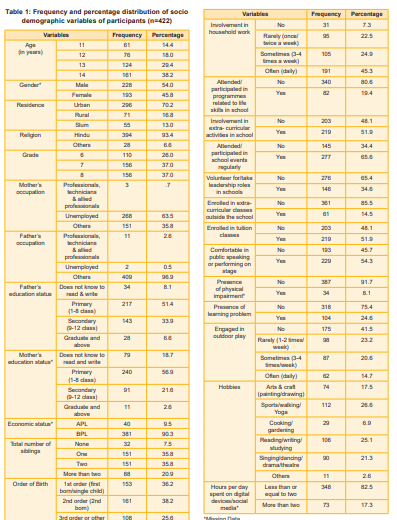

“Others” mentioned under father’s and mother’s occupation included skilled workers, shop and market sales workers, skilled agricultural and fishery workers, craft and related trade workers, plant & machine operators or assemblers, and elementary occupations.
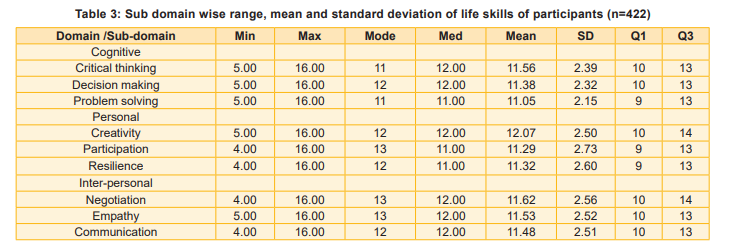
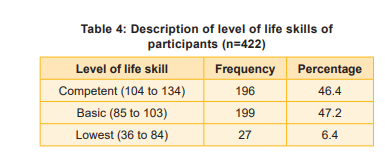
The scores followed a normal distribution except for the cognitive domain in which the spread of scores were the least (Table 2). The subdomain wise description of life skills score is presented in Table 3. Majority of the participants had basic or competent level of life skills (Table 4). Chi square/ Fisher exact test was applied to identify the factors associated with level of life skills. Age (χ² = 60.206, df = 6, p < 0.001), gender (χ² = 26.81, df = 2, p < 0.001), grade (χ² = 25.32, df = 4, p < 0.001), mother’s occupation (χ² = 14.18, df = 4, p = 0.002), economic status (χ² = 10.95, df = 2, p = 0.002), involvement in household work (χ² = 27.58, df = 6, p < 0.001), participation in life skills-related programmes in school (χ² = 17.81, df = 2, p < 0.001), involvement in extracurricular activities (χ² = 47.51, df = 2, p < 0.001), regular participation in school events (χ² = 14.25, df = 2, p < 0.001), leadership roles in school (χ² = 46.73, df = 2, p < 0.001), comfort in public speaking or stage performance (χ² = 21.45, df = 2, p < 0.001), type of hobbies (χ² = 21.46, df = 10, p = 0.018), and hours spent on digital devices (χ² = 19.69, df = 2, p < 0.001) were associated with the level of life skills.
Discussion
The findings of the present study indicate that the majority of school-going adolescents in Bhopal district of Madhya Pradesh possessed basic to competent levels of life skills, with a mean life-skill score of 103.34 ± 13.64. Findings are similar to other studies in India where most adolescents exhibited moderate or average levels of life skills (Borah et al, 2020; Deya et al, 2022; Thippeswamy et al, 2025).
Domain-wise analysis revealed variation across different life-skill domains. The cognitive domain demonstrated comparatively lower mean scores especially in problem-solving. Similar domain-wise variations have been documented in earlier studies, emphasising the need for balanced development across all life-skill domains (Borah et al, 2020; Thippeswamy et al, 2025). These findings underscore the importance of integrating curricular and co-curricular activities that promote higher-order cognitive skills, as underscored in the National Education Policy, Government of India (2020).
Our findings suggest that life-skill development is shaped by both developmental progression and meaningful engagement in home, school and everyday life contexts. Participation in school activities, leadership opportunities, and other structured experiences may provide adolescents with platforms for communication, collaboration, and decision-making, thereby supporting psychosocial growth. Similarly, involvement in household responsibilities and constructive hobbies may offer experiential learning that strengthens responsibility, resilience, and interpersonal understanding. Older adolescents demonstrated better life skills, reflecting developmental maturation, consistent
with previous studies (Mahanta et al, 2024; Manjunatha, 2025). Gender differences observed in the present study align with those of Borah et al (2020) and Thippeswamy et al (2025). Digital media use also showed a significant association, supporting evidence that duration and purpose of digital device use influence adolescents’ cognitive and socio-emotional functioning (ClementeSuárez et al, 2024).
Limitations:
The study was limited to early adolescents enrolled in government schools. Data were based on self-report questionnaire and problem-based items in the tool demanded sustained attention from responders.
Implications of study:
The findings highlight the need for introducing the structured life skills education at the higher primary school level in Madhya Pradesh. Training of nurses and school teachers in the use of standardised tools such as LSMT-E may facilitate early identification of life skill deficits among early adolescents. Communitybased initiatives involving parents and caregivers by community health officers or medical officer at PHC level can strengthen adolescents’ socioemotional competencies. Integration of life skills assessment into nursing curricula may support capacity building of nursing graduates in promoting adolescent health.
Recommendation:
Future researches may assess life skills of early adolescents in CBSE, ICSE and state board schools to identify if differences in life skills is associated with the nature of affiliation of the schools. The participants in the study may be followed up longitudinally to assess the changes in life skills as they transition to late adolescents and adulthood.
Conclusion
In the present study majority of the adolescents demonstrated basic to competent levels of life skills highlighting the need for further improvement. Adolescents’ life skill levels were associated with engagement in household work, their active involvement in co-curricular activities, participation in leadership roles in school, limited digital media use and mothers’ occupation and family economic status.
1. World Health Organization. Life Skills Education for Children and Adolescents in Schools. Geneva: World Health Organization; 2020 (cited 2025 Dec 26). https://www. who.int/publications/i/item/WHO-MNH-PSF-93.7A
2. Borah P, Ahmed N, Kollipara S. Assessment of life skills among early adolescents: A descriptive study. Indian Journal of Psychiatric Nursing 2020 Jan; 17(1): 2-7
3. Thippeswamy V, Vishwesh K, Ali A, Lakshmana G. Life skills among school-going adolescents in South India: A gender comparison. J Educ Health Promot 2025 Apr 30; 14: 151-56. doi: 10.4103/jehp.jehp_43_24
4. Dhingra R, Chauhan KS. Assessment of life-skills of adolescents in relation to selected variables. Int J Sci Res Publ 2017; 7(8): 201-05
5. Sudha P, Mythili T. A study on life skills among high school adolescents studying in English and Tamil medium in government school. Int J Health Sci 2022; 6(S4): 3743-51
6. Wahlang HB, Humtsoe A, Kapoor KC. Assessment of Life skills among the adolescents residing in Child Care Institutions. Int J Hum Soc Sci Manag 2022; 2(2): 331-37
7. UNICEF India. Comprehensive Life Skills Framework: Rights-based and Life-cycle Approach to Building Skills for Empowerment [Internet]. New Delhi: UNICEF India; 2019. Available from: https://www.unicef.org/india/reports/comprehensive-life-skills-framework
8. Singh R. Life Skills Measurement Tool Elementary (Hindi): Technical Manual, UNICEF and Young Lives India; 2020
9. Ministry of Human Resource Development. National Education Policy 2020. New Delhi: GOI; 2020
10. Torres DG, Romero AMO, Fuentes-Ramírez A. Life skills that promote school health in adolescents: A concept analysis. BMC Public Health 2025; 25(1): 3351 }
11. Avci DE, Korur F. Evaluation of the life skills of students in adolescence: Scale development and analysis. J Sci Learn 2022; 5(2): 226-41
12. Rajdeep C, Thomas B. Impact of sociodemographic variables on life skills among adolescents in rural belt of Anand district, Gujarat. Int J Food Nutr Sci 2023; 12(1): 1542-49
13. Deya S, Patra A, Giri D, Varghese LA, Idiculla D. The status of life skill education in secondary schools: An evaluative study. Online Int Interdiscip Res J 2022; 12(1): 76-88
14. Mahanta P, Deuri SP, Priyadarshee A, Sobhana H. A study on life skills among adolescents attending government schools. Indian J Psychiatry Nursing 2024; 21(1): 17-21
15. Manjunatha P. Assessment of life skills among male and female high school students in Mysore district. Int Educ Res J 2025; 11(3): 45-48
16. Clemente-Suárez VJ, Beltrán-Velasco AI, Herrero-Roldán S, Rodriguez-Besteiro S, Martínez-Guardado I, Martín-Rodríguez A, et al. Digital device usage and childhood cognitive development: Exploring effects on cognitive abilities. Children 2024; 11(11): 1299. Available from: https://doi.org/10.3390/children11111299

This work is licensed under a Creative Commons Attribution-NonCommercial-ShareAlike 4.0 International License.