
Neonates frequently undergo painful procedures during hospitalisation, including heel lancing, venipuncture, and intramuscular injections. Acute pain triggers physiological stress responses such as tachycardia and desaturation, and repeated exposure is associated with long-term neurodevelopmental consequences (Stevens et al, 2018; Cavicchiolo et al, 2022). Pre-term infants exhibit heightened vulnerability due to immature nociceptive pathways.
Although pharmacologic agents such as opioids or local anaesthetics can reduce pain, concerns regarding respiratory depression, neurotoxicity, and dosing challenges limit their use in neonatal care. This underscores the need for safe, feasible, nurse-led non-pharmacological strategies that can be consistently implemented at the bedside. A range of non-pharmacological interventions—including oral sucrose, breastfeeding, non-nutritive sucking (NNS),
skin-to-skin contact (SSC), facilitated tucking, swaddling, and selected sensory approaches— have been explored in neonatal pain management research (stevens et al, 2018; García-Valdivieso et al, 2023; Canadian Paediatric Society, 2024). These interventions are increasingly incorporated into clinical guidelines and are commonly delivered by nursing staff in routine procedures. This narrative review synthesises literature published between 2018 and 2025 to examine reported outcomes, feasibility considerations, and implementation aspects of nurse-led nonpharmacological interventions for neonatal procedural pain.
True, numerous studies have investigated non-pharmacological approaches to neonatal procedural pain, but the reported outcomes vary considerably due to differences in methodological design, sample characteristics, intervention timing and dosing, and the use of diverse pain assessment instruments such as PIPP, PIPP-R, and NIPS. This heterogeneity limits direct crossstudy comparison and complicates interpretation of relative effectiveness.
Need of the study:
Existing literature often focuses on individual intervention outcomes rather than providing an integrated synthesis that contextualises findings within methodological variability and clinical practice realities. Further, while nurses play a central role in delivering procedural pain management, differences in institutional protocols, training, and resource availability influence consistent implementation. An updated narrative synthesis of recent evidence is therefore warranted to consolidate current knowledge, acknowledge methodological diversity, and support evidence-informed neonatal nursing practice without overstating comparative superiority among interventions.
Objectives
• To examine, within a narrative review framework, the reported effectiveness of individual and combined nurse-led non-pharmacological interventions used to manage neonatal procedural pain. • To synthesise available evidence across diverse study designs while acknowledging variability in intervention protocols and outcome measures.
• To identify barriers and facilitators influencing implementation in clinical settings.
• To highlight gaps in current evidence for nursing practice and future research.
Review of Literature
Oral sucrose/Sweet solutions: Oral sucrose is one of the most extensively studied nonpharmacological interventions for neonatal procedural pain. Even minimal doses (0.1-0.2 mL) have been associated with reductions in PIPP or PIPP-R scores during heel lancing and venipuncture (Yeo CM et al, 2018). Multiple studies report reductions in validated pain scores, particularly when sucrose is administered in combination with NNS (Pekyigit & Açikgoz, 2023; Tanr?verdi et al, 2025). Repeated sucrose administration has not been shown to reduce short-term effectiveness within individual studies, and available follow-up data have not indicated measurable developmental harm during reported observation periods (Weng et al, 2024) However, variations in dosing, timing, and outcome measures limit direct cross-study comparison.
Breastfeeding and NNS: Comparative studies report lower pain scores with breastfeeding compared to certain alternative approaches within individual trial settings. NNS independently has been associated with reductions in crying duration, behavioural distress, and heart rate variability during procedures. Differences in procedural type, infant characteristics, and assessment tools should be considered when interpreting findings across studies.
Skin-to-Skin Contact (SSC/KMC): SSC has been associated with stabilisation of autonomic responses, reductions in cortisol levels, and promotion of parent-infant bonding. Systematic reviews report reductions in behavioural and physiological pain indicators across multiple procedures and neonatal populations (ValdiviesoGarcía et al, 2023; Anbalagan et al, 2024). When evaluated in combination with sucrose or breastfeeding, SSC has been reported to contribute to improved pain-related outcomes within specific study contexts (Yaman KH et al, 2025). Nevertheless, variability in duration of contact and timing relative to procedures contributes to heterogeneity in reported findings.
Facilitated Tucking and Swaddling: Facilitated tucking provides physical containment and has
been associated with decreased motor activity and observable distress during procedures. RCTs report comparable reductions in pain scores between facilitated tucking and oral dextrose for heel lance pain within individual trials (Ranjbar et al, 2020). Swaddling has also been associated with reductions in PIPP scores, particularly when used alongside other interventions such as sucrose (Bhamani et al, 2022). Differences in technique and procedural context may influence outcome variability.
Sensory Interventions
In music therapy white noise, gentle touch, and multisensory stimulation have been explored as adjunctive strategies. Some studies report reductions in pain scores during minor procedures (Yilmaz et al, 2025; Acharya et al, 2025). However, findings are less consistent compared to more extensively studied interventions. The methodological diversity of sensory intervention trials highlights the need for further standardised research.
Methodology
Study design: A narrative review design was employed to integrate findings from diverse study designs examining nurse-led non-pharmacological interventions for neonatal procedural pain. Given the methodological variability among included studies, the findings were synthesised descriptively to provide an integrated overview of reported outcomes and implementation considerations. Inclusion of diverse study designs provided a comprehensive overview of available evidence within the selected timeframe.
Data sources & search strategy:
A structured search was conducted in PubMed, CINAHL, Cochrane Library, and Google Scholar for studies published during 2018-2025. Keywords included: neonate, procedural pain, sucrose, breastfeeding, non-nutritive sucking (NNS), skin-to-skin, facilitated tucking, swaddling, music therapy, and white noise. Boolean operators (AND, OR) were used to combine key words appropriately. Titles and abstracts were screened for relevance prior to fulltext review.
Reference lists of relevant articles were also screened to identify additional eligible studies. Google Scholar results were screened using predefined inclusion criteria. Only peer-reviewed journal articles indexed in recognised academic databases were included. Conference abstracts, pre-prints, and non-indexed sources were excluded to minimise selection and indexing bias.
Inclusion Criteria
Studies involving neonates undergoing procedural pain
Non-pharmacological nurse-deliverable
interventions
Randomised controlled trials, cohort/ observational studies, and systematic reviews
Use of validated pain assessment tools (e.g., PIPP, PIPP-R, NIPS)
Studies published between 2018 and 2025 Exclusion Criteria Studies focusing solely on pharmacological interventions
Case reports, editorials, or commentaries Studies without measurable pain-related outcomes
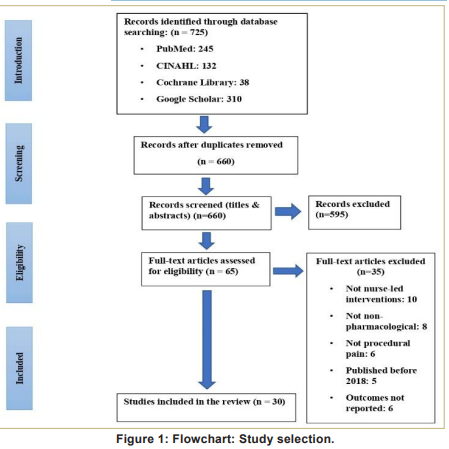
A total of 725 records were identified through database searches. After removal of duplicates, 660 records were screened by title and abstract; 65 full-text articles were assessed for eligibility, and 30 studies meeting the inclusion criteria were included in the final review (Fig 1). Due to heterogeneity in study populations, intervention timing and dosing, procedural types, and outcome measurement tools, direct quantitative comparison across interventions was not feasible. Therefore, studies were grouped according to intervention type and synthesised narratively. Reported findings were summarised descriptively, with attention to contextual factors that may influence variability in outcomes.
Randomised controlled trials were appraised using the Joanna Briggs Institute (JBI) critical appraisal checklist. Observational studies were assessed using appropriate JBI tools. Given the narrative design of the review, quality appraisal findings were considered during interpretation but were not used as exclusion criteria. Due to heterogeneity and inclusion of systematic reviews, a pooled risk-of-bias synthesis was not undertaken.
Results
The 30 studies included in this review comprised 18 randomised controlled trials, 5 cohort or observational studies, and 7 systematic reviews or meta-analyses. Geographically, the studies represented diverse regions, including Italy, Canada, Turkey, Iran, Portugal, Spain, China, India, and the United States, reflecting global research on neonatal non-pharmacological pain management.
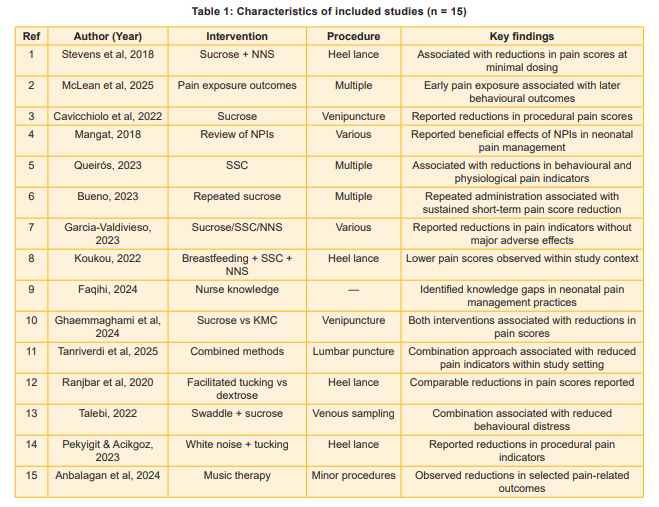
The studies evaluated a range of nurse-led interventions, including oral sucrose, breastfeeding, non-nutritive sucking (NNS), skin-to-skin contact (SSC), facilitated tucking, swaddling, and sensory interventions such as music therapy and white noise. Neonatal procedures examined included heel lancing, venipuncture, intramuscular injections, and lumbar puncture. Pain outcomes were measured using various validated tools, including PIPP, PIPP-R, and NIPS. Differences in intervention protocols, timing, and assessment methods contributed to heterogeneity across studies. A total of 30 studies were included in the final review, and their characteristics are summarised in Table 1.
Across the included studies, nurse-led nonpharmacological interventions were associated with reductions in behavioural and physiological indicators of procedural pain. Combination approaches—such as sucrose with NNS or SSC with breastfeeding—were frequently reported within individual studies to produce greater reductions in pain scores compared to single interventions evaluated in the same trial context. However, differences in study design, pain assessment tools,procedural types, and neonatal populations limit direct cross-study comparison.
Oral sucrose was commonly associated with short-term reductions in validated pain scores across various procedures. Breastfeeding and NNS were linked to improvements in crying duration, behavioural responses, and selected physiological parameters. SSC was associated with improved physiological stability and reductions in pain-related behaviours. Facilitated tucking and swaddling were described as feasible bedside strategies associated with observable reductions in distress behaviours. Sensory interventions, including music therapy and white noise, demonstrated variable but promising findings, though methodological diversity and smaller sample sizes were noted in several studies.
Overall, while multiple interventions were associated with reductions in pain indicators, heterogeneity in outcome measurement and intervention protocols precluded quantitative
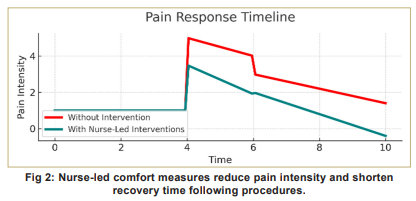
synthesis or definitive ranking of comparative effectiveness (Fig 2).
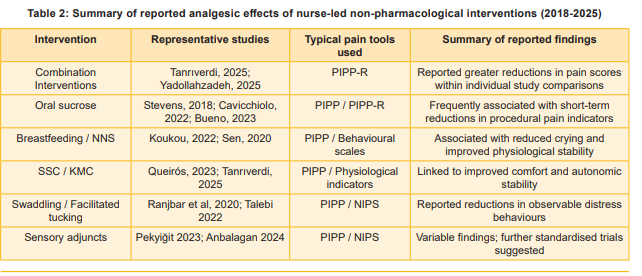
No significant short-term adverse effects were reported in the included studies. Available follow-up data did not indicate measurable neurodevelopmental harm within reported observation periods. However, most studies focused on short-term procedural outcomes, and long-term safety data remain limited (Table 2).
Discussion
This narrative review synthesises contemporary evidence (2018-2025) on nurse-led nonpharmacological interventions for neonatal procedural pain (Table 2). Across the included studies, interventions such as oral sucrose, breastfeeding, non-nutritive sucking (NNS), skin-toskin contact (SSC), facilitated tucking, swaddling, and selected sensory approaches were associated with reductions in behavioural and physiological indicators of pain during procedures (Stevens et al, 2018; Valdivieso García et al, 2023; Weng et al, 2024; Anbalagan et al, 2024; Yilmaz et al, 2025).
As primary bedside caregivers, neonatal nurses play a central role in selecting, timing, and adapting non-pharmacological interventions based on infant stability and contextual factors, highlighting the importance of professional autonomy within institutional guidelines. In addition to reported pain outcomes, implementation factors remain critical. Barriers such as limited training, absence of standardised protocols, and inconsistent parental involvement may affect the consistent delivery of nurse-led interventions (Ghaemmaghami et al, 2024). Addressing these contextual factors is essential to enhance integration of evidence-informed practices into routine neonatal care. The findings align with family-centred and developmental care frameworks, which emphasise environmental modification, parental involvement, and individualised comfort strategies in neonatal care settings.
Oral sucrose was among the most frequently examined interventions and was associated with short-term reductions in validated pain scores across multiple procedures (Yeo CM et al, 2018). Breastfeeding and NNS were reported to reduce crying duration and improve physiological stability during minor procedures SSC was associated with improved autonomic regulation and reductions in observable distress behaviours (Araque BY et al, Anbalagan et al, 2024). Facilitated tucking and swaddling were described as feasible bedside strategies that support physiologic containment during painful procedures (Weng et al, 2024). Sensory interventions demonstrated variable
findings across studies, reflecting both emerging interest and methodological diversity (Anbalagan et al, 2024; Yilmaz et al, 2025). Several studies evaluated multimodal approaches, including combinations such as sucrose with NNS or SSC with breastfeeding (Tanr?verdi et al, 2025).
Within individual study contexts, these combined strategies were associated with greater reductions in pain indicators compared to single interventions assessed within the same trial. However, differences in study design, intervention timing, neonatal characteristics, and pain assessment tools such as PIPP, PIPP-R, and NIPS limit direct cross-study comparison and preclude definitive ranking of interventions.
Methodological variability across included trials warrants cautious interpretation. Sample sizes ranged considerably, and gestational age categories were not uniformly defined across studies. Blinding is inherently challenging in nonpharmacological trials, particularly for behavioural interventions such as SSC or facilitated tucking, potentially introducing performance and detection bias.
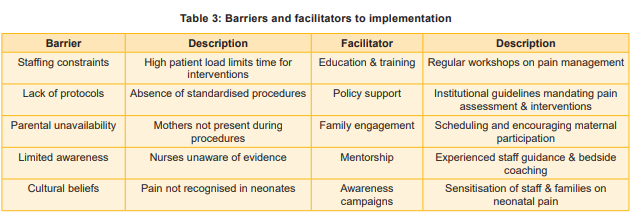
The heterogeneity observed across included studies highlights the complexity of neonatal pain assessment and management. Variability in procedural types, dosing protocols, and outcome measures influences interpretation of reported findings. Therefore, conclusions regarding relative effectiveness should be considered within the methodological and clinical context of each study. While most studies reported reductions in pain indicators, some trials demonstrated modest or statistically non-significant differences between intervention groups, particularly in smaller samples or when procedural intensity was low. Variability in outcome measures and timing of assessment may partly explain inconsistent findings. Barriers and facilitators to implementation are given in Table 3.
Ethical considerations are central to neonatal pain management. Neonates are a vulnerable population, and minimising procedural pain aligns with principles of beneficence and non-maleficence. Nurse-led non-pharmacological interventions offer low-risk strategies that support humane, developmentally sensitive care. Overall, this review supports the role of nurse-led non-pharmacological strategies in neonatal pain management while acknowledging methodological variability and the need for cautious interpretation of comparative findings.
Limitations
A narrative review design was used; no quantitative meta-analysis was conducted, and effect sizes were not pooled. Considerable heterogeneity existed across studies in terms of gestational age, procedural types, intervention timing, dosing protocols, and outcome measures (e.g., PIPP, PIPP-R, NIPS), limiting direct comparison between interventions. Included studies varied in design (RCTs, cohort studies, systematic reviews), which may introduce methodological variability and potential bias. Relevant studies outside the selected timeframe (2018 and 2025) or from other databases may not have been captured. Publication bias cannot be excluded, as studies reporting positive findings are more likely to be published. Inclusion of systematic reviews alongside primary trials may have resulted in overlap of some underlying studies.
Implications
Implications for Nursing Practice
• Nurse-led non-pharmacological interventions can be integrated into routine procedural care in NICUs.
• Multimodal approaches may be considered based on clinical context and infant stability.
• Standardised institutional protocols may enhance consistency in implementation.
• Regular pain assessment using validated tools (e.g., PIPP, PIPP-R, NIPS) should accompany all procedures.
Implications for Nursing Education
• Structured training programmes are needed to improve nurses’ knowledge and confidence in delivering evidence-informed nonpharmacological interventions.
• Simulation-based learning may support skill development in techniques such as facilitated tucking and skin-to-skin positioning.
Implications for Policy
• Development of unit-based guidelines may promote standardised neonatal pain management practices.
• Policies encouraging parental involvement (e.g., breastfeeding, SSC) may enhance implementation of comfort strategies.
Implications for Future Research
• Future studies should aim for standardised outcome reporting to enable stronger comparisons.
• Larger multicentre trials may improve generalisability.
• Further research is needed to examine implementation barriers and long-term outcomes.
Recommendations
Acknowledgement
The author declares that this review was conducted independently and acknowledges the contributions of the broader padiatric nursing research community whose published work informed this synthesis.
Conclusion
Nurse-led non-pharmacological interventions appear to offer safe and feasible approaches for managing neonatal procedural pain. Strategies including sucrose administration, breastfeeding, skin-to-skin contact (SSC), facilitated tucking, swaddling, and selected sensory interventions have been associated with reductions in behavioural and physiological pain indicators across various clinical contexts.
While individual studies report beneficial effects, heterogeneity in study design, intervention protocols, and outcome measures limits direct comparison across interventions. Multimodal strategies have demonstrated promising findings within specific study settings. However, conclusions regarding relative effectiveness should be interpreted cautiously.
Strengthening standardised implementation, structured nursing education, and consistent pain assessment practices may support improved integration of evidence-informed neonatal pain management strategies.

This work is licensed under a Creative Commons Attribution-NonCommercial-ShareAlike 4.0 International License.