The nursing curriculum continues to evolve. However, teaching methods have not progressed at the same pace (Karimi et al, 2004). Many health institutions include skills-lab training as a vital component of their programmes, helping bridge the gap between classroom learning and clinical practice (Devi et al, 2019). In nursing education, the nursing competence laboratory provides a controlled environment for students to develop and master clinical procedures before performing them on patients (Sodhi, 2017). Traditionally, skills are taught using the “see one, do one” method, where the instructor demonstrates a procedure and students subsequently practice it (Giacomino et al, 2020)
Inadequate skill acquisition, often related to the quality of training, contributes to poor skill retention. Therefore, innovative teaching strategies such as Peyton’s 4-Step Approach are essential to enhance students’ proficiency, performance, and confidence in clinical settings (Varghese & Abraham, 2024). Peyton’s method, widely used for teaching procedural skills, includes four stages:
Stage 1: Demonstration: The teacher demonstrates the steps without any explanation.
Stage 2: Deconstruction: The teacher demonstrates the steps with an explanation.
Stage 3: Comprehension: The teacher repeats the process a third time as the trainee explains each step, reinforcing their understanding.
Stage 4: Performance: The learner does the task independently.
A key strength of this approach is the emphasis on learner explanation (Stage 3), promoting active thinking, self-explanation, and integration of new knowledge with prior learning (Garg et al, 2023). It supports active learning, critical thinking, and improved psychomotor performance, making it a safe and effective strategy in nursing education (Awad et al, 2018). The cognitive process of self-explanation further enhances knowledge integration and retention (Gertraud et al, 2016).
Cardiopulmonary Resuscitation (CPR) is a critical life-saving procedure that must be performed promptly and skillfully. Effective CPR requires confidence and competence, which can only be achieved through structured training (Ahmed et al, 2018). Hence, the researcher aimed to evaluate the effectiveness of Peyton’s Four-Step approach on CPR skill performance among nursing students, as the findings may support its adoption for improving procedural competence and better patient care quality.
Review of Literature
Related to Peyton’s Four Step Approach
A quasi-experimental study was conducted on 80 students by Awad et al (2018) to ascertain how Peyton’s method affected nursing students’ performance during skill-lab training, at Mansoura University in Egypt. The outcomes of the control and intervention groups were compared using the objective structured assessment checklist. A dependent sampling t-test was employed to compare within a group. The study group performed a remarkably independent intramuscular injection efficiency as compared to the control group. So, nursing students agreed that it was advantageous to teach practical skills utilising Peyton’s four-step technique as a model.
Garg et al (2023) evaluated the efficacy of Peyton’s Approach in 50 undergrad students in the first phase of MBBS at All India Institute of Medical Sciences Gujarat, via a prospective randomised trial. The pupils were split up into groups using the full enumeration sample approach. Two procedures, taking blood pressure and a hand cleansing technique, were taught using two different methods. A uniform grading criterion for the assessment of outcomes was developed to evaluate the student’s skills after the training session. The results displayed that students in the research learned faster, had more confidence and skill in performing procedures compared to the traditional technique.
Related to the Traditional Demonstration Method
Devi et al (2019) carried out a quasi-experimental study to evaluate how nursing students learn obstetrical palpation by comparing the effectiveness of a video-assisted teaching programme with traditional demonstration among 60 BSc graduates from the Sikkim College of Nursing. The study included a control group pre-test and post-test design. Third-year nursing learners were randomly assigned to two groups for obstetrical palpation training; the experimental group got video instruction while the control group received conventional demonstration. The results showed a significant difference in both pre-test and post-test skill results between students in the two groups (t=18.35, p<0.001). Even though both methods were similarly effective at enhancing abilities, conventional demonstration outperformed the video-assisted training software in post-test skills comparison (t=36.4, p=0.001). The results showed that demonstration outperforms video-assisted teaching programmes in skill development.
Ogun?owo SO and Ajibade BL conducted an experimental study among 74 2nd year nursing students chosen by stratified random sampling; a pre-test, intervention, and post-test for all were administered at Bowen University Teaching Hospital, Nigeria. This study aimed to improve the learning outcomes of nursing students by comparing the effectiveness of lecture and demonstration methods. The results were analysed using means, two-tail ANOVA, bar charts, pie charts, frequency distribution tables, and t-tests. It is advised that during medical-surgical nursing education, instructors utilise both the lecture and demonstration methods.
The present study was undertaken to address this gap and evaluate the effectiveness of Peyton’s Four-Step approach in enhancing procedural skill performance among nursing students.
Objectives
The study attempted:
1. To assess the level of skill among undergraduate nursing students for performing Cardio Pulmonary Resuscitation on manikin after using (a) Conventional Demonstration method; and (b) Peyton’s Four Step Approach (PFSA); and
2. To compare the effectiveness of PFSA vs Conventional Demonstration method on level of skill for performing Cardio Pulmonary Resuscitation, among undergraduate nursing students.
Material and Method
This quasi-experimental post-test only control group study was conducted between June and December 2024 in a selected college of nursing in Delhi.
Sample size and sampling procedure: The sample size of the present study consisted of 58 undergraduate nursing students, with 29 students each in the experimental and control group. The sample size was considered adequate based on the availability of participants who fulfilled the inclusion criteria during the period of data collection and was feasible for conducting the intervention and individual skill assessment effectively.
A non-probability purposive sampling technique was used to select the participants, as the study specifically required first-year undergraduate students who were available during the data collection period and willing to participate in the study. Purposive sampling was considered appropriate because the participants possessed characteristics relevant to the objectives of the study, particularly the need for students with similar educational exposure and no prior formal CPR training.
After participants’ selection, lottery method was used to allocate the students into experimental and control groups. Equal numbers of chits labelled as “experimental group” and “control group” were prepared and mixed thoroughly. Each participant was asked to pick one chit, and based on the selected chit, students were assigned to either the experimental or control group, ensuring equal and unbiased group allocation.
Study procedure: The study was conducted after approval from the Ethical Committee. Permission was taken from the Principal of the College where the study was conducted. The purpose of the study was explained to participants, and written informed consent was taken. The confidentiality and anonymity of the students were maintained throughout the study.
The sociodemographic details comprised of six questions related to demographic variables. Second tool was a structured observation checklist to assess the skill for performing CPR among undergraduate nursing students. Structured observation checklist consisted of 20 items. The scoring criteria for structured observation checklist was as follows: For each correct step performed, score-2; for every incomplete step performed, score-1; For step not performed, score-0. Score of 32-40 indicated ‘Good’ skill; 20-31 ‘Average’ skill; and 0-19 ‘Poor’ skill.
Statistical analysis: We employed descriptive and inferential statistics, such as frequency, percentage, mean, median, standard deviation, and Mann-Whitney U test to describe the sociodemographic characteristics and to find the comparison between two groups. The criteria for statistical significance were set at p-value <0.001. For statistical analysis, SPSS 26.0 software was used.
Study variables: Based on previous research, we considered the following sociodemographic variables: Age (in years), Gender, Occupation of father, Occupation of mother, having witnessed cardio-pulmonary resuscitation, and whether ever underwent CPR training.
The intervention technique: Data were collected using two tools. The first tool consisted of a structured sociodemographic questionnaire containing items related to age, gender, parents’ occupation, previous exposure to CPR, and prior CPR training. The second tool was a structured observation checklist developed to assess the procedural skill performance of undergraduate nursing students in performing advanced nursing procedures such as CPR. The checklist consisted of 20 procedural steps related to CPR performance. Each correctly performed step was awarded 2 marks, incompletely performed steps received 1 mark, and steps not performed were scored 0, with a maximum obtainable score of 40.
The intervention administered to the experimental group was Peyton’s Four-Step approach (PFSA), which included demonstration, deconstruction, comprehension, and performance. In the first step, the investigator demonstrated the procedure without explanation. In second, the procedure was repeated with detailed verbal explanation. During the third step, students verbally guided the investigator through each step of the procedure to reinforce understanding. In the final step, students independently performed the procedure under supervision. The control group received teaching through the Conventional Demonstration method, where the investigator demonstrated and explained the procedure followed by students’ return demonstration.
The content validity of the tool was established through expert evaluation by specialists in Medical-Surgical Nursing and Nursing Education. Necessary modifications were incorporated based on their suggestions to ensure clarity and relevance of the tool. The reliability of the structured observation checklist was established using the inter-rater reliability method with Cohen’s Kappa coefficient. The obtained reliability coefficient was 0.82, indicating good agreement between raters and confirming that the tool was reliable for assessing procedural skill performance among undergraduate nursing students.
Data collection: The data was collected over a period of 3 weeks at the selected College of Nursing, Delhi. The participants were divided into experimental and control groups by lottery method. The control group received training through the Conventional Demonstration method on Day 2, whereas the experimental group received training using Peyton’s Fourstep approach on Day 3. Post-test assessment of the control group was conducted on Day 8 and that of the experimental group on Day 9 using a structured observation checklist.
To minimise researcher bias, standardised instructions, uniform teaching content, and predefined scoring criteria were used for both groups. All students were assessed individually under similar conditions using the same structured observation checklist. The researcher observed and collected the post-test data objectively using the checklist.
Results
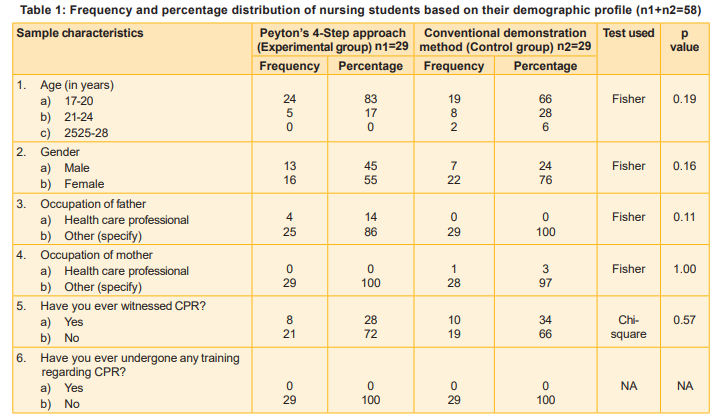
Table 1 describes the demographic characteristics of nursing students by their age, gender, occupation of father, occupation of mother, witnessing CPR, and training regarding CPR. In the experimental group, most students (n=24, 83%) were aged 17-20 years, and 5 (17%) were 21-24 years and none in 25-28 years. In the control group, 19 (66%) were 17-20 years, 8 (28%) were 21-24 years, and 2 (6%) were 25-28 years. By gender, the experimental group had 16 (55%) females and 13 (45%) males, while the control group had 22 (76%) females and 7 (24%) males. Regarding fathers’ occupation, 25 (86%) in the experimental group and all 29 (100%) in the control group were in non-health care fields, with only 4 (14%) fathers in the experimental group being health care professionals. As for mothers’ occupation, all 29 (100%) in the experimental group and 28 (97%) in the control group were in non-health care fields, with just 1 (3%) in the control group as a health care professional.
In terms of CPR exposure, 21 (72%) in the experimental group and 19 (66%) in the control group had not witnessed CPR, while 8 (28%) and 10 (34%), respectively, had witnessed it. Notably, none of the students in either group had received CPR training.
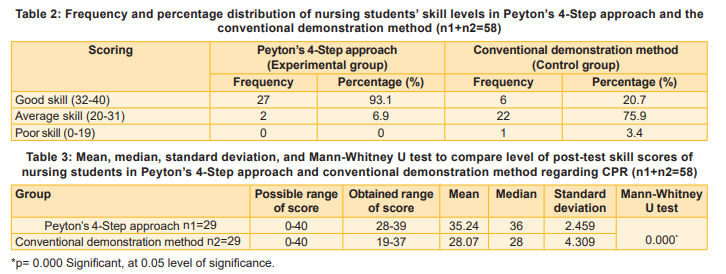
Table 2 shows that in the experimental group, 27 (93.1%) students demonstrated good skills (32-40), while 2 (6.9%) students exhibited average skills (20-31), and none had poor skills (0-19). Whereas, in the control group, 22 (75.9%) students demonstrated average skills (20-31), while 6 (20.7%) students demonstrated good skills (32-40) and 1 (3.4%) student displayed poor skills (0-19).
The experimental group had a mean score of 35.24 with a median of 36, indicating a higher average performance compared to the control group, which had a mean score of 28.07 and a median of 28 (Table 3). The possible score range for both groups was from 0 to 40, but the experimental group achieved scores between 28 and 39, while the control group scored between 19 and 37. This suggests that the students in the experimental group performed better. The standard deviation for the experimental group was 2.459, which is lower than the control group’s standard deviation of 4.309, indicating that the scores in the experimental group were more consistent and less spread out. The Mann-Whitney U test value for the comparison between the two groups was .000, which is lower than the p-value <0.001. Therefore, it can be stated that the difference observed in the mean post-test skill scores of the two groups was a true difference and not by chance.
Discussion
Skill lab learning, skill retention, and competency are essential aspects of nursing education across all specialties, ensuring proficiency in clinical practice. Students must practice these procedures in a controlled lab environment to enhance their
skills before applying them in real-life scenarios. So, the current study aimed to evaluate the effectiveness of Peyton’s 4-Step approach versus the Conventional demonstration method in enhancing CPR skills among nursing students.
Differentiation between average skill and poor skill: The differentiation between average skill and poor skill in performing the CPR procedure was based on the scores obtained using the structured observation checklist. The checklist consisted of 20 procedural steps with a maximum obtainable score of 40. Each correctly performed step was awarded 2 marks, incompletely performed steps received 1 mark, and steps not performed were scored 0. The scoring criteria and classification of skill levels were developed according to Bloom’s Taxonomy of the Psychomotor Domain for assessing practical skills, which emphasises the hierarchical development of procedural competence from guided performance to accurate and independent execution of skills. Based on the total score obtained, the level of skill was categorised as good skill (32–40), average skill (20–31), and poor skill (0–19). Students categorised under average skill were able to perform most of the CPR steps with partial accuracy.
The findings of the current research revealed that after implementing two different teaching methods, the experimental group displayed a mean score of 35.24, showing a median of 36, indicating a higher average performance compared to the control group, which had a mean score of 28.07 and a median of 28. The possible score range for both groups was from 0 to 40, but the experimental group achieved scores between 28 and 39, while the control group scored between 19 and 37. Thus, the study revealed that Peyton’s 4-Step approach proved to be an effective technique for acquiring advanced procedural skills.
Awad et al (2018) evaluated the effectiveness of Peyton’s Four-Step approach in demonstration-lab training among nursing students among a total of 80 students divided into two groups. The experimental group (20 level-one and 20 level-four students) was trained using Peyton’s method, while the control group (20 level-one and 20 level-four students) received conventional instruction. Intramuscular injection was taught to level-one students and arterial puncture to levelfour students. The experimental group achieved significantly higher performance scores than the control group. The findings indicated that Peyton’s Four-Step approach was beneficial for teaching practical skills, especially among fourth-year nursing students.
In a prospective randomised study Dietsch G. et al. evaluated the effectiveness of Peyton’s method in teaching complex spinal manipulation techniques. A total of 95 medical students were randomly assigned to either a Peyton group (PG) or a conventional teaching group (CG). Evaluation included multiple-choice (MG) exams to assess theoretical knowledge and Structured Skill Assessments to evaluate practical skills, with a follow-up assessment after six months. Results showed no significant difference in MC exam scores between the groups. However, the Peyton group achieved significantly higher practical skill grades. No gender differences were observed. Although skill levels declined in both groups at six months, Peyton’s method was found to be more effective than traditional teaching for learning advanced spinal manipulation techniques.
The findings of the present study revealed that undergraduate nursing students who received training through Peyton’s 4-Step approach demonstrated significantly higher post-test skill scores compared to those who received training through the Conventional Demonstration method. This indicates that PFSA was more effective in enhancing procedural skill performance among nursing students. The improved performance of the experimental group may be attributed to the structured and sequential learning process involved in PFSA, which promotes active participation, verbalisation, repetition, and independent execution of the procedure.
Further, the higher skill scores obtained by the experimental group even after a one-week interval before post-test assessment suggest better retention of procedural skills among students trained through PFSA. The lower standard deviation observed in the experimental group also indicates greater consistency in skill acquisition among the participants. Therefore, the study findings support the effectiveness of Peyton’s 4-Step approach as an effective teaching strategy for improving competency in advanced nursing procedures such as CPR among undergraduate nursing students.
Nursing Implications
Nursing education: The study suggests the need to update teaching strategies and adopt innovative methods. Peyton’s Four-Step approach promotes active participation and systematic skill practice, enhancing knowledge retention, critical thinking, and problem-solving skills.
Nursing administration: Nursing administrators can utilise Peyton’s Four-Step approach as an effective strategy for training staff in new procedures and protocols to enhance patient safety. Nursing practice: In the evolving healthcare system, mastery of clinical skills is vital. Peyton’s Four-Step approach enhances skill retention and application, improves procedural accuracy and decision-making, reduces errors, and promotes effective patient communication and quality care.
Nursing research: Further research is needed to explore and compare different teaching methodologies in nursing to develop innovative approaches and achieve excellence in nursing education.
Limitations: Due to the small sample size, the findings lack generalisability.
Recommendations
Based on the findings of the study, the study can be conducted in different settings with a larger sample size. Educators should receive training to improve their knowledge and skills in using PFSA techniques. Longitudinal studies are needed to evaluate students’ skill retention and clinical application over time.
Conclusion
This study contributes to the existing literature by demonstrating the effectiveness of Peyton’s 4-Step approach specifically for teaching advanced nursing procedures such as CPR among undergraduate nursing students in the Indian nursing education setting. Unlike previous studies which focussed mainly on medical education, the present study directly compared PFSA with the Conventional Demonstration method using objective skill assessment. After implementing the two teaching methods, the experimental group achieved a higher post-test mean score than the control group. Thus, Peyton’s Four-Step approach was found to be more effective than the Conventional Demonstration method for teaching CPR to nursing students.
1. Karimi MH, Derakhshan A, Valai N, Mortazavi F. The effectiveness of video-based education on gaining practical learning skills in comparison with demonstrating the method’s effectiveness among university students. J Med Educ 2003; 4: 27-30
2. Devi B, Khandelwal B, Das M. Comparison of the effectiveness of video-assisted teaching program and traditional demonstration on student learning skills of performing obstetrical palpation. Iran J Nurs Midwifery Res [Internet] 2019; 24(2): 118-23
3. Sodhi J. Comprehensive Textbook of Nursing Education. 2017, pp 59-60
4. Giacomino K, Caliesch R, Sattelmayer KM. The effectiveness of Peyton’s 4-step teaching approach on skill acquisition of procedures in health professions education: A systematic review and meta-analysis with integrated meta-regression. PeerJ 2020; 8(e10129): e10129
5. Varghese S, Abraham L. Comparison of Peyton’s 4-Step Approach with the conventional bedside technique in teaching clinical examination skills to medical students. Cureus 2024; available from: http://dx.doi.org/10.7759/cureus.54397
6. Garg R, Sharma G, Chaudhary A, Mehra S, Loomba PS, Chauhan VD. Evaluation of Peyton’s 4-Step Approach for skill acquisition in undergraduate medical students: A prospective randomized study [Internet]. medRxiv 2023. Available from: http://dx.doi. org/10.1101/2023.07.27.23293240
7. Awad S, Mohamed M. Effectiveness of Peyton’s 4-Step approach on nursing students’ performance in skill-lab training. Journal of Nursing Education and Practice 2018 Dec; Doi: 10.5430/jnep. v9n5p1. Available form URL: https://doi.org/10.5430/jnep.v9n5p
8. Gertraud D, Lubke C, Horst K, Simon M, Moddaber A, Sonmez T, et al. Peyton’s 4-Step Approach for teaching complex spinal manipulation techniques: A prospective randomized trial. BMC Medical Education 2016 Nov; 3(16): Doi: 10.1186/s12909-016-0804-0
9. Ahmed F, Morsi S, Mostafa MH. Effect of Payton’s Four Step Approach on skill acquisition, self-confidence and self-satisfaction among critical care nursing students. IOSR Journal of Nursing and Health Science 2018; 7(6): 38-47
10. Ogunloucq SO, Ajibade BL Investigation the defferiential efficacy of lecture and demoustralion teaching methods in teaching medical-Surgical nursing among nurssing students BMC Nursing 2024l 23:884
11. Dielsch G, Lubkec, Horstk, Simon M, Modabber A, Sonmez TT et al. Peyton four step approach for teachining complex spinal manipulation techniques-a prospective randomized irail. BMC Med Educ 2016; 16:284

This work is licensed under a Creative Commons Attribution-NonCommercial-ShareAlike 4.0 International License.