
Schizophrenia is a severe, chronic psychiatric disorder characterised by disturbances in thought, perception, emotions, behaviour, and social functioning. It affects approximately 24 million people worldwide and remains one of the leading causes of disability among young adults. The disorder typically develops during the most productive years of life, resulting in longterm impairment in occupational performance, interpersonal relationships, and independent living. Despite advances in pharmacological and psychosocial management, schizophrenia continues to impose a substantial burden on affected individuals, their families, healthcare systems, and society (Kaushik & Bhatia, 2013).
Modern psychiatric care emphasises community-based management, allowing individuals with schizophrenia to remain within their families rather than in long-term institutional care. Consequently, family members have assumed a central role in providing emotional support, supervising medication adherence, managing behavioural disturbances, assisting with daily living activities, and ensuring continuity of treatment. Among family caregivers, spouses occupy a particularly unique position because they are expected to fulfil emotional, social, financial, and caregiving responsibilities simultaneously (Dani & Thienhaus, 1996).
Caregiver burden is defined as the physical, emotional, psychological, social, and financial strain experienced while caring for a family member with a chronic illness. In schizophrenia, caregiver burden is often intensified because of the unpredictable course of illness, recurrent relapses, persistent negative symptoms, cognitive deficits, social stigma, and reduced occupational functioning of the affected individual. Long-term caregiving frequently results in anxiety, depression, social isolation, marital dissatisfaction, economic hardship, sleep disturbances, and deterioration in caregivers' overall quality of life. Understanding the extent of caregiver burden is essential for developing family-centred mental health interventions and improving the quality of life of both patients and caregivers (Murray CJL 2012, et al).
Previous studies in different countries have consistently demonstrated that caregivers of individuals with schizophrenia experience significantly higher levels of burden than caregivers of many other chronic medical conditions. Longer duration of illness, severe psychotic symptoms, poor treatment adherence, repeated hospitalisations, unemployment, and limited social support further increase caregiver stress. The psychological well-being of caregivers directly influences patient recovery, medication adherence, relapse prevention, and successful community reintegration (Caqueo-Urízar et al, 2009).
In India, where family members remain the primary source of care for individuals with severe mental illness, caregiver burden has become an important public health concern. Cultural expectations often require spouses to continue caregiving despite considerable emotional distress and financial constraints. Although several studies have examined caregiver burden among family members, comparatively fewer investigations have focused exclusively on spouses, who experience unique marital, emotional, and social challenges. The situation becomes more complex in regions such as Jammu & Kashmir, where prolonged socio-political stress, changing family structures, economic limitations, and restricted access to mental health services may further intensify caregiver burden. Evidence regarding the experiences of spouses caring for these patients remains limited. Understanding the magnitude and determinants of caregiver burden among spouses is essential for designing targetted nursing interventions, strengthening familycentred psychiatric care, and developing policies that support caregivers as integral members of the treatment team.
Psychiatric nurses play a crucial role in identifying caregiver stress, providing education, teaching coping strategies, facilitating support groups, and promoting adherence to treatment plans. Routine assessment of caregiver burden can enable early intervention, improve caregiver wellbeing, reduce burnout, and ultimately contribute to better patient outcomes. Therefore, assessing caregiver burden among spouses represents an important step towards comprehensive mental healthcare.
Need of the study: Caregiver burden among family members of individuals with schizophrenia has been reported in several national and international studies, yet very few have examined the experiences of spouses in the Kashmir region. This study is among the first to evaluate spousal caregiver burden among schizophrenic patients. The findings provide region-specific evidence that can assist psychiatric nurses, mental health professionals, and policymakers in developing culturally appropriate caregiver support programmes
Objectives
This study endeavoured to: (i) assess the burden experienced by spouses of individuals diagnosed with schizophrenia receiving treatment at the Institute of Mental Health and Neurosciences Kashmir (IMHANS-K); (ii) describe the sociodemographic characteristics of spouses caring for individuals with schizophrenia; (iii) determine the association between caregiver burden and the type of schizophrenia; (iv) identify the distribution of caregiver burden among spouses of individuals with schizophrenia; provide evidence for strengthening family-centred psychiatric nursing interventions for caregivers of individuals with schizophrenia.
Methodology
Study design and setting: A quantitative, descriptive, cross-sectional research design was adopted to assess the burden experienced by spouses of individuals diagnosed with schizophrenia receiving treatment at the IMHANS-K, Srinagar. The cross-sectional design was considered appropriate because it allowed the investigators to assess caregiver burden and its association with clinical characteristics at a single point in time.
The study was conducted in the outpatient department (OPD) of IMHANS-K, which is the largest tertiary care mental health institute in the region and receives patients from all districts of J&K. The study population comprised spouses of individuals diagnosed with schizophrenia attending the psychiatric outpatient department of IMHANS-K during the study period.
Inclusion criteria: The study included spouses who (a) were legally married to individuals diagnosed with schizophrenia according to the International Classification of Diseases, Tenth Revision (ICD-10) diagnostic criteria; aged 18 years or older; (b) had been living with and caring for the patient for at least one year; accompanied the patient during outpatient visits; (c) were able to understand either Urdu or English; and (d) were willing to participate and provided written informed consent.
Exclusion criteria: Spouses (a) diagnosed with any severe psychiatric disorder or cognitive impairment; (b) suffering from serious physical illness that interfered with participation; (c) caring for patients with severe neurological disorders or intellectual disability in addition to schizophrenia; and (d) who declined participation or were unable to complete the interview, were excluded from the study.
A total of 100 spouses participated in the study. The sample size was estimated using a prevalence-based formula considering the expected prevalence of caregiver burden reported in previous studies, a 95 percent confidence level, and a 5 percent margin of error. Considering the feasibility of recruitment during the study period, 100 eligible spouses were enrolled. A non-probability purposive sampling technique was used to recruit participants. Eligible spouses accompanying patients diagnosed with schizophrenia during outpatient visits were approached individually.
Study variables: Dependent variable was, burden experienced by spouses. Independent variables were: age, gender, residence, occupation, duration of illness, type of schizophrenia.
Research instrument: Data were collected using two instruments. Section I is a structured demographic and clinical information schedule developed by the investigators to obtain demographic information. Section II, i.e. Caregiver burden was assessed using BAS, a standardised instrument widely used for evaluating subjective and objective caregiver burden among family caregivers of individuals with severe mental illness. The instrument measures emotional, physical, social and financial burden experienced by caregivers. Higher scores indicate greater caregiver burden.
Validity and reliability: The BAS is an internationally recognised standard instrument with satisfactory psychometric properties. Previous validation studies have demonstrated good internal consistency with Cronbach's alpha values ranging between 0.89 and 0.91.
Prior to data collection, the questionnaire was reviewed for content appropriateness by experts in psychiatric nursing and psychiatry. A pilot study was conducted among approximately 10 percent of the estimated eligible samples to assess feasibility, clarity and applicability of the instrument in the study setting. Participants included in the pilot study were excluded from the final analysis. The pilot confirmed the feasibility of recruitment, acceptability of the questionnaire and average interview duration.
Data collection: Prior administrative permission was obtained from the Director, IMHANS-K before commencement of the study. Eligible participants attending the psychiatric OPD were identified with the assistance of treating psychiatrists and nursing staff. The objectives and procedures of the study were explained individually to each participant. Written informed consent was obtained before enrolment. Face-to-face interviews were conducted in a private setting using the structured demographic questionnaire and the BAS. Each interview required approximately 20-30 minutes to complete. Privacy and confidentiality were maintained throughout the data collection process. Completed questionnaires were checked daily for completeness and accuracy before data entry.
Ethical consideration: Ethical approval for the study was obtained from the Institutional Ethics Committee prior to commencing the research. Participation was entirely voluntary. Written informed consent was obtained from every participant after explaining the objectives, benefits and potential risks of the study. Participants were assured that confidentiality would be maintained; information would be used exclusively for research purposes; refusal to participate would not affect treatment; and, they could withdraw from the study at any time without providing any reason.
Statistical analysis: Data were entered into IBM SPSS Statistics Version and analysed using descriptive and inferential statistics. Descriptive statistics included frequency, percentage, mean, standard deviation. Inferential statistics included Chi-square test to determine the association between caregiver burden and the type of schizophrenia. A p-value below 0.05 was considered statistically significant.
Results
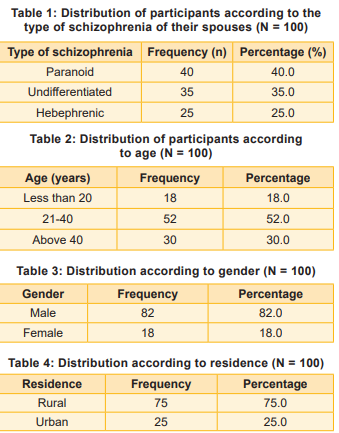
Among the 100 participants, 40 percent were spouses of individuals diagnosed with paranoid schizophrenia, making it the most common subtype in the study population (Table 1). This was followed by undifferentiated schizophrenia (35%), while 25 percent of participants were caring for individuals with hebephrenic schizophrenia. The findings indicate that paranoid schizophrenia constituted the largest diagnostic category among patients attending the psychiatric OPD.
Table 2 depicts that more than half (52%) of the participants belonged to the 21-40 years age group, followed by 30 percent above 40 years of age. Only 18 per cent were younger than 20 years. These findings indicate that caregiver responsibilities were predominantly undertaken by adults in their economically productive years. Majority of caregivers were male (82%), whereas females constituted only 18 percent of the study participants, which reflects the caregiving pattern observed among the study population (Table 3). Three-fourths (75%) of the caregivers resided in rural areas, while only a fourth (25%) belonged to urban areas, suggesting that schizophrenia caregiving is predominantly undertaken by families living in rural communities (Table 4).
Table 5 depicts that most caregivers (80%) were employed in the private sector or were selfemployed, whereas 20 percent were government employees. Occupational responsibilities may further contribute to caregiver burden by
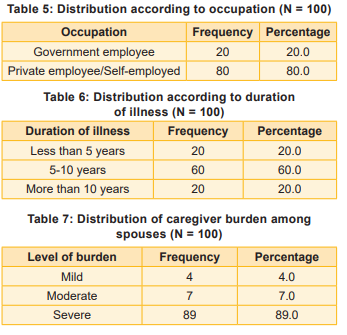
increasing financial and time-related pressures. The majority (60%) of patients had been living with schizophrenia for 5-10 years, while 20 percent had illness duration of less than five years and another 20 percent had illness duration exceeding ten years. These findings indicate that most caregivers had been providing long-term care (Table 6). Overall, 89 percent of spouses experienced severe caregiver burden, while 7 percent reported moderate burden and only 4 percent experienced mild burden. The high prevalence of severe burden indicates that caregiving for individuals with schizophrenia imposes substantial psychological, emotional, social, and financial challenges on spouses. These findings underscore the importance of routine caregiver assessment and the implementation of structured psychosocial support programmes within psychiatric services (Table 7).
The findings demonstrate that caregiver burden among spouses of individuals with schizophrenia is remarkably high, and there is need for comprehensive caregiver support, psycho education, counselling services, and family-centred mental health interventions to reduce caregiver distress and improve patient outcomes.
Discussion
The present study revealed that the majority of spouses experienced severe caregiver burden, highlighting the substantial psychological, emotional, social, and financial challenges associated with long-term caregiving. These findings reinforce the need for integrating caregiver assessment and support into routine psychiatric services.
The study found that 52 percent of caregivers were in the 21-40-year age group, 82 percent of them were male. This suggests that caregiving responsibilities were predominantly assumed by individuals in their economically productive years, when they are also expected to render employment and family responsibilities. The predominance of male caregivers in the present study differs from many international reports where females constitute the majority of caregivers. This difference may reflect the sociocultural context of Kashmir, where male spouses often accompany patients to tertiary care hospitals and assume responsibility for financial and treatment-related decisions. Three-fourth (75%) of the caregivers were from rural area, indicating that schizophrenia affects families across geographically dispersed communities where access to specialised mental health services may be limited. Rural caregivers frequently face additional challenges, including transportation difficulties, financial constraints, limited availability of community mental health services, and persistent social stigma associated with mental illness. These factors may contribute to increased caregiver burden and reduced access to supportive interventions.
As for clinical profile of patients, 40 percent were diagnosed with paranoid schizophrenia, 35 percent with undifferentiated schizophrenia, and 25 percent with hebephrenic schizophrenia. Paranoid schizophrenia represented the largest diagnostic category among participants attending the psychiatric OPD. The higher proportion of paranoid schizophrenia concurs with previous epidemiological studies reporting it as one of the most frequently diagnosed subtypes in clinical practice.
A major finding of the present study was that 89 percent of spouses experienced severe caregiver burden, whereas only 7 percent reported moderate burden and 4 percent experienced mild burden. This demonstrates that caregiving for individuals with schizophrenia places a considerable burden on spouses, affecting multiple domains of daily life. Longterm caregiving often requires continuous supervision of treatment, management of behavioural disturbances, emotional support, financial assistance, and coping with social stigma. These cumulative responsibilities may adversely affect caregivers' physical and mental health and overall quality of life. The findings are consistent with those reported by Challuri and Sowmya Grace (2019), who observed high levels of caregiver burden among spouses of individuals with schizophrenia and identified illness severity and duration as significant predictors of caregiver stress. Similarly, Kaushik & Bhatia (2013) found that spouses of patients with schizophrenia experienced poorer quality of life and greater psychological distress compared with spouses of individuals with bipolar disorder. These studies support the present findings and highlight the substantial impact of schizophrenia on marital and family functioning.
The present study also demonstrated a statistically significant association between the type of schizophrenia and the severity of caregiver burden (p = 0.001). Spouses of individuals diagnosed with paranoid schizophrenia showed the highest proportion of severe burden. One possible explanation is that paranoid schizophrenia is frequently characterised by persistent delusions, suspiciousness, impaired interpersonal relationships, and recurrent relapses, all of which increase caregiving demands. These behavioural and psychological manifestations may require continuous supervision and contribute to greater emotional exhaustion among caregivers. The duration of illness also appeared to influence caregiver burden. Most participants had been caring for their spouses for five to ten years, indicating prolonged exposure to caregiving responsibilities. Previous studies have consistently shown that caregiver burden increases with the chronicity of illness because prolonged caregiving often results in physical fatigue, emotional exhaustion, financial strain, and reduced social participation. Long-term caregiving without adequate psychosocial support may ultimately compromise both caregiver wellbeing and patient outcomes.
Limitations of the study: The study was conducted at a single tertiary care institution, which may limit the generalisability of the findings. The crosssectional design prevented the assessment of changes in caregiver burden over time and did not establish causal relationships. Purposive sampling may have introduced selection bias, and caregiver burden was assessed through self-reported responses, which may be influenced by recall or social desirability bias.
Nursing Implications
For nursing practice: Routine assessment of caregiver burden should be incorporated into psychiatric outpatient services; psychiatric nurses should provide structured psychoeducation regarding schizophrenia, treatment adherence, relapse prevention, and coping strategies; family counselling and caregiver support groups should be strengthened to reduce caregiver stress and improve family functioning.
For nursing education: Undergraduate and postgraduate nursing curricula should emphasise caregiver assessment and familycentred mental healthcare; continuing nursing education programmes should strengthen nurses' competencies in caregiver counselling and psychosocial rehabilitation.
For nursing administration: Mental health institutions should establish caregiver counselling clinics and multidisciplinary family support services; hospital administrators should ensure the availability of educational materials and referral systems for caregivers.
For nursing research: Future studies should evaluate interventions designed to reduce caregiver burden and improve quality of life; longitudinal and multicentre studies with larger samples are recommended to strengthen the evidence base.
Recommendations
Based on the findings, it is recommended that:
Conclusion
The study bring s out valuable evidence regarding the experiences of spouses caring for individuals with schizophrenia, emphasising the need to strengthen family-centred mental health services in J&K. Caregiver support programmes, community mental health outreach, counselling services, and culturally appropriate psycho educational interventions should be incorporated into routine psychiatric practice. Such initiatives may improve caregiver resilience, reduce psychological distress, enhance treatment adherence, decrease relapse rates, and ultimately improve the quality of life of both patients and their families.
1. Murray CJL, Ezzati M, Flaxman AD, Lim SS, Lozano R, Michaud C, et al. GBD 2010: Design, definitions, and metrics. Lancet 2012; 380(9859): 2063-66
2. Kaushik P, Bhatia MS. Burden and quality of life in spouses of patients with schizophrenia and bipolar disorder. Delhi Psychiatry J 2013; 16(1): 83-89
3. Dani MM, Thienhaus OJ. Characteristics of patients with schizophrenia in two cities in the United States and India. Psychiatr Serv 1996; 47(3): 300-301
4. US Department of Health and Human Services. Glossary of Aging Terms. Washington (DC): US Department of Health and Human Services, 2005
5. Caqueo-Urízar A, Gutiérrez-Maldonado J, MirandaCastillo C. Quality of life in caregivers of patients with schizophrenia: A literature review. Health Qual Life Outcomes 2009; 7(84). Doi: 10.1186/1477-7525-7-84
6. Schulz R, Beach SR. Caregiving as a risk factor for mortality: The caregiver health effects study. JAMA 1999; 282(23): 2215-19
7. Avasthi A. Preserve and strengthen family to promote mental health. Indian J Psychiatry 2010; 52(2): 113-16
8. Chan SWC, Yip B, Tso S, Cheng BS, Tam W. Evaluation of a psychoeducation program for Chinese clients with schizophrenia and their family caregivers. Patient Educ Couns 2009; 75(1): 67-76
9. Roychaudhuri J, Mondal D, Boral A, Bhattacharya D. Family burden among long-term psychiatric patients. Indian J Psychiatry 1993; 35(2): 81-85
10. Caqueo-Urízar A, Gutiérrez-Maldonado J. Burden of care in families of patients with schizophrenia. Qual Life Res 2006; 15(4): 719-24
11. Rammohan A, Rao K, Subbakrishna DK. Burden and coping in caregivers of persons with schizophrenia. Indian J Psychiatry 2002; 44(3): 220-27
15. World Health Organization. Schizophrenia. Geneva: World Health Organization; 2022
16. American Psychiatric Association. Diagnostic and Statistical Manual of Mental Disorders. 5th edn, Text Revision. Washington (DC): American Psychiatric Association; 2022
17. National Institute for Health and Care Excellence. Psychosis and Schizophrenia in Adults: Prevention and Management. London: NICE; 2023
18. World Health Organization. World Mental Health Report: Transforming Mental Health for All. Geneva: World Health Organization; 2022

This work is licensed under a Creative Commons Attribution-NonCommercial-ShareAlike 4.0 International License.