
I ntensive care unit (ICU) psychosis, more commonly recognised as ICU delirium, is an acute neuropsychiatric syndrome characterised by disturbances in attention, awareness, cognition, and perception that fluctuate over time (Wilson et al, 2020). It is a common complication among critically ill patients, particularly those receiving mechanical ventilation, sedation, or prolonged intensive care.
The reported prevalence of ICU delirium ranges from 20 percent to 80 percent, depending on patient characteristics and illness severity. Delirium is associated with prolonged mechanical ventilation, increased length of ICU and hospital stay, higher healthcare costs, long-term cognitive impairment, and increased mortality (Devlin et al, 2018). Despite its clinical significance, ICU delirium remains under-recognised and under-diagnosed, especially in busy critical care settings where competing clinical priorities may delay systematic assessment (Kotfis et al, 2020; Krewulak et al, 2018).
damental to improving patient outcomes; nurses play a central role in this process as they provide continuous bedside care, and are often the first healthcare professionals to recognise subtle changes in patients’ cognitive status. International guidelines recommend routine delirium assessment using validated instruments such as the Confusion Assessment Method for the Intensive Care Unit (CAM-ICU) and the Intensive Care Delirium Screening Checklist (ICDSC) (Ely EW et al, 2001; Bergeron et al, 2001). Nevertheless, studies have shown that the implementation of these evidence-based assessment tools remains inconsistent. Limited knowledge, inadequate training, heavy workload, insufficient staffing, lack of institutional protocols, and low confidence in delirium assessment have been identified as major barriers that affect nurses’ ability to perform timely and accurate assessments (Devlin et al, 2018; Bannon et al, 2023; Trogrli? et al, 2015).
Although substantial international literature has explored nurses’ knowledge and practices regarding ICU delirium, evidence from India remains limited, particularly concerning nurses’ perceptions and the barriers influencing routine delirium assessment. Most Indian studies have focused on the prevalence, risk factors, or clinical management of delirium rather than examining nursing-related determinants that influence assessment practices.
Further, little is known about the educational and organisational factors affecting ICU nurses working in tertiary care hospitals in Gujarat. Addressing this gap is essential for developing targeted educational programmes, strengthening institutional policies, and promoting evidencebased critical care nursing practices (Marra et al, 2021; Lange S et al, 2023).
The present study was therefore undertaken to assess the perception of ICU nurses regarding ICU psychosis and to identify the personal and professional barriers influencing its assessment among nurses working in selected hospitals of Anand district (Gujarat) to eventually improving early recognition of ICU psychosis and enhancing the quality and safety of critical care services.
Materials and Methods
A quantitative descriptive study was conducted to assess ICU nurses’ perception regarding ICU psychosis and to identify the personal and professional barriers influencing its assessment. A cross-sectional design was considered appropriate for examining nurses’ perceptions and perceived barriers at a single point in time without manipulating the study variables (Polit et al, 2021).
The study was conducted in the medical, surgical, and cardiac intensive care units of selected multispecialty hospitals in Anand district (Gujarat). Data were collected in JuneJuly 2023. The study population comprised registered nurses working in adult ICUs. Nurses with at least one year of ICU experience who were willing to participate were included, whereas those working exclusively in neonatal or paediatric ICUs or unavailable during the study period were excluded. A total of 100 ICU nurses were recruited using a non-probability purposive sampling technique. A formal sample size calculation was performed because the study was exploratory and descriptive in nature, and recruitment was based on the feasibility, and the availability of eligible participants during the data collection period.
Data Collection
Data were collected using a modified structured questionnaire adapted from previously published standardised instruments assessing ICU delirium and refined through an extensive review of the literature (Bergeron et al, 2001; Ely et al, 2001; Trogrli? et al, 2019. The instrument comprised three sections: socio-demographic characteristics, a 25-item perception scale, and a 15-item barriers scale. The perception scale assessed knowledge regarding the definition, risk factors, clinical manifestations, assessment, prevention, and management of ICU psychosis, whereas the barriers scale evaluated personal and professional factors influencing routine delirium assessment.
Responses were recorded on a 5-point Likert scale ranging from Strongly Disagree (1) to Strongly Agree (5), with negatively worded items reverse-scored. Perception scores ranged from 25 to 125 and were categorised as inadequate (25-42), partially adequate (43-84), and adequate (85-125). Barrier scores ranged from 15 to 75, with higher scores indicating greater perceived barriers.
The questionnaire was validated by a panel of nine experts, including nursing academicians specialising in mental health and critical care nursing and consultant psychiatrists. Their recommendations were incorporated to improve the relevance, clarity, and comprehensiveness of the instrument. Reliability analysis was performed using IBM SPSS Statistics version 20.0. The modified questionnaire demonstrated acceptable internal consistency (reliability coefficient = 0.66) (DeVellis et al, 2021).
Ethical approval was obtained from the Institutional Ethics Committee, School of Nursing, Zydus Hospitals and Healthcare Research. Administrative permission was obtained from the participating hospitals. Written informed consent was secured from all participants before data collection; confidentiality and anonymity were maintained throughout the study as per established ethical principles (World Medical Association, 2013).
Data Analysis
Completed questionnaires were checked for completeness; data were coded and analysed using IBM SPSS Statistics version 20.0. Descriptive statistics (frequencies, percentages, means, standard deviations, and minimum and maximum scores) were used to summarise participant characteristics, perception scores, and barrier scores. Associations between demographic variables and perception and barrier levels were examined using the Chi-square (χ²) test, with statistical significance set at p <0.05.
Results
Participants’ Characteristics
Most participants were female (70%) and aged 22-30 years (84%). More than half (56%) held a General Nursing and Midwifery qualification, while 44 percent had completed a Bachelors in Nursing. Most participants were staff nurses (89%), and 71 percent had 1-5 years of ICU experience. Nearly half (49%) worked in medical ICUs, followed by surgical ICUs (35%) and cardiac ICUs (16%).
Most nurses (93%) worked on rotational shifts. More than half (57%) reported previous knowledge regarding ICU psychosis, and among
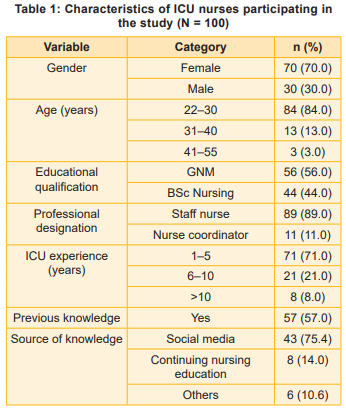
these participants, social media (75.4%) was the most frequently reported source of information, followed by continuing nursing education programmes (14.0%) (Table 1).
Perception Regarding ICU Psychosis
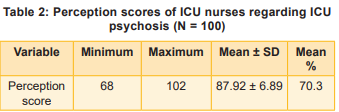
Overall, 70 percent of ICU nurses demonstrated an adequate perception regarding ICU psychosis, whereas 30 percent had a partially adequate perception. None of the participants exhibited an inadequate level of perception. The mean perception score was 87.92 ± 6.89, with scores ranging from 68 to 102, indicating a generally satisfactory understanding of ICU psychosis among the participants (Table 2).
Perceived Barriers to ICU Psychosis Assessment
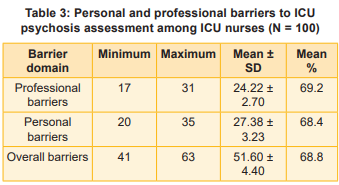
ICU nurses reported comparable levels of personal and professional barriers to the assessment of ICU psychosis. Professional barriers demonstrated a slightly higher mean percentage (69.2%) than personal barriers (68.5%).
Frequently reported professional barriers included inadequate staffing, excessive workload, lack of institutional protocols, and time constraints. Common personal barriers included insufficient knowledge, limited familiarity with delirium assessment tools, and inadequate educational preparation (Table 3).
Association between Demographic Variables and Perception
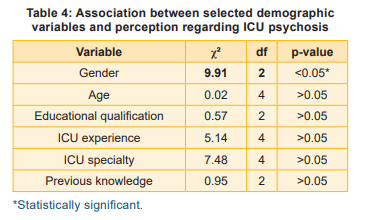
Chi-square analysis demonstrated a statistically significant association between gender and perception regarding ICU psychosis (χ² = 9.91, p <0.05). No statistically significant associations were observed between perception scores and age, educational qualification, ICU experience, ICU speciality, duty schedule, or previous knowledge regarding ICU psychosis (p > 0.05) (Table 4).
Association between Demographic Variables and Perceived Barriers
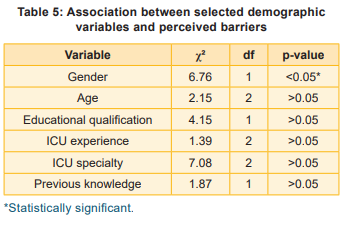
A statistically significant association was also identified between gender and perceived barriers (χ² = 6.76, p 0.05) (Table 5).
Discussion
The findings indicate that 70 percent of nurses demonstrated an adequate perception of ICU psychosis, while the remaining 30 percent had a partially adequate perception suggesting a generally satisfactory level of awareness, and that persistent knowledge gaps may influence the early recognition and management of delirium in critically ill patients.
The relatively high proportion of nurses with adequate perception is consistent with studies reporting increasing awareness of delirium among critical care nurses following wider dissemination of evidence-based recommendations and educational resources. Elliott (2014) reported that nurses recognised ICU delirium as an underdiagnosed condition and identified important knowledge deficits and perceived barriers to routine delirium screening among critical care professionals. Recent international guidelines (Devlin et al, 2018) emphasise that nurses are central to the routine assessment of delirium because of their continuous bedside presence and their ability to identify early cognitive changes. Nevertheless, the finding that nearly one-third of participants demonstrated only partially adequate perception suggests that knowledge has not been translated uniformly into clinical practice. This may reflect variations in educational preparation, limited exposure to structured delirium education, and inconsistent implementation of standardised assessment tools.
A major finding of the present study was that social media constituted the principal source of prior knowledge regarding ICU psychosis, whereas comparatively few nurses reported acquiring knowledge through continuing nursing education programmes, this has important implications in the Indian healthcare context.
Digital platforms provide rapid access to educational material and professional networking opportunities; however, the quality and scientific validity of information obtained through these sources are variable. Reliance on informal learning may therefore contribute to inconsistent knowledge and misconceptions regarding delirium assessment and management. Increasing access to structured continuing professional development programmes and evidence-based institutional training may help receive accurate and current information aligned with international clinical guidelines (Devlin et al, 2018; Marra et al, 2021).
The study also identified comparable levels of personal and professional barriers, indicating that both individual and organisational factors influence routine delirium assessment. Personal barriers included insufficient knowledge, limited familiarity with assessment tools, languagerelated challenges, and difficulty distinguishing ICU psychosis from other neurological conditions. Professional barriers included heavy workload, inadequate staffing, time constraints, limited interdisciplinary collaboration, and the absence of standardised institutional protocols. Similar barriers, where inadequate staffing, competing clinical priorities, and limited organisational support reduce compliance with routine delirium screening despite the availability of validated instruments have been reported (Trogrli? et al, 2015; Pun et al, 2019). These findings suggest that improving nurses’ knowledge alone may be insufficient unless accompanied by organisational changes that facilitate evidence-based practice.
Gender was the only demographic variable significantly associated with both perception and perceived barriers. Female nurses demonstrated higher perception scores while simultaneously reporting greater barriers to delirium assessment. Because female nurses constituted bulk of the study sample, this finding should be interpreted cautiously. The observed association may reflect greater clinical exposure, increased awareness of practice challenges, or differences in self-reporting rather than true gender-related differences in competency.
Comparable evidence regarding gender differences remains limited and inconsistent; therefore, additional multicentre studies are required to determine whether this association is reproducible in other clinical settings.
In contrast, no significant associations were observed between perception or barrier scores and age, educational qualification, ICU experience, ICU speciality, duty pattern, or previous knowledge regarding ICU psychosis.
Although several studies have reported that higher educational qualifications and longer critical care experience are associated with better delirium knowledge, the present findings suggest that knowledge gaps may be shared across different professional groups within the participating institutions. This may indicate limited availability of structured delirium education irrespective of professional experience, and reinforces the need for institution-wide educational initiatives rather than programmes targeted only to newly appointed nurses.
The present study contributes to the limited Indian evidence on ICU psychosis assessment by identifying educational and organisational barriers that influence routine delirium assessment. These findings provide practical evidence to support policy development, nursing education, and quality improvement initiatives in critical care settings.
From a clinical perspective, integrating validated delirium assessment tools such as the Confusion Assessment Method for the Intensive Care Unit or the Intensive Care Delirium Screening Checklist into routine nursing practice, supported by continuing education and institutional protocols, could improve early recognition and timely management of ICU psychosis. Strengthening interdisciplinary collaboration and ensuring adequate staffing may further reduce barriers to consistent delirium assessment, thereby enhancing patient safety and improving critical care outcomes (Devlin et al, 2018; Ely et al, 2001; Bergeron et al, 2001).
Strengths & Limitations
The study has several strengths. It addresses an underexplored area in Indian critical care nursing, utilises a content-validated questionnaire, and examines both nurses’ perceptions and perceived barriers within the same investigation. However, some limitations exist. The use of purposive sampling and recruitment from selected hospitals in a single district may limit the generalisability of the findings. The cross-sectional design precludes causal inference, and the use of self-reported data may have desirability bias. Besides, the moderate reliability coefficient of the questionnaire suggests that further psychometric refinement may enhance its precision in future studies.
Future research should include multicentre investigations involving larger and more diverse samples across different regions of India. Longitudinal and interventional studies evaluating the effectiveness of structured educational programmes, implementation of validated delirium screening protocols, and organisational strategies to reduce identified barriers are also recommended. Qualitative studies may further explore nurses’ experiences and contextual factors influencing routine delirium assessment, thereby informing interventions that are responsive to local healthcare settings.
Recommendations
- Structured continuing nursing education programmes on ICU psychosis and delirium assessment should be implemented to strengthen nurses’ knowledge and clinical competence. Healthcare institutions should incorporate validated delirium assessment tools, such as the Confusion Assessment Method for the Intensive Care Unit (CAM-ICU) or the Intensive Care Delirium Screening Checklist (ICDSC), into routine ICU practice through standardised protocols.
- Organisational barriers, including inadequate staffing, heavy workload, and limited access to training, should be addressed to facilitate consistent delirium assessment. Future multicentre studies involving larger and more diverse samples are recommended to evaluate the effectiveness of educational interventions and organisational strategies in improving delirium assessment practices and patient outcomes across Indian intensive care settings.
Conclusion
The present study demonstrated that most ICU nurses had an adequate perception of ICU psychosis; however, significant personal and professional barriers continue to hinder its routine assessment in critical care settings. Heavy workload, inadequate staffing, limited training, and the absence of standardised delirium assessment protocols emerged as the principal challenges. These findings highlight the need for structured continuing nursing education, implementation of validated delirium assessment tools, and institutional policies that support routine screening and early recognition of ICU psychosis.
Strengthening nurses’ competencies and addressing organisational barriers may facilitate evidence-based delirium assessment, ultimately improving patient safety and clinical outcomes in intensive care units. The study contributes valuable evidence to the limited Indian literature on ICU psychosis assessment and provides evidence to inform future educational, clinical, and organisational strategies for improving delirium assessment in Indian intensive care units.
1. Wilson JE, Mart MF, Cunningham C, Shehabi Y, Girard TD, MacLullich AMJ, et al. Delirium. Nat Rev Dis Primers 2020; 6(1): 90. https://doi.org/10.1038/s41572-020-00223-4
2. Devlin JW, Skrobik Y, Gélinas C, Needham DM, Slooter AJC, Pandharipande PP, et al Clinical practice guidelines for the prevention and management of pain, agitation/ sedation, delirium, immobility, and sleep disruption in adult patients in the ICU. Crit Care Med 2018; 46(9): e825-73
3. Kotfis K, Williams RS, Wilson JE, Dabrowski W, Pun BT, Ely EW. COVID-19: ICU delirium management during the pandemic. Crit Care 2020; 24(1): 176. doi:10.1186/ s13054-020-02882-x
4. Krewulak KD, Stelfox HT, Leigh JP, Ely EW, Fiest KM. Incidence and prevalence of delirium subtypes in an adult ICU: A systematic review and meta-analysis. Crit Care Med 2018; 46(12): 2029-35
5. Ely EW, Margolin R, Francis J, May L, Truman B, Dittus R, et al. Evaluation of delirium in critically ill patients: Validation of the confusion assessment method for the intensive care unit (CAM-ICU). Crit Care Med 2001; 29(7): 1370-79. doi:10.1097/00003246-200107000-00012
6. Bergeron N, Dubois MJ, Dumont M, Dial S, Skrobik Y. Intensive Care Delirium Screening Checklist: Evaluation of a new screening tool. Intensive Care Med 2001; 27(5): 859-64. doi: 10.1007/s001340100909
7. Bannon L, McGaughey J, Verghis R, Clarke M. Nurses’ knowledge and attitudes towards delirium in adult intensive care units: A systematic review. Int J Nurs Stud 2023;137: 104381
8. Marra A, Kotfis K, Hosie A, MacLullich AMJ, Pandharipande PP, Ely EW, et al. Delirium monitoring: Recent advances and future perspectives. Intensive Care Med 2021; 47(12): 1394-1407 9. Trogrli? Z, van der Jagt M, Bakker J, Balas MC, Ely EW, van der Voort PHJ, et al. A systematic review of implementation strategies for delirium assessment in intensive care units. Crit Care 2015; 19:157
10. Pun BT, Balas MC, Barnes-Daly MA, Thompson JL, Aldrich JM, Barr J, et al. Caring for critically ill patients with the ABCDEF bundle: Results of the ICU Liberation Collaborative in over 15000 Adults. Crit Care Med 2019; 47(1): 3-14
11. Lange S, Medrzycka-Dabrowska W, Friganovi? A, et al. Intensive care nurses’ knowledge and practices regarding delirium: A multicentre cross-sectional study. Int J Environ Res Public Health 2023; 20(3): 2215
12. Polit DF, Beck CT. Nursing Research: Generating and Assessing Evidence for Nursing Practice. 11th edn, 2021. Philadelphia: Wolters Kluwer
13. DeVellis RF, Thorpe CT. Scale Development: Theory and Applications. 5th edn. 2021. Thousand Oaks (CA): Sage Publications; 2021
14. World Medical Association. World Medical Association Declaration of Helsinki: Ethical principles for medical research involving human subjects. JAMA 2013; 310(20): 2191-94
15. Elliott SR. ICU delirium: A survey into nursing and medical staff knowledge of current practices and perceived barriers towards ICU delirium in the intensive care unit. Intensive Crit Care Nurs 2014; 30(6): 333-38. doi: 10.1016/j. iccn.2014.06.004
16. Alrawahi N, Viswam A, Elsheikh A. ICU nurses’ perception, knowledge, and barriers on delirium assessment. J Nurs Educ Pract 2022; 12(11): 64-73doi. 10.5430/jnep. v12n11p64

This work is licensed under a Creative Commons Attribution-NonCommercial-ShareAlike 4.0 International License.