
Percutaneous Catheter Drainage (PCD) is a minimally invasive image-guided procedure frequently used in the management of liver abscesses, pancreatic collections, biliary disorders, and other abdominal fluid accumulations. PCD has become an important therapeutic approach because of its minimally invasive nature and its role in effective drainage and clinical recovery. Although clinically effective, patients with an indwelling catheter require active participation in their care. Catheter management, monitoring of drainage and symptoms, medication adherence, nutrition and hydration, pain management, and recognition of potential complications require adequate knowledge and self-care skills. Inadequate self-care may interfere with recovery and functional independence. Self-care is an important component of nursing care, particularly when patients have temporary or continuing limitations in their ability to meet their self-care needs. Orem's Self-Care Deficit Nursing Theory emphasises the role of nursing in supporting patients when their self-care abilities are insufficient to meet their therapeutic self-care demands (Orem et al, 2001). Nurses play an important role in strengthening patients' ability to participate in their own care through structured education, demonstration, reinforcement, and supportive guidance. The use of structured self-care interventions may improve patients' knowledge, confidence, self-management skills, and functional independence. However, an important evidence gap remains regarding structured selfcare interventions specifically among patients undergoing PCD. Existing literature related to PCD has predominantly focused on procedural effectiveness, drainage outcomes, clinical recovery and complications, whereas comparatively less attention has been given to nursing interventions designed to improve self-care ability and activities of daily living in this population. Therefore, there is a need for a structured, patient-centred nursing intervention addressing the practical, physical and psychological aspects of self-care during catheter management.
Objectives
The study was carried out to:
1. Assess (a) self-care ability, and (b) activities of daily living, among patients undergoing Percutaneous Catheter Drainage.
2. Evaluate the effectiveness of structured selfcare intervention on (a) self-care ability, and (b) activities of daily living, among patients undergoing Percutaneous Catheter Drainage.
Materials and Methods
A quantitative research approach with a quasiexperimental, non-equivalent control-group pre-test–post-test design was adopted. A total of 80 patients with PCD were selected through non-probability purposive sampling. The samplesize estimation was based on the findings of Xu Wenhong et al (2016). Considering a 5 per cent level of significance (α=0.05) and 95 per cent study power (1−β=0.95), the minimum calculated sample size was 37 participants per group. After allowing 10 percent attrition, the sample was increased to 40 participants per group, resulting in a total sample of 80 participants.
Eligible participants were adults aged ≥18 years with PCD who were willing to participate and able to understand and respond to the study tools. Patients who were critically ill or haemodynamically unstable, had cognitive impairment or severe psychiatric illness, unable to communicate effectively, discharged before completion of the intervention period, or unwilling to participate, were excluded. Following enrolment, eligible participants were allocated to the experimental and control groups using a computer-generated random allocation sequence, with 40 participants in each group.
Data Collection
Data were collected from 21 June 2025 to 18 October 2025. After obtaining written informed consent, baseline socio-demographic and clinical information was collected using the Patient Clinical Profile Proforma.
Pre-test assessment of self-care ability and activities of daily living was conducted before intervention using the Structured Self-Care Ability Assessment Scale and Barthel Index, respectively.
Study Tools
Tool I: Patient Clinical Profile Proforma was used to collect relevant socio-demographic and clinical characteristics.
Tool II: Structured Self-Care Ability Assessment Scale was an investigator-developed 30-item scale based on Orem's Self-Care Deficit Nursing Theory, relevant literature, clinical guidelines and expert consultation. It covered six domains: catheter management, pain management, symptom monitoring, medication adherence, nutrition & hydration, and psychological wellbeing. Each item was scored dichotomously, with a total score ranging from 0 to 30.
Tool III: Barthel Index was used to assess activities of daily living. The index includes 10 areas of functional activity, with higher scores indicating greater functional independence (Mahoney & Barthel, 1965).
Validity and Reliability
Content validity was established through evaluation by seven experts from nursing and relevant clinical specialties. The Content Validity Index was 0.97 for the Patient Clinical Profile Proforma, 1.00 for the Structured Self-Care Ability Assessment Scale, and 0.95 for the Barthel Index.
Reliability was established using the testretest method. The reliability coefficient was 0.923 for the Structured Self-Care Ability Assessment Scale and 0.937 for the Barthel Index (p<0.001).
Structured Self-Care Intervention
The structured self-care intervention was developed based on Orem's Self-Care Deficit Nursing Theory, relevant literature and clinical guidelines, and was refined through expert consultation. The intervention comprised six components: catheter management, pain management, symptom monitoring, medication adherence, nutrition and hydration, and psychological well-being. The intervention was delivered individually by the investigator for 15-20 minutes daily during hospitalisation up to day 7 during catheter dressing. Education, demonstration, reinforcement and clarification were provided according to individual patient needs.
The experimental group received the structured self-care intervention in addition to routine hospital care. The control group received routine hospital care and standard nursing management according to institutional protocol. The structured intervention and intervention materials were restricted to the experimental group to minimise contamination.
Post-test assessment was conducted in both groups on the seventh day during catheter dressing using the same study instruments.
Ethical considerations:
Ethical approval was obtained from the College of Nursing Ethics Committee. Written informed consent was obtained from all participants. Confidentiality and anonymity were maintained throughout the study.
Statistical Analysis
Data were analysed using Statistical Package for the Social Sciences (SPSS), version 20. Frequency, percentage, mean and standard deviation were used for descriptive analysis. Paired t-test and independent t-test were used for comparison of outcome scores. Chi-square test and analysis of variance were used for appropriate categorical and association analyses. A p-value <0.05 was considered statistically significant.
Results
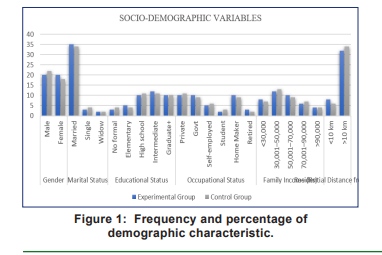
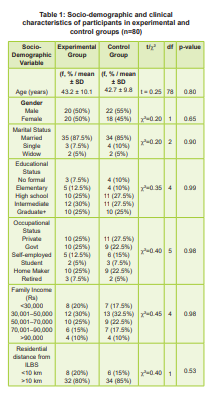
Baseline assessment revealed that the experimental and control groups were comparable with respect to selected socio-demographic and clinical characteristics, with no statistically significant difference between the groups (Table 1). Range, mean percentage and mean difference of self-care ability domain within experimental and control groups is shown in Table 2. Demographic features of both groups are in Fig 1.
Baseline assessment revealed that the experimental and control groups were comparable with respect to selected socio-demographic and clinical characteristics, with no statistically significant difference between the groups.
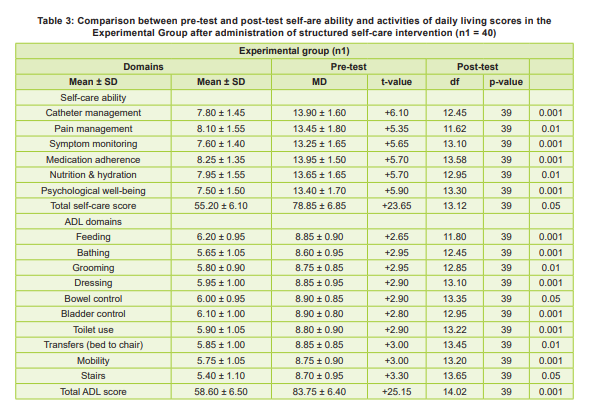
Activities of daily living also improved substantially in the experimental group. The mean ADL score increased from 58.60±6.50 at pre-test to 83.75±6.40 at post-test, whereas the control group showed minimal change from 59.15±6.75 to 60.05±6.60 (Table 3).
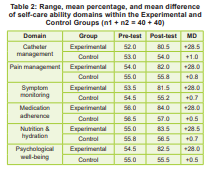
Post-test comparison demonstrated higher selfcare ability and activities of daily living scores in the experimental group compared with the control group. The statistical analysis demonstrated a significant difference in the post-test outcome scores between the two groups.
Discussion
The present study demonstrated that the structured self-care intervention significantly improved self-care ability and activities of daily living among patients undergoing PCD. The experimental group showed a marked improvement in self-care ability, with the mean score increasing from 55.20±6.10 to 78.85±6.85, while only minimal improvement was observed in the control group. The improvement may be attributed to systematic education, demonstration, reinforcement and individualised guidance related to catheter care and symptom management.
The intervention addressed six important areas of self-care: catheter management, pain management, symptom monitoring, medication adherence, nutrition and hydration, and psychological well-being. Addressing these areas together may have enabled participants to develop greater confidence and ability to participate actively in their own care.
The findings are consistent with Orem's SelfCare Deficit Nursing Theory, which emphasises the role of nursing in supporting individuals when their self-care abilities are insufficient to meet their self-care demands (Orem et al, 2001). In the present study, the structured intervention provided supportive and educational nursing assistance aimed at strengthening patients' selfcare capabilities. Activities of daily living also demonstrated substantial improvement in the experimental group, with the mean score increasing from 58.60±6.50 to 83.75±6.40. This improvement may be related to better symptom management, improved confidence in catheter-related care, and greater participation in daily activities following the intervention.
The greater improvement observed in the experimental group compared with routine care suggests that structured and individualised selfcare education may provide additional benefits beyond standard nursing care. The findings support the integration of structured self-care education into routine nursing management for patients with PCD.
Strengths and Limitations
The study evaluated a structured, individualised and theory-based self-care intervention using a pre-test–post-test comparison between experimental and control groups. Both self-care ability and activities of daily living were assessed using instruments with established validity and reliability.
The study was conducted at a single tertiary-care centre with a relatively small sample and purposive sampling, which may limit generalisability. Posttest assessment was conducted on the seventh day; therefore, the sustainability of intervention effects over a longer period could not be established.
Nursing Implications
The findings have implications for nursing practice, education, administration and research.
In nursing practice: Structured self-care interventions may be incorporated into routine care for patients undergoing PCD to strengthen self-management and functional independence. In nursing education: The findings support the inclusion of evidence-based patient education and discharge-planning strategies in nursing education and continuing professional development.
In nursing administration: Standardised selfcare protocols and educational materials may be developed to facilitate consistent patient education.
In nursing research: The findings provide a basis for future studies involving larger samples, multicentre settings, longer follow-up and technology-assisted self-care interventions.
Conclusion
The study concluded that the structured self-care intervention was effective in improving self-care ability and activities of daily living among patients undergoing PCD. The substantial improvement observed in the experimental group compared with routine care suggests that structured, individualised self-care education may strengthen patients' ability to participate in their care and improve functional independence. Incorporation of structured self-care interventions into routine nursing care may support recovery and improve patient outcomes among individuals undergoing PCD.
Acknowledgement: The investigators express sincere gratitude to the authorities of the Institute of Liver and Biliary Sciences, New Delhi, the College of Nursing Ethics Committee, nursing personnel, and all participants for their cooperation and support during the conduct of the study.
1. Orem DE, Taylor SG, Renpenning KM. Nursing: Concepts of Practice. 6t h edn, St Louis (MO); Mosby, 2001
2. Tanaka Maki. Orem's nursing self-care deficit theory: A theoretical analysis focusing on its philosophical and sociological foundation. Nurs Forum 2022 May; 57(3): 480- 85. doi: 10.1111/nuf.12696
3. Lin JW, Chen CT, Hsieh MS, Lee IH, Yen DHT, Cheng HM, et al. Percutaneous catheter drainage versus percutaneous needle aspiration for liver abscess: A systematic review, meta-analysis and trial sequential analysis. BMJ Open 2023 Jul 30; 13(7): e072736. doi:10.1136/bmjopen-2023-072736
4. Al-Sayaghi KM, Alhujaily M, Zaky MK, Alhasan AS, Babikir TB, Alnehmi FS, et al. Percutaneous needle aspiration versus catheter drainage in the management of liver abscess: An updated systematic review and meta-analysis. ANZ Journal of Surgery 2023 Apr; 93(4): 840-50
5. Van Sonnenberg E, Ferrucci JT, Mueller PR, Wittenberg J, Simeone JF. Percutaneous drainage of abscesses and fluid collections: technique, results, and applications. Radiology 1982 Jan; 142(1): 1-10. doi:10.1148/radiology.142.1.7053517
6. Choudhary S, Gupta P, Shah J, Singh A, Jearth V, Samanta J, et al. Role of imaging in evaluating the complications of endoscopic management of pancreatic fluid collections in acute pancreatitis. Abdominal Radiology (New York) 2024 Jul; 49(7): 2449-58. doi:10.1007/s00261-024-04348-y
7. Ganaie KH, Choh NA, Parry AH, Shaheen FA, Irfan Robbani, Gojwari TA, et al. The effectiveness of image-guided percutaneous catheter drainage in the management of acute pancreatitis-associated pancreatic collections. Polish Journal of Radiology 2021 Jun 15; 86: 359-65. doi:10.5114/ pjr.2021.107448
8. Smallfield S, Fang L, Kyler D. Self-Management interventions to improve activities of daily living and rest and sleep for adults with chronic conditions: A systematic review. American Journal of Occupational Therapy 2021 Jul 1; 75(4): 7504190010p1-21. doi:10.5014/ajot.2021.046946
9. Lorig KR, Holman HR. Self-management Education: History, definition, outcomes, and mechanisms. Annals of Behavioral Medicine 2003 Aug; 26(1): 1-7 doi:10.1207/ s15324796abm2601_01 10. Matarese M, Lommi M, De Marinis MG, Riegel B. A systematic review and integration of concept analyses of self-care and related Concepts. Journal of Nursing Scholarship 2018 Apr 12; 50(3): 296-305 doi:10.1111/jnu.12385
11. Riegel Barbara, Jaarsma Tiny, Stromberg. A middle-range theory of self-care of chronic illness. ANS Adv Nurs Sci [Internet] 2012 Jul [cited 2026 Aug 12]. Available from: https:// pubmed.ncbi.nlm.nih.gov/22739426/
12. Mahoney FI, Barthel DW. Functional evaluation: The Barthel Index. Maryland State Medical Journal [Internet] 1965 Feb 1 [cited 2026 Aug 12]; 14: 61-65. Available from: https:// pubmed.ncbi.nlm.nih.gov/14258950/
13. Motamed-Jahromi M, Kaveh MH. Effective interventions on improving elderly’s independence in activity of daily living: A systematic review and logic model. Frontiers in Public Health 2021 Feb 15; 8 (516151). doi:10.3389/fpubh.2020.516151
14. Hartweg DL, Metcalfe SA. Orem’s self-care deficit nursing theory: Relevance and need for refinement. Nursing Sci Quarterly 2021 Dec 23; 35(1): 70-76. doi:10.1177/08943184211051369

This work is licensed under a Creative Commons Attribution-NonCommercial-ShareAlike 4.0 International License.