Pregnancy is a normal life event that involves considerable physical and psychological adjustments for the mother (Ricci, 2016). From conception to birth, a woman’s body goes through a number of astonishing changes as it prepares to carry and grow a new life (Zhu et al, 2020). The substantial burden of maternal and foetal mortality continuously challenges healthcare in whole world. Many of the adverse outcomes during pregnancy can be prevented and controlled through the provision of advanced maternal care services (Bale et al, 2003). In December 2019, first case of a novel coronavirusassociated pneumonia was reported in Wuhan City, China. This new coronavirus disease was termed Coronavirus Disease-19 (COVID-19) by the World Health Organisation (WHO) on 11 February 2020, and announced as a Pandemic in March 2020 (Hanaei et al, 2020). As of 21 April 2020, COVID-19 had reached all over the world, with about 1, 80,000 deaths of a total of more than 2 million confirmed cases. Studies estimate the real mortality rate to be about six percent in China, rising to about 15 percent in other countries (Aleebrahim-Dehkordi et al, 2020).
Coronaviruses are enveloped, non-segmented, single-stranded ribonucleic acid (RNA) viruses causing disease from common colds to severe fatal diseases. The two best known fatal viruses are SARS-Cov, which causes severe acute respiratory syndrome (SARS), and MERS-CoV, which causes middle east respiratory syndrome (MERS). Pregnant women may be susceptible to developing more severe symptoms after infection with respiratory viruses. Due to physiological changes of the immune and cardiopulmonary systems during pregnancy (Jamieson et al, 2006). Global maternal and foetal outcomes have worsened during the COVID-19 pandemic, with an increase in maternal deaths, stillbirth, ruptured ectopic pregnancies and maternal depression (Chmielewska et al, 2021). It is well known that pregnancy alters the immune system and its response to viral infection, and infection with coronavirus, could lead to more severe symptoms, especially in third trimester.
A retrospective comparison of pregnancy outcomes done between 16 women with COVID19 and 45 women without COVID-19 in order to study the effect of COVID-19 on pregnancy outcomes and neonatal prognosis showed that none progressed to critical pneumonia. Ten cases of neonates delivered from pregnant women with COVID-19 were collected, nucleic acid tests were all negative. There was no significant difference in foetal distress, meconium-stained amniotic fluid, pre-term birth and neonatal asphyxia between two group (all p>0.05) (Zhang et al, 2020).
During the 2020 COVID-19 pandemic, the rate of gestational diabetes mellitus (GDM) rose significantly compared to 2019, with a sharp spike during the last 5 to 6 months of the year. This jump occurred because those mothers spent their crucial first trimester of pregnancy under strict lockdown conditions. The increase was completely independent of traditional risk factors like maternal age or weight, as the 2019 control group showed perfectly steady rates all year. Ultimately, the sudden spike was driven by pandemic-induced lifestyle changes, specifically a drastic reduction in physical activity, altered eating habits, and high stress levels that naturally raised maternal blood sugar (Zanardo et al, 2021).
The outcome of pregnant women with COVID19 infection and its effect on the growing foetus remains unclear. The review of relevant articles shows different findings and contradictory outcomes which makes one difficult to arrive at a conclusion. Still studies are going on, as only a little is known about COVID-19 itself. It indicates that there is a need to update the knowledge about the effect of COVID-19 in pregnancy and its outcome on maternal and neonatal health. Hence this study was undertaken.
Objectives
This study aimed to assess the (1) maternal outcome among post-COVID women, and (2) outcome of neonates born to post-COVID women.
Materials and Methods
A quantitative non-experimental approach was used in this study to assess the maternal outcome among post-COVID women and the outcome of neonates born to post-COVID women in Baby Memorial Hospital, Kozhikode (Kerala). The sample of 272 mothers and their newborns were selected for the study, in which 136 mothers had COVID19 infection in pregnancy and 136 mothers did not had COVID-19 infection in pregnancy. For each subject in the study cohort matching was done based on parameters such as age and parity.
Sampling technique used was consecutive sampling method. The tool used consisted of personal and clinical data sheet, maternal outcome data sheet and neonatal outcome data sheet which were prepared by the researcher. Content validity of tool was validated by eight experts from nursing and one from medicine. Inter-rater reliability was assessed which was 1.000 for all three tools. Before starting the actual data, pilot study was conducted to test the feasibility of the study, and permission obtained from concerned authorities. Ensuring confidentiality, the actual data were collected between 27 March 2023 and 22 April 2023 from Medical Records of Baby Memorial Hospital, Kozhikode.
Results
The study was conducted among 272 participants (136 women with COVID-19 infection and their newborn as study cohort and 136 women without COVID-19 infection and their newborn as comparison group). Mean maternal age in study cohort was 27.90, in comparison group it was 27.66. Majority of the mothers (89.7%) in study cohort acquired COVID-19 infection in third trimester; over half of them (56.9%) were asymptomatic. Among mothers with symptoms, over a fifth (20.6%) experienced cough; second most common symptom was fever (17.6%). The tie of onset of COVID-19 symptoms, signs and symptoms of COVID-19 and COVID-19 status of neonates was assessed only in study cohort.
Analysis of association between COVID-19 and selected maternal variables such as elevated antenatal temperature, antenatal tachycardia, antenatal tachypnoea, elevated WBC count, thrombocytopenia, decreased foetal movements, anaemia, gestational diabetes mellitus, antenatal hospitalisation, receiving antibiotic therapy, antenatal ICU admission, intranatal tachycardia and tachypnoea, mode of delivery–LSCS and post-natal elevated temperature, post-natal tachycardia, tachypnoea, hypertension, puerperal pyrexia and post-natal ICU admission. A p-value below 0.05 indicated a significant association between COVID-19 and selected variables.
For the remaining variables which include antenatal oxygen saturation, fasting blood sugar, post-prandial blood sugar, HbA1C, abnormal ultrasound report, antepartum haemorrhage, oligohydramnios, polyhydramnios, gestational hypertension, pre- eclampsia, HELLP syndrome, hypothyroidism, disseminated intravascular coagulation, epigastric pain, pancreatitis, receiving antiviral therapy, antenatal blood transfusion, antenatal artificial ventilation, elevated intranatal temperature, intranatal
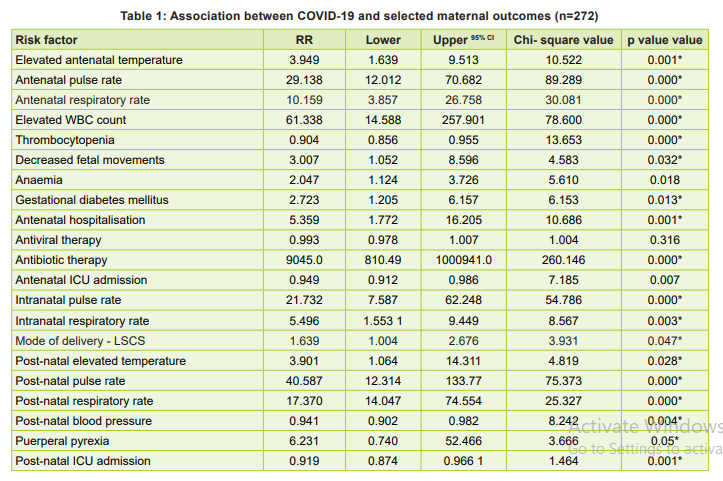
oxygen saturation, intranatal PPH, intranatal ICU admission, post-natal oxygen saturation, post-natal PPH, post-natal blood transfusion and post-natal artificial ventilation, the p-value was more than 0.05, hence no significant association of COVID-19 was noticed to exist with selected maternal outcome (Table 1).
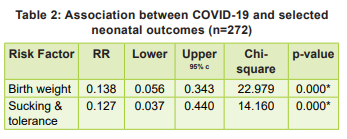
COVID-19 infection during pregnancy is significantly linked to lower birth weights and difficulties with infant sucking and breast milk tolerance (p 0.05) was found with conditions like foetal distress, growth retardation, respiratory distress, neonatal asphyxia, or congenital anomalies. Additionally, COVID-19 did not significantly increase the risk of early newborn death, the need for surfactant therapy, or NICU admissions (Table 2).
Discussion
Majority of the mothers (89.7%) in our study of cohort developed COVID-19 during third trimester. Similar observations were found in a study at Zhongnan Hospital of Wuhan University, China where majority of participants between 36-39 weeks were affected (Cao et al, 2020). Most mothers in our study (59.6%) were asymptomatic. This finding mirrors a study at Tata Main Hospital, Jamshedpur, which reported that the majority of pregnant women with COVID-19 were asymptomatic despite hepatic complications (Molina et al, 2022).
In this study, COVID-19 was strongly associated with gestational diabetes mellitus (RR 2.72, 95% CI, 1.20 - 6.15). In a systematic review to assess impact of COVID-19 on pregnancy outcome, Wastnedge et al (2021) also showed strong association with gestational diabetes mellitus (OR 1.99, 95% CI 1.09 to 3.64).
According to this study, 20.6 percent of mothers had cough, 1.5 percent of women received antiviral therapy, and rest of patients received antibiotic therapy, 0.7 percent needed ICU admission, no maternal mortality, increased Caesarean section (62.2%), when compared to comparison group. All neonates were negative for COVID19. The rate of neonatal NICU admission was 6.0 percent while in a prospective cohort study conducted in Turkey to update experience of a tertiary pandemic centre on 533 pregnant women with COVID-19, 30.9 percent were asymptomatic but 33.4 percent women had cough. 48.9 percent women received COVID-19 therapy and 1.3 percent needed ICU admission; maternal mortality was observed in 0.4 percent cases. Caesarean section rate was 66.4 percent. All neonates were negative for COVID-19. The rate of admission to neonatal NICU was 99 percent (Yang et al, 2020).
In this study, two (1.5%) were severe cases, Caesarean section (66.2%) was more among study cohorts and all the neonates were tested negative. Similarly, the analysis of pregnancy outcomes of pregnant women with COVID-19 showed that all were ordinary cases except one which required ICU admission, most of the participants had cesarean section. All the neonates born to mothers with COVID-19 were negative for SARS-CoV-2 infection (Blitz et al, 2020). Neonatal birth weight was found in association with COVID 19 (RR 0.13 95% CI 0.05 to 0.34) with chi-square value p<0.05. But a contradictory finding was reported by Cribiù et al (2022) in a study in Bangladesh to assess birth outcomes among pregnant women with and without COVID-19, with no significance with COVID-19.
Recommendation A similar study can be conducted (a) in different settings with a large sample size, (b) prospectively so that long term outcomes can be measured.
An exploratory study can be conducted to identify effect on pregnancy.
Nursing Implication The educational system needs to prepare the nurses to provide a comprehensive approach to antenatal care. They should be trained to provide quality care in labour room and NICU and during post-natal period.
Nurse administrators should be made aware of the quality antenatal services so as to alleviate complications of COVID-19 in pregnancy.
In-service education for the nursing officers is essential to update their knowledge and skill in identification and prevention complications and ensuring quality care services.
As the backbone of the health care system, nurses should take initiatives to conduct further studies.
Conclusion
Maternal vital signs, antenatal hospitalisation, decreased foetal movements, metabolic conditions like GDM are linked with COVID-19 infection. It also increases risk for antenatal hospitalisation and undergoing procedures like lower segment Caesarean section. Neonatal birth weight can also be influenced by COVID-19 infection.
1. Ricci S. Essentials of Maternity, Newborn, and Women’s Health Nursing - 12 Month Access Card Stand Alone Edition. Lippincott Williams & Wilkins; 2016
2. Zhu N, Zhang D, Wang W, Li X, Yang B, Song J, et al. A novel coronavirus from patients with pneumonia in China, 2019. N Engl J Med 2020 Jan 24; 382(8): 727-33
3. Bale JR, Stoll BJ, Lucas AO (ed). Improving Birth Outcomes: Meeting the Challenge in the Developing World. Institute of Medicine (US) Committee on Improving Birth Outcomes. Washington (DC): National Academies Press (US); 2003 [Improving Birth Outcomes:]
4. Hanaei S, Rezaei N. COVID-19: Developing from an outbreak to a pandemic. Arch Med Res 2020 May; 51(6): 582-84
5. Aleebrahim-Dehkordi E, Soveyzi F, Deravi N, Rabbani Z, Saghazadeh A & Rezaei N. Human coronaviruses SARS-CoV, MERS-CoV, and SARS-CoV-2 in children. J Pediatr Nurs 2021 Jan-Feb; 56: 70-79
6. Jamieson DJ, Theiler RN, Rasmussen SA. Emerging infections and pregnancy. Emerge Infect Dis 2006 Nov; 12(11): 1638-43
7. Chmielewska B, Barratt I, Townsend R, Kalafat E, van der Meulen J, et al. Effects of the COVID-19 pandemic on maternal and perinatal outcomes: A systematic review and metaanalysis. Lancet Glob Health 2021 Jun; 9(6): 759-72
8. Zhang L, Jiang Y, Wei M, Cheng BH, Zhou XC, Li J, et al. Analysis of the pregnancy outcomes in pregnant women with COVID-19 in Hubei Province. Zhonghua Fu Chan Ke Za Zhi 2020 Mar 25; 55(3): 166-71
9. Zanardo V, Tortora D, Sandri A, Severino L, Mesirca P, Straface G. COVID-19 pandemic: Impact on gestational diabetes mellitus prevalence. Diabetes Res Clin Pract 2021 Nov 19; 183. doi: 10.1016/j.diabres.2021.109149
10. Cao D, Yin H, Chen J, Tang F, Peng M, Li R, et al. Clinical analysis of ten pregnant women with COVID-19 in Wuhan, China: A retrospective study. Int J Infect Dis 2020 Jun; 95:294- 300
11. Molina RL, Tsai TC, Dai D, Soto M, Rosenthal N, Orav EJ, et al. Comparison of pregnancy and birth outcomes before vs during the COVID-19 pandemic. JAMA Netw Open 2022 Aug 12; 5(8): e2226531
12. Wastnedge EAN, Reynolds RM, van Boeckel SR, Stock SJ, Denison FC, Maybin JA, et al. Pregnancy and COVID-19. Physiol Rev 2021 Jan 1; 101(1): 303-18
13. Yang P, Wang X, Liu P, Wei C, He B, Zheng J, et al. Clinical characteristics and risk assessment of newborns born to mothers with COVID-19. J Clin Virol 2020 Jun 1; 127:104356
14. Blitz MJ, Grünebaum A, Tekbali A, Bornstein E, Rochelson B, et al. Intensive care unit admissions for pregnant and nonpregnant women with coronavirus disease 2019. Am J Obstet Gynecol 2020 Aug 1; 223(2): 290-91
15. Cribiù FM, Erra R, Pugni L, Rubio-Perez C, Alonso L, et al. Severe SARS-CoV-2 placenta infection can impact neonatal outcome in the absence of vertical transmission. J Clin Invest 2021 Mar 15; 131(6): e145427

This work is licensed under a Creative Commons Attribution-NonCommercial-ShareAlike 4.0 International License.