
GGender-affirming healthcare includes a wide range of services such as hormone therapy, mental health counselling, voice therapy, preventive health services, and gender-affirming surgical consultations that help individuals align their physical characteristics and healthcare needs with their gender identity (Duffy et al, 2025). However, access to such services remains uneven across regions due to limited availability of trained providers, geographic barriers, financial constraints, and institutional discrimination within healthcare systems (Grasso et al, 2022).
Telehealth has emerged as a promising strategy to address barriers to gender-affirming healthcare by enabling remote delivery of medical services through digital technologies. It includes modalities such as video consultations telemedicine platforms, mobile health (mHealth) applications, remote monitoring tools, and electronic consultation systems that connect patients and providers across geographic boundaries and support services such as medical consultations, mental health support, and hormone therapy management, without requiring in-person visits (Dowshen & Lett, 2022). The integration of telehealth into genderaffirming care gained particular attention during the COVID-19 pandemic, when healthcare systems rapidly transitioned to virtual service delivery models to maintain continuity of care (Hertling et al, 2021; Kloer et al, 2023). Studies indicate that telehealth can reduce travel burden, lower healthcare costs, improve appointment adherence, and increase access to specialised providers (Apple et al, 2022).
A scoping review by Pandya & Redcay (2021) found that most studies focus on HIV-related care, mental health services, and gender-affirming interventions. However, reviews related to the accessibility of telehealth for gender affirming services are limited. Recent studies from highincome countries have demonstrated the potential of telehealth to improve access to hormone therapy, counselling, HIV prevention, and provider training among transgender population (Blosnich et al, 2019; Nightingale et al, 2025). However, the applicability of these findings to low- and middleincome countries remains uncertain.
Objectives
This review attempted to synthesise the role of telehealth in improving access to genderaffirming healthcare services for transgender and gender-diverse individuals. The guiding research question is: How does telehealth improve access to evidence-based gender-affirming healthcare?
Methods & Materials
This study employed a narrative review design to allow for a comprehensive overview of emerging evidence, diverse study designs, and evolving digital health interventions in transgender healthcare. It considered studies that examined telehealth, telemedicine, mobile health (m-health), or other digital health technologies in delivering gender-affirming healthcare services, such as hormone therapy, mental healthcare, surgical consultations, HIV prevention services, counselling, and other supportive or multidisciplinary services delivered through virtual platforms. Quantitative, qualitative, and mixed-methods research studies published in peer-reviewed journals and some grey literature published between 2019 and 2026 were included, with no geographical restrictions. Only Englishlanguage articles were considered. Editorials, commentaries, or opinion pieces lacking empirical data or analysis were excluded.
A comprehensive literature search was conducted using PubMed and ScienceDirect. These searches were also supplemented with Google Scholar. The Boolean search method was applied using “AND” and “OR” to combine three key concepts: population (transgender and gender-diverse individuals), exposure (telehealth, telemedicine, and digital health technologies), and outcome (access to gender-affirming healthcare).
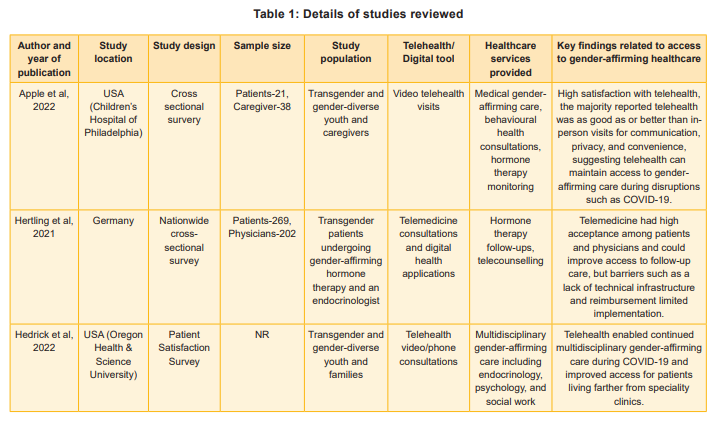
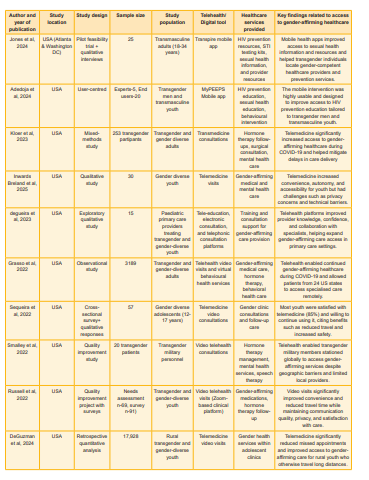
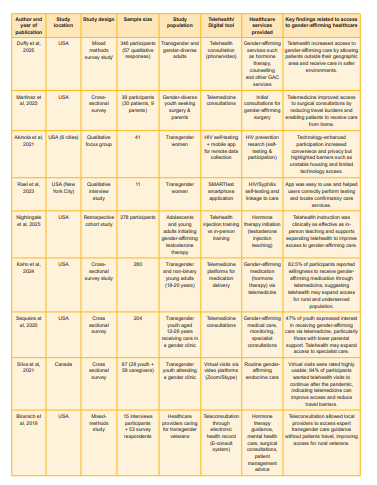
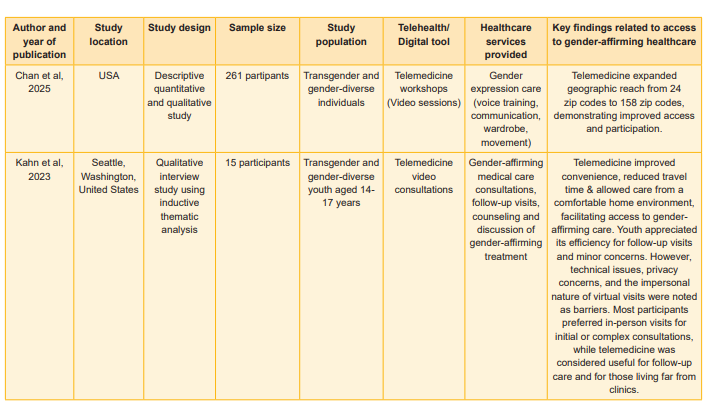
Approaching the screening for relevance phase, duplicates were removed by reviewing titles and abstracts; relevant studies were then screened for eligibility, and full texts were assessed against the inclusion criteria. Grey literature sources, including relevant websites, were also screened. The characteristics of the included studies are mentioned in Table 1. No formal quality assessment was conducted; however, studies were considered based on methodological rigour, their relevance, clarity of findings, and credibility of data sources.
Results
A total of 24 studies, published between 2019 and 2026, were included in this review, comprising quantitative (12), mixed-methods (6), and qualitative (6) These small to large observational studies, with varying sample sizes, were conducted across diverse geographical regions and global settings including individuals accessing telehealth services. The study populations primarily included transgender and gender-diverse youth, adults seeking gender-affirming care, healthcare providers, and caregivers of transgender youth (Silva et al, 2021; Apple et al, 2022).
Telehealth modalities examined across the studies included video consultations, telemedicine clinics, electronic consultations, mobile health applications, tele-education platforms, and remote counselling services (Blosnich et al, 2019; Sequeira et al, 2023). The services delivered through telehealth encompassed genderaffirming hormone therapy management, mental health counselling, surgical consultations, sexual health services, HIV prevention interventions, and provider training programme (Grasso et al, 2022; Nightingale et al, 2025; Jones et al, 2023). The findings of the included studies were synthesised into five major themes that capture the role of telehealth in improving access to gender-affirming healthcare. The thematic framework for telehealth to improve access to gender-affirming healthcare is depicted in Fig 1.
Several telehealth tools and digital platforms were used to deliver gender-affirming healthcare services. The most common modality was videobased telemedicine, enabling remote interactions between patients and healthcare providers for routine consultations, follow-ups, and mental health services (Martínez et al, 2023; Silva et al, 2021; Apple et al, 2022). Paediatric gender clinics also implemented video visits for hormone therapy management and follow-up monitoring (Hedrick et al, 2022; Russell et al, 2021). Mobile health (m-health) applications and digital interventions were used to support sexual health education and HIV prevention among transgender populations (Jones et al, 2023; Adedoja et al, 2024). Smartphone applications such as HIV testing support tools enabled users to receive instructions, interpret results, and connect with healthcare providers remotely (Rael et al, 2023). Telehealth platforms were also used to provide multidisciplinary services, including mental health counselling, gender-affirming hormone therapy monitoring, speech therapy, and social transition support. Some telehealth programmes also incorporated a teleeducation and training platform to enhance healthcare providers’ competence in delivering gender affirming care.
Benefits of Telehealth for Gender-Affirming Healthcare Access
One of the most significant benefits was the reduction of geographic barriers to care. Telehealth
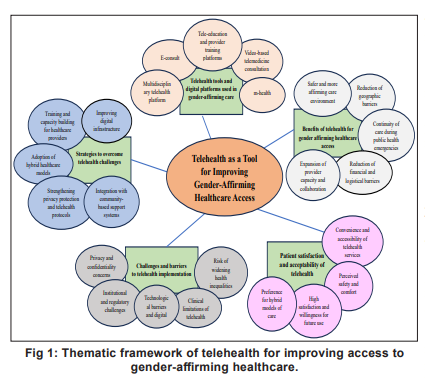
enabled transgender individuals living in rural or underserved areas to access specialised genderaffirming care providers without the need for long-distance travel. Telemedicine programmes allowed patients from multiple states and regions to access gender-affirming services remotely. Telehealth also improved continuity of care during the COVID-19 pandemic, when many in-person healthcare services were disrupted (Hedrick et al, 2022). Telehealth was particularly valued by individuals who experienced stigma or discrimination in traditional healthcare settings. Another key benefit was the reduction of financial and logistical barriers to healthcare. Telemedicine reduced travel time, transportation costs, and missed work or school days associated with in-person visits (Martínez et al, 2023). It also facilitated provider training and collaboration, enabling healthcare providers to access specialists and improve their knowledge of gender-affirming care (Blosnich et al, 2019; Sequeira et al, 2023).
Patient satisfaction and acceptability of telehealth: Most receivers found gender-affirming virtual consultations & care convenient, safe, and comparable to in-person visits (Silva et al, 2021; Apple et al, 2022). Virtual gender clinic visits were also rated highly for usability and reliability, with many participants preferring a hybrid model combining telehealth and in-person care. Qualitative studies further highlighted the perceived benefits of telehealth, including improved comfort, reduced stigma, and increased flexibility in accessing care (Sequeira et al, 2021).Telehealth was particularly valued among transgender youth who experienced anxiety or discrimination in traditional healthcare environments.
Technological barriers to telehealth implementation: These included limited internet connectivity, lack of access to digital devices, and low digital literacy, particularly among individuals living in rural or economically disadvantaged communities (Hertling et al, 2021). Privacy concerns also emerged as a significant barrier. Some transgender youth reported difficulties discussing sensitive health issues during telehealth visits when family members were present at home (Silva et al, 2021). Similarly, participants expressed concerns about maintaining confidentiality during virtual consultations.
Healthcare providers also reported institutional and regulatory challenges, including reimbursement limitations, lack of telehealth infrastructure, and training in telemedicine technologies. Another challenge involved the limitations of telehealth for certain clinical assessments. Some participants preferred in-person visits for initial evaluations, physical examinations, or complex medical procedures (Marinkovic et al, 2025). So, disparities in technology access & digital inclusion were identified as potential barriers that could worsen existing health inequalities among marginalised transgender populations (Apple et al, 2022). Strategies to overcome telehealth challenges in gender-affirming healthcare include improving digital infrastructure and access to technology, both identified as key to expanding telehealth accessibility.
Ensuring affordable internet access and providing digital devices to underserved populations may help reduce the digital divide (Hertling et al, 2024). Training programmes for healthcare providers were also recommended to improve provider competency in telehealth and gender-affirming care (Sequeira et al, 2023). Tele-education platforms can support healthcare providers in developing the skills needed to deliver gender-affirming services remotely.
Many studies recommended adopting hybrid healthcare models that combine telehealth with in-person visits. Hybrid models allow patients to receive routine follow-up care remotely while attending in-person appointments for physical examinations or specialised procedures. Improving privacy protections and telehealth protocols was also suggested to ensure that patients feel safe and comfortable during virtual consultations. Integrating telehealth with community-based support programmes and digital health interventions may further improve engagement with transgender communities and enhance healthcare accessibility.
Discussion
Our results highlighted high levels of patient satisfaction and acceptability associated with telehealth-delivered gender-affirming care. The findings are consistent with previous research, indicating that digital and telehealth interventions play an important role in improving access to gender-affirming healthcare for transgender and gender-diverse populations. The results align with previous literature, which states that telemedicine has the potential to improve accessibility and continuity of gender-affirming care while maintaining acceptable levels of patient satisfaction and feasibility (Stoehr et al, 2022). Similarly, the current review found that telehealth services enabled individuals living in rural or underserved areas to access gender-affirming healthcare providers without extensive travel.
Previous research also demonstrated that telehealth services are particularly valuable for individuals facing structural barriers to healthcare access, including limited provider availability and geographic distance (Sequeira et al, 2021; McGregor et al, 2023). Sequeira et al (2022) and McGregor (2023) also identified high satisfaction and strong acceptability of telehealth-based gender-affirming care among both patients and caregivers. Previous research has highlighted the growing role of digital health resources and online educational materials in supporting access to gender-affirming healthcare. Nguyen et al (2025) suggest that most online patient education materials for gender-affirming surgery are written at readability levels far above recommended health literacy standards, with a pooled Flesch-Kincaid Grade Level of approximately 12.49, indicating that many resources require college-level literacy to understand. Privacy concerns have also been noted, particularly among transgender youth participating in telehealth consultations within shared home environments (Williams et al, 2023). Telehealth may unintentionally widen healthcare disparities for individuals who lack adequate technological resources. Consequently, telehealth appears most effective when integrated within hybrid models that combine virtual services with opportunities for in-person care.
Previous studies highlight the importance of culturally competent and inclusive health information for transgender and genderdiverse communities, who often face stigma, discrimination, and limited provider knowledge in traditional healthcare settings. Telehealth offers a more accessible, private, and affirming alternative, and improves access to care and helps in reducing stigma-related barriers. However, most studies were conducted in high-income countries, which may limit the generalisability of results to other settings.
Implications
Telehealth can expand access by connecting patients with trained providers regardless of geographic location, particularly in undeserved areas. It also enhances patient engagement and continuity of care by reducing travel time, financial burden, and logistical barriers.
Future Research Direction
Future research should focus on evaluating the long-term effectiveness of telehealth in genderaffirming care and its impact on health outcomes and quality of life. Additional studies are needed to examine telehealth implementation across diverse geographical contexts, particularly in low- and middle-income countries, Further, investigating hybrid models that combine telehealth and inperson care may help optimise comprehensive gender-affirming healthcare.
Conclusion
Telehealth has strong potential to improve access to gender-affirming healthcare by addressing structural, geographical, and financial barriers. Despite challenges such as technological access, privacy, and clinical limitations, its integration can support more equitable and inclusive healthcare delivery.
1. Duffy CMC, Wall CSJ, Cull SL, Otieno JA, Schult D, Mardigian FR, et al. Improving access to gender-affirming care: A mixed-methods exploration of the role of telehealth. Ann Behav Med 2025 Jan 4; 59(1): kaaf074. doi:10.1093/abm/kaaf074
2. Grasso C, Campbell J, Yunkun E, Todisco D, Thompson J, Gonzalez A, et al. Gender-affirming care without walls: Utilization of telehealth services by transgender and gender diverse people at a federally qualified health center. Transgender Health 2022 Apr 11; 7(2): 135-43. doi:10.1089/trgh.2020.0155. PubMed PMID: 36644515; PubMed Central PMCID: PMC9829154
3. Dowshen N, Lett E. Telehealth for Gender-Affirming care: Challenges and opportunities. Transgender Health 2022 Apr 1; 7(2): 111-12. doi:10.1089/trgh.2021.0206
4. Hertling S, Hertling D, Martin D, Graul I. Acceptance, use, and barriers of telemedicine in transgender health care in times of SARS-CoV-2: Nationwide cross-sectional survey. JMIR Public Health Surveill 2021 Dec 3; 7(12): e30278. doi:10.2196/30278
5. Kloer C, Lewis HC, Rezak K. Delays in gender affirming healthcare due to COVID-19 are mitigated by expansion of telemedicine. Am J Surg 2023 Feb; 225(2): 367-73. doi:10.1016/j. amjsurg.2022.09.036
6. Pandya AK, Redcay A. Access to health services: Barriers faced by the transgender population in India. J Gay Lesbian Ment Health 2021 Apr 3; 25(2): 132-54. doi:10.1080/19359705 .2020.1850592
7. Blosnich JR, Rodriguez KL, Hruska KL, Kavalieratos D, Gordon AJ, Matza A, et al. Utilization of the Veterans Affairs’ Transgender E-consultation program by health care providers: Mixed-methods study. JMIR Med Inform 2019 Jan 14; 7(1): e11695. doi:10.2196/11695
8. Nightingale KJ, Jelinek SK, Jones C, Bevington LM, Darien K, Ding A, et al. Telehealth versus in-person injection instruction for adolescents and young adults initiating gender-affirming testosterone therapy. Transgender Health 2025 Aug 1; 10(4): 325-33. doi:10.1089/trgh.2024.0130
9. Hedrick HR, Glover NT, Guerriero JT, Connelly KJ, Moyer DN. A new virtual reality: Benefits and barriers to providing pediatric gender-affirming health care through telehealth. Transgender Health 2022 Apr 1; 7(2): 144-49. doi:
10.1089/ trgh.2020.0159 10. Rael CT, Kutner BA, Lentz C, Lopez-Ríos J, Dolezal C, Arumugam S, et al. Transgender women’s experiences using SMARTtest, a Smartphone application to facilitate self- and partner-HIV/syphilis testing using the INSTI Multiplex. Arch Sex Behav 2023 Jul; 52(5): 1961-68. doi:10.1007/s10508- 023-02602-w
11. Sequeira GM, Kidd KM, Rankine J, Miller E, Ray KN, Fortenberry JD, et al. Gender-diverse youth’s experiences and satisfaction with telemedicine for gender-affirming care during the COVID-19 pandemic. Transgender Health 2022 Apr 1; 7(2): 127-34. doi:10.1089/trgh.2020.0148
12. Martínez JA, Hijaz B, Subedi S, Boskey ER, Ganor O. Patient and parent perspectives on the utility of telemedicine for initial surgical gender care consultations: A cross-sectional survey. Digit Health 2023 Jan; 9: 20552076231191619.
13. Sequeira GM, Kahn NF, Chamonica Hernandez M, Lucas R, Kidd KM, Kyweluk M, et al. Mental health care utilization, unmet care needs, and barriers to receiving care in adolescence among transgender and nonbinary young adults. Transgender Health 2025 Aug 1; 10(4): 394-400.
14. DeGuzman PB, Lyons GR, Azar FN, Kimble A, Huang G, Rheuban K, et al. Impact of telemedicine on access to care for rural transgender and gender-diverse Youth. J Pediatr 2024 Apr; 267: 113911. doi:10.1016/j.jpeds.2024.113911
15. Kahn NF, Kidd KM, Hodax JK, Goldenberg ME, Asante PG, Kyweluk MA, et al. Telemedicine-based provision of adolescent gender-affirming medical care to promote equitable access. Telemed E-Health 2024 Jul 1; 30(7): 1896-1900.
16. Inwards-Breland DJ, Yeh D, Marinkovic M, Richardson T, Marino-Kibbee B, Bayley A, et al. Facilitators and barriers to using telemedicine for gender-affirming care in gender-diverse youth: A qualitative study. J Telemed Telecare 2025 Jul; 31(6): 873-81. doi:10.1177/1357633X241231015
17. Smalley JM, Lozano JM, McMahon CJ, Colburn JA. Improving global access to transgender health care: Outcomes of a telehealth quality improvement study for the air force transgender program. Transgender Health 2022 Apr 1; 7(2): 150-68. doi:10.1089/trgh.2020.0167
18. Sequeira GM, Kidd KM, Coulter RWS, Miller E, Fortenberry D, Garofalo R, et al. Transgender youths’ perspectives on telehealth for delivery of gender-affirming care. J Adolesc Health 2021 Jun; 68(6): 1207-10. doi:10.1016/j. jadohealth.2020.08.028
19. Russell MR, Rogers RL, Rosenthal SM, Lee JY. Increasing access to care for transgender/gender diverse youth using telehealth: A quality improvement project. Telemed E-Health 2021 Oct 8; tmj.2021.0268
20. Jones J, Butler G, Woody M, Castel AD, Kulie P, Sheets M, et al. Preferences for and experiences of an HIV-prevention mobile App designed for transmasculine people: Pilot feasibility trial and qualitative investigation. JMIR Form Res 2023 Sep 21; 7: e51055. doi:10.2196/51055
21. Silva ED, Fighera TM, Allgayer RM, Lobato MIR, Spritzer PM. Physical and sociodemographic features associated with quality of life among transgender women and men using gender-affirming hormone therapy. Front Psychiatry 2021 Jul 26; 12: 621075
22. Adedoja D, Kuhns LM, Radix A, Garofalo R, Brin M, Schnall R. MyPEEpPS Mobile App for HIV prevention among transmasculine youth: Adaptation through community-based feedback and usability evaluation. JMIR Form Res 2024 May 30; 8: e56561. doi:10.2196/56561
23. Chan S, Prata M, Firtch G, Avins A, Pressman A. Utilizing telemedicine to enhance access to gender expression care for transgender and gender diverse individuals. Sci Rep 2025 Nov 25; 15(1). WOS:001625430000003. doi:10.1038/ s41598-025-25706-w
24. Apple DE, Lett E, Wood S, Freeman Baber K, Chuo J, Schwartz LA, et al. Acceptability of telehealth for gender-affirming care in transgender and gender diverse youth and their caregivers. Transgender Health 2022 Apr 1; 7(2): 159- 64. doi:10.1089/trgh.2020.0166
25. Akinola M, Wirtz AL, Chaudhry A, Cooney E, Reisner SL, American cohort to study HIV acquisition among transgender women: Perceived acceptability and feasibility of HIV self-testing and app-based data collection for HIV prevention research with transgender women in the United States. AIDS Care 2021 Aug 3; 33(8): 1079-87
26. Kahn NF, Anan YH, Bocek KM, Christakis DA, Richardson LP, Pratt W, et al. Understanding transgender and gender-diverse youth’s experiences receiving care via telemedicine: Qualitative interview study. JMIR Pediatr Parent 2023 Feb 14; 6: e42378. doi:10.2196/42378
27. Sequeira GM, Kahn NF, Bocek KM, Shafii T, Asante PG, Christakis DA, et al. Pediatric primary care providers’ perspectives on telehealth platforms to support care for transgender and gender-diverse youths: Exploratory qualitative study. JMIR Hum Factors 2023 Jan 31; 10: e39118. doi:10.2196/39118
28. McGregor K, Williams CR, Botta A, Mandel F, Gentile J. Providing essential gender-affirming telehealth services to transgender youth during COVID-19: A service review. J Telemed Telecare 2023 Feb; 29(2): 147-52. doi:10.1177/1357633X221095785
29. Stoehr JR, Hamidian Jahromi A, Hunter EL, Schechter LS. Telemedicine for gender-affirming medical and surgical care: A systematic review and call-to-action. Transgender Health 2022 Apr; 7(2): 117-26
30. Nguyen A, Li R, Galiano R. A critical assessment of online patient education materials for gender-affirming surgery: A systematic review and meta-analysis. J Sex Med 2025 May; 22(5): 951-60. WOS:001464217400001

This work is licensed under a Creative Commons Attribution-NonCommercial-ShareAlike 4.0 International License.